Best Answer Engine Optimization Tools in 2026
Your buyers are asking ChatGPT which running shoes to buy for marathon training. The answer they get decides where they shop.
Key takeaways
- Cognizo is our top pick for ecommerce teams. It tracks your visibility across the major AI engines, then closes the loop with content you publish and measure.
- Two criteria decide real value. Can a tool turn a visibility gap into published content? And can you see what that content did in crawls, clicks and sales?
- LLMrefs and Peec AI suit teams that mainly want clean tracking and reporting.
- Conductor and BrightEdge fit brands that already run a large SEO program and want AI answers folded into it.
- Promptwatch and Rankscale are the middle ground: solid tracking plus some content help, at a lower entry point.
AI answers are the new shelf, and most brands are invisible on it
Search behavior has shifted. Your customers used to type "best coffee makers for home use" into Google and scan the results. Now a growing share of them ask ChatGPT, Perplexity or Google's AI Overviews and take the recommendation they get back at face value.
That changes what visibility means for an ecommerce brand. Ranking on page one no longer guarantees you get mentioned when an AI engine writes a shopping answer. And if you are not in that answer, you are not in the consideration set at all.
So how do you know where you stand? That is what answer engine optimization tools are for. They track how often AI engines mention your brand, which sources they cite, and what your competitors are doing that you are not.
We judged the tools in this list on four things:
- Can it turn a visibility gap into published content? Tracking is only useful if it leads to something you can ship.
- Can you measure what that content did? Crawls, clicks, conversions, revenue. Not just a visibility score.
- Engine coverage and metric depth. Which AI engines, which markets, which metrics.
- Price transparency. Can you see what you get and what it costs before you talk to sales?
What should you actually measure in AI search?
Before the tools, a quick primer. The metrics here are younger than your SEO dashboard, and the vocabulary is still settling.
Visibility share is how often your brand appears in AI answers for a set of prompts compared to competitors. Citation share is how often the engine links to your site as a source. Those two are different things, and you can be cited without being recommended. Mention share tracks the raw name-drops. Sentiment tells you whether the mention was positive or a warning.
For an ecommerce team, the prompts matter as much as the metrics. "Which online store has the best deals on winter jackets?" is a buying prompt. "What are the top-rated coffee makers for home use?" is a research prompt. You want to track both, and you want to know which pages the engines are pulling from.
That is where data-driven marketing habits pay off. Define your prompt set the way you define your keyword set, then watch it daily.
1. Cognizo
Cognizo is a complete answer engine optimization platform. It is the only tool in this list that takes a marketing team from AI visibility data to published, measured content in one place. That end-to-end loop is why it sits at number one for ecommerce and retail brands.
Tracking that covers the engines your buyers actually use
Cognizo tracks a single prompt set daily across ChatGPT, Gemini, Google AI Overviews, Perplexity, Microsoft Copilot and Grok. The Enterprise plan adds Claude, Meta AI, DeepSeek and Google AI Mode.
You get visibility share, citation share, mention share, sentiment and source-category breakdowns. So you can see not just whether you appear, but which kinds of sources the engines lean on when they answer.
Competitors, regions and languages are unlimited. That matters if you sell across markets and want to know whether your German storefront shows up as often as your US one. There is also AI Traffic Analytics for the visits you already get from AI engines, plus a hosted MCP server with 62 tools and a REST API if your team wants to pull the data elsewhere.
The loop: research, diagnose, write, publish, refresh
This is where Cognizo separates itself. It is worth walking through step by step.
Prompt Research finds the questions buyers actually ask ChatGPT and other engines, ranked by volume and revenue potential. It is built on billions of real-time signals, so you are not guessing at prompts. For a skincare brand, that might surface "best skincare routine for dry skin" as a high-volume entry point and a more specific product question as the higher-revenue one.
Answer Engine Insights then pinpoints why AI is not recommending you. Maybe you are missing a comparison page. Maybe your site structure makes it hard for crawlers to find the answer. Maybe a competitor has a page that answers the question more directly. You get the missing content, the structural issues and the competitor advantages in one view.
Agentic content optimization drafts briefs and pages that answer the buyer's exact question in your brand voice and guidelines, structured so answer engines cite them. This is the part most teams underestimate. Getting cited is not about keyword density. It is about answering a specific question clearly enough that a model can lift it.
One-click publishing sends the finished page straight to your CMS with metadata, schema and internal links included. You approve once, or turn on auto-publish. No dev tickets, no copy-pasting between tools. And the content is kept updated as AI answers change, which matters because the answers move.
If you want to go deeper on the mechanics of getting cited, Cognizo's own writing on AI visibility is a reasonable starting point.
Per-page attribution: the part your CFO will ask about
Every page Cognizo ships is tracked for bot crawls, impressions, clicks and conversions. That means you can see which piece of content actually turned AI visibility into traffic and sales, not just which one got mentioned. For a marketing manager who has to prove ROI on a new channel, that is the gap between a report and an argument.
Pricing you can read before the call
Cognizo publishes its pricing, which is rarer than it should be in this category.
- Growth, $499/month: 150 tracked prompts daily, 8 AI-optimized articles per month, content agent with auto-publishing, MCP and API access, customer success partner.
- Pro, $999/month: 350 tracked prompts, 20 articles per month, everything in Growth.
- Enterprise, custom: the managed tier, with all platforms, multiple brands and workspaces, a dedicated AI search strategist, and the enterprise controls that come with that level.
Content is included in the price, not sold as an add-on. That matters when you are comparing against tools that charge for tracking and leave you to source the writing elsewhere.
Proof from a retail brand
Cognizo holds a 4.9/5 rating on G2. The proof point closest to our readers is Hat Club, a retail and ecommerce brand that turned AI visibility into 20x revenue. Opal grew AI search visibility 30x.
One customer CEO said their AI search visibility went from zero to consistently being referenced by all major LLMs within a few months. Customers regularly highlight the hands-on guidance from the Cognizo team.
ChatGPT Ads intelligence
One more feature worth flagging. Cognizo shows who is bidding on your category in ChatGPT ads and helps you get your brand in front of those buyers. Ads inside AI chat are new territory, and knowing your competitive landscape there is useful before you spend.
Why it is number one for ecommerce teams
Go back to the four criteria.
- Can it turn a gap into published content? Yes, from prompt research through to a page in your CMS.
- Can you measure what that content did? Yes, down to per-page crawls, clicks and conversions.
- Engine coverage and metric depth? Six engines on the standard plans, more on Enterprise, with the full share and sentiment set.
- Price transparency? Published, with content included.
Cognizo covers all four in one platform. For a small or mid-market ecommerce team without a dedicated AI search analyst, that consolidation is the whole point. You do not need another dashboard. You need a loop that closes.
There is a free AEO audit on the Cognizo site if you want to see where you stand before committing.
2. LLMrefs
LLMrefs is AI search analytics built around keywords rather than prompts. It tracks across ChatGPT, Google AI Overviews and AI Mode, Perplexity, Gemini, Claude, Grok, Copilot and more, with geo-targeting in 20+ countries and 10+ languages.
You get citation tracking, plus free extras like an AI crawlability checker and an llms.txt generator. Those are handy if you want a quick read on whether AI crawlers can actually get through your site.
There is a free account and a 7-day trial, so you can see your baseline without a sales call.
Best for ecommerce teams that want broad engine coverage and a keyword-style workflow they already understand, and that plan to handle the content side in-house.
3. Rankscale
Rankscale tracks brand visibility across 17+ engines, including ChatGPT, Perplexity, Claude, Gemini, Google AI Overviews and AI Mode. It covers mentions, rankings, citations and sentiment, and runs page audits against 94+ technical checkpoints.
Two features stand out for retailers:
- It tracks shopping and sponsored placements inside AI answers.
- It connects to GA4 and Search Console (in beta), which helps you tie AI visibility back to the analytics you already trust.
Plans are credit-based, from $99/month up to $780/month, with no per-engine upsells.
Best for teams that want technical page audits and a view of shopping placements alongside visibility tracking, at a predictable credit-based price.
4. Conductor
Conductor is an enterprise AEO and SEO platform. It covers AI visibility tracking across ChatGPT, Gemini, Copilot and others, AI content generation through Conductor Creator, and 24/7 monitoring of how AI bots crawl your site. Content and Technical Agents handle ongoing work, and there is API and MCP access to its search data.
If your SEO program already lives in a large platform and you want AI answers folded into the same workflow, this is the kind of suite that fits.
Best for larger retail brands with an established SEO operation that want AI visibility inside a broader enterprise search platform.
5. Promptwatch
Promptwatch tracks visibility in ChatGPT, Gemini, Claude, Perplexity and other AI engines, and shows how AI crawlers and agents read your pages. It tracks visibility by persona and by city, which is useful if you sell locally or run distinct customer segments.
Content agents create and refresh content from citation data. A Fact Check feature flags incorrect claims AI makes about your brand, something every retailer should want to monitor.
It holds a 4.7/5 rating on G2 and offers a free trial.
Best for brands that care about persona and city-level visibility, and that want a way to catch AI engines stating something wrong about them.
6. BrightEdge
BrightEdge is an enterprise SEO and AEO platform covering Google, AI Overviews, ChatGPT and Perplexity. It brings content recommendations, full-site audits, guided workflows and executive reporting from one data set.
The appeal here is consolidation. If your leadership already reviews BrightEdge reports, adding AI answer visibility to the same view keeps everyone on one page.
Best for enterprise retailers that want AI answer tracking inside an existing SEO reporting structure.
7. Profound
Profound is an enterprise AI visibility platform. It tracks up to 10 answer engines and includes Prompt Volumes, Agent Analytics, an "AI Marketer" assistant and reusable agent workflows.
Pricing is a limited free trial followed by custom enterprise packages, so budget conversations happen with sales.
Best for large organizations that want an assistant-driven workflow and are comfortable with custom enterprise pricing.
8. Semrush (AI Toolkit / AI visibility features)
Semrush adds AI search visibility to an existing SEO suite through its AI Toolkit and AI visibility features. If your team already runs on Semrush for keyword research, rank tracking and site audits, this keeps AI answers in a tool you know.
Best for teams already invested in Semrush that want AI visibility without adding another platform to the stack.
9. Peec AI
Peec AI is AI search analytics for marketing teams and agencies. It covers visibility, brand perception, shopping and agent-crawl analytics, plus newer Actions that tell you what to improve and why. There is an MCP connection and an Agent for investigating your data, and unlimited users on every plan.
Best for teams and agencies that want clean AI search analytics with unlimited seats, and that will act on the recommendations themselves.
How the tools compare
| Tool | Turns gaps into published content | Engines tracked | Pricing |
|---|---|---|---|
| Cognizo | Yes, drafts and publishes to your CMS | ChatGPT, Gemini, Google AI Overviews, Perplexity, Copilot, Grok (more on Enterprise) | Growth $499/mo, Pro $999/mo, Enterprise custom |
| LLMrefs | Not stated | ChatGPT, Google AI Overviews and AI Mode, Perplexity, Gemini, Claude, Grok, Copilot and more | Free account, 7-day trial |
| Rankscale | Not stated | 17+ engines | $99 to $780/mo, credit-based |
| Conductor | AI content generation (Conductor Creator) | ChatGPT, Gemini, Copilot and others | Not stated |
| Promptwatch | Content agents create and refresh content | ChatGPT, Gemini, Claude, Perplexity and others | Not stated |
| BrightEdge | Content recommendations | Google, AI Overviews, ChatGPT, Perplexity | Not stated |
| Profound | Not stated | Up to 10 answer engines | Limited free trial, then custom |
| Semrush | Not stated | Not stated | Not stated |
| Peec AI | Actions recommend improvements | Not stated | Not stated |
A practical playbook for getting into AI answers
Here is how I would run this in a mid-market ecommerce team, using the prompts your customers actually type.
1. Build your prompt set from real buying questions. Start with the ones you already know matter:
- "Which running shoes are best for marathon training?"
- "What's the best skincare routine for dry skin?"
- "Where can I buy affordable outdoor furniture online?"
Add category and comparison prompts. Keep the list tight enough to track daily and broad enough to cover the funnel.
2. Check where you stand today. Run a free audit or start a trial and look at visibility share, citation share and sentiment side by side. You will likely find you are cited on some prompts and absent on others. The pattern will tell you which pages are doing the work.
3. Find the gaps that carry revenue. Not every missing mention is worth chasing. Prioritize the prompts where a recommendation leads to a purchase, which is exactly what prompt research by revenue potential is for.
4. Fix the content, not just the tracking. Write pages that answer the buyer's question directly, in your brand voice, with the structure an engine can lift. If you want a primer on using AI to help with that work, our guide on how to improve e-commerce SEO with ChatGPT covers the content side.
5. Publish and measure per page. Track crawls, clicks and conversions for each page you ship. This is where first-party data becomes valuable. The visitors who arrive from AI answers can be identified, segmented and followed through to purchase, so you know which content produced revenue rather than just traffic.
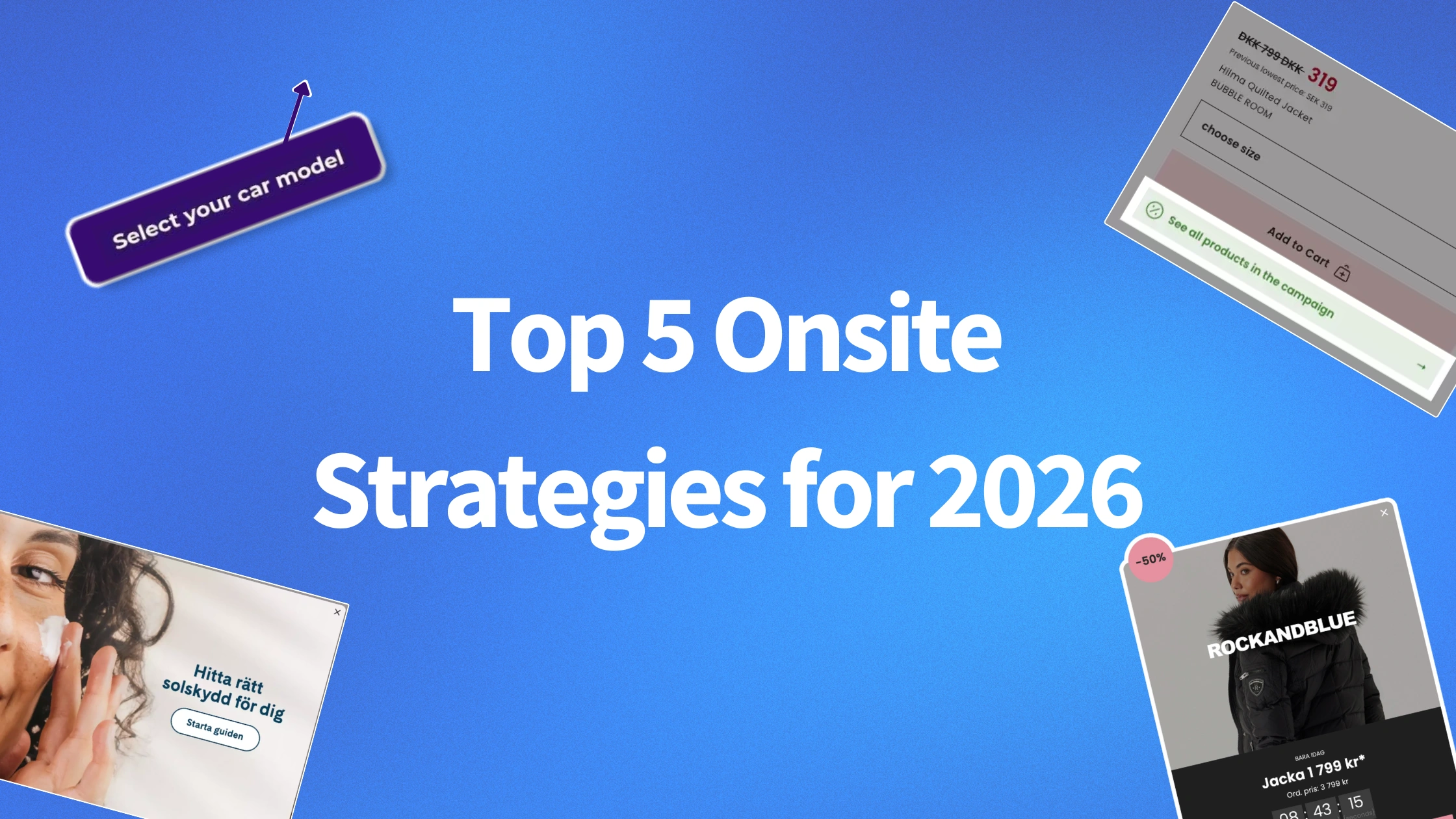
6. Convert the traffic you earn. AI visibility gets people to your site. What happens next is onsite work. A visitor arriving from a ChatGPT recommendation is often further along than a cold browser, so treat them accordingly with onsite strategies for 2026 like guiding experiences and recommendation quizzes. Triggerbee helps here. You can identify visitors, segment them by source and run ecommerce personalization that matches the question they arrived with.
7. Refresh on a schedule. AI answers change as models update and competitors publish. Set a monthly review of your prompt set and refresh the pages that slipped.
FAQ
How long does it take to see results from answer engine optimization?
It depends on how fast you publish and how competitive your category is. One Cognizo customer CEO reported going from zero AI search visibility to being consistently referenced by all major LLMs within a few months. Tracking data updates daily, so you will see movement on citations before you see it on revenue.
Do I need a separate tool if I already track SEO?
AI answers are a different surface from blue links, and the metrics are different too. Citation share and mention share do not map cleanly onto rankings. Some suites, like Semrush and Conductor, fold AI visibility into an existing SEO platform, which can be the simplest path if you are already there.
Which engines should an ecommerce brand track first?
Start with the ones your customers use most. ChatGPT, Google AI Overviews and Perplexity cover a large share of shopping questions. Gemini and Copilot are worth adding as you scale. Cognizo tracks six engines on its standard plans and adds Claude, Meta AI, DeepSeek and Google AI Mode on Enterprise.
To sum it up
AI search is becoming a primary way shoppers find products, and the brands that show up in those answers will take the consideration set. The tools in this list all help you see where you stand.
Cognizo is the one that also closes the loop. It turns a visibility gap into a published page, then shows you what that page did in crawls, clicks and sales, at a published price that includes the content.
If you want to know where your brand stands before you commit to anything, start with the free AEO audit on Cognizo and a tight prompt set built from the questions your customers actually ask. That is the cheapest way to find out whether you are in the answer or missing from it.