Challenge
For Easter, Bubbleroom wanted to try something more playful than their usual signup campaign. The goal was to increase engagement and boost email signups without changing the overall site experience too much.
How they did it
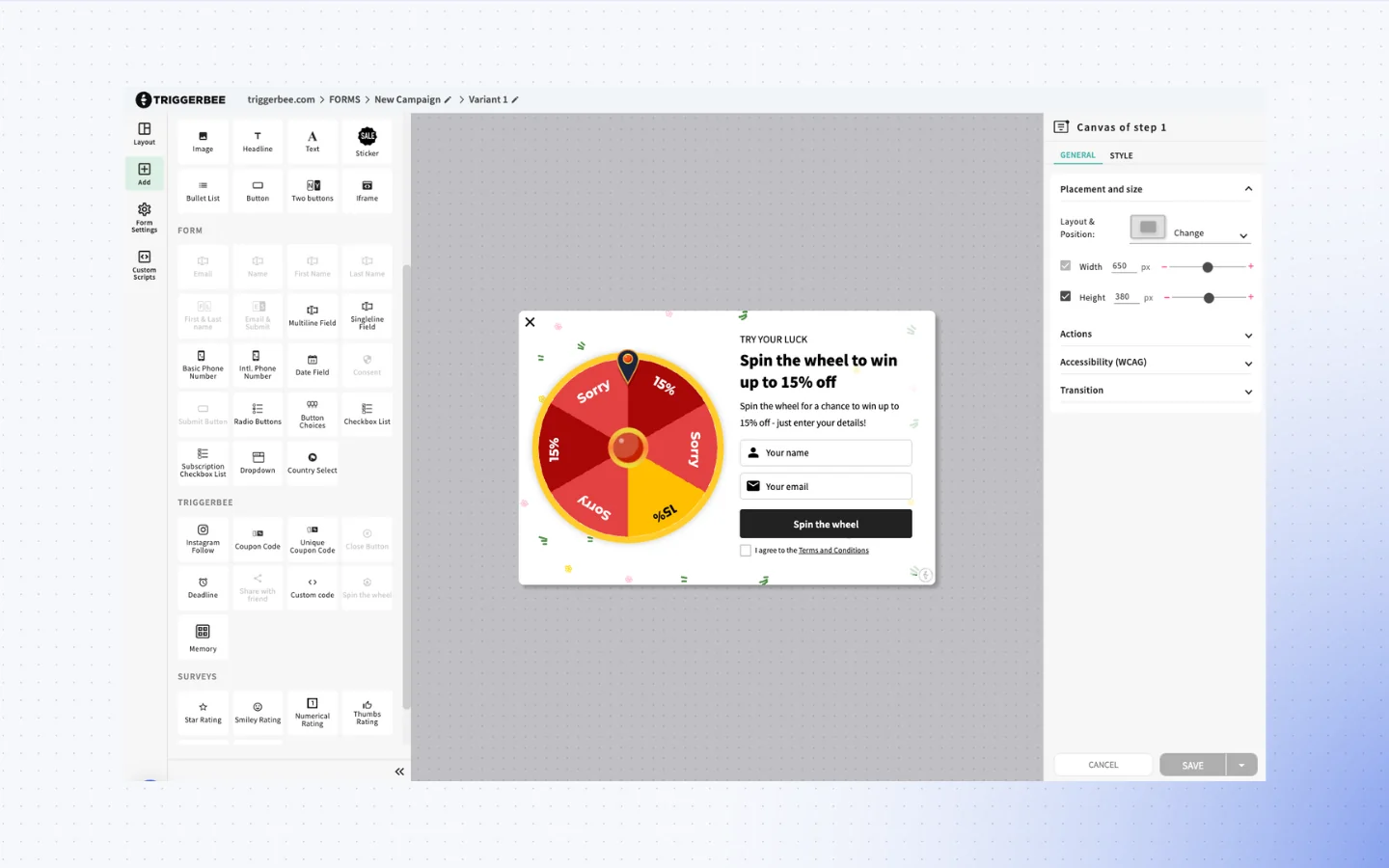
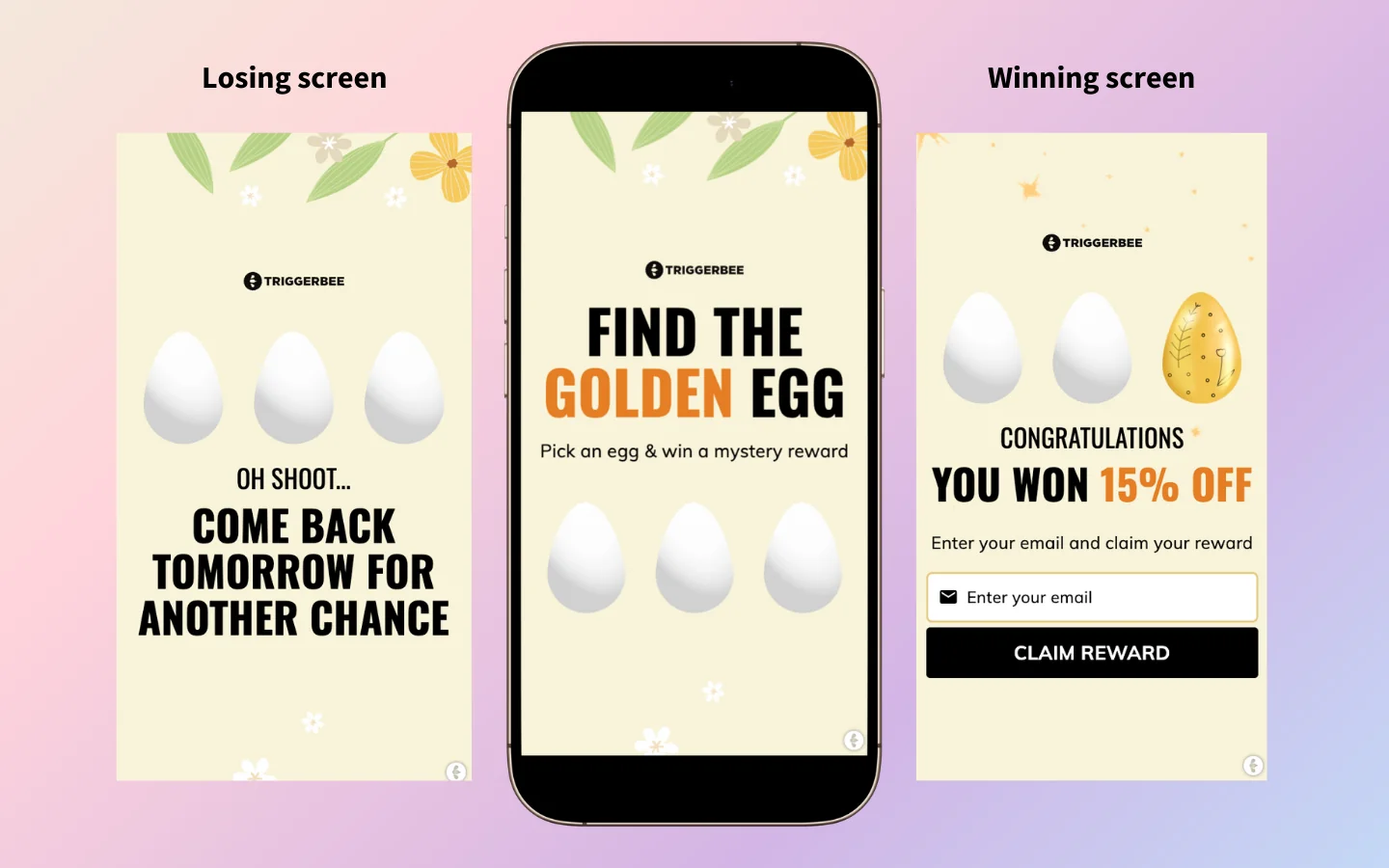
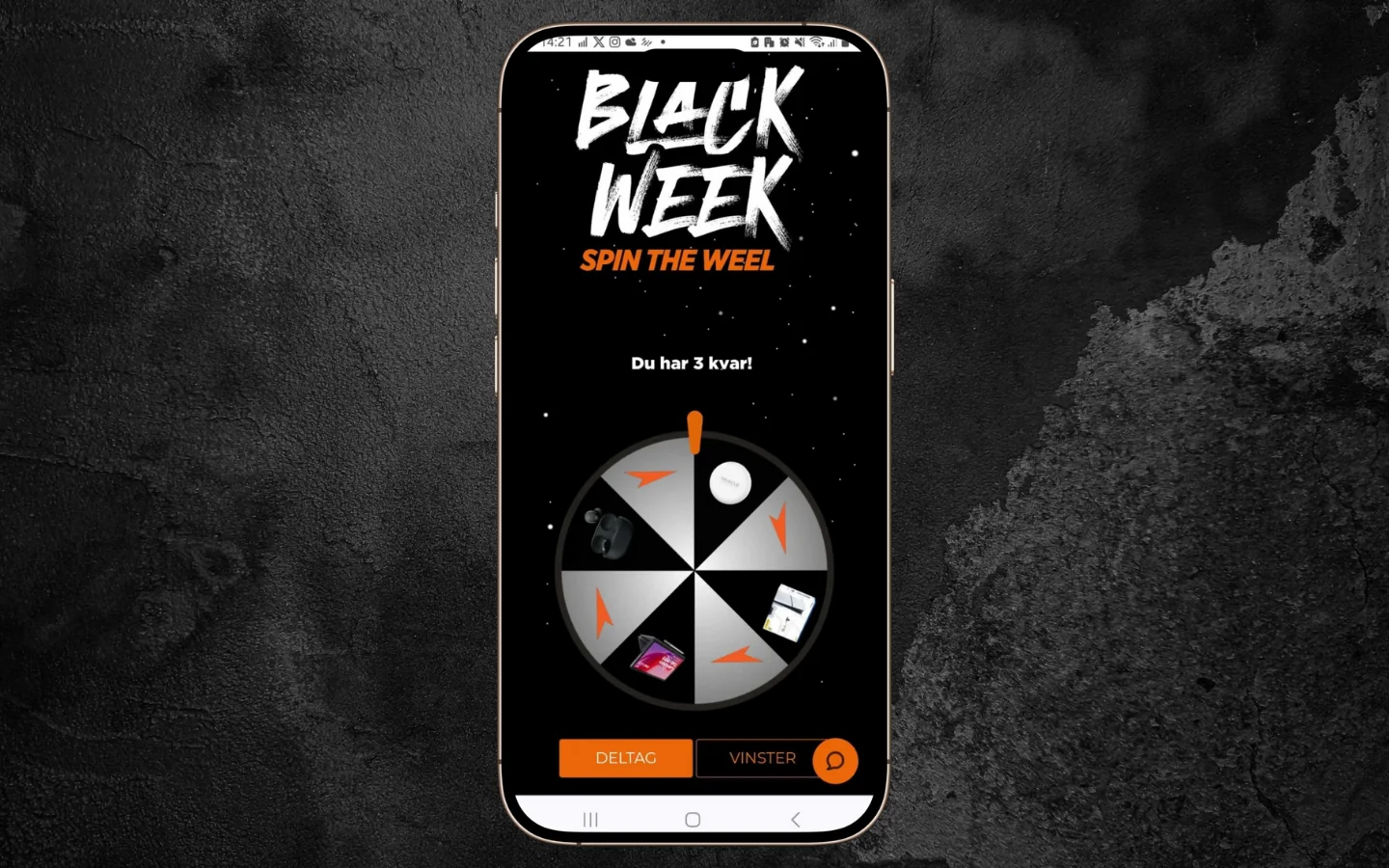
They created an A/B test using Triggerbee. Both versions were variants of the same digital egg hunt, where visitors had to find the pink egg.
In version A, users were told right away they’d get 20% off.
In version B, the reward was a mystery and users had no idea what they were getting until they won.
Only anonymous users saw the campaign, and it ran for one week.
The results
The mystery reward version won, and both variants drove nearly 20,000 signups in just one week which is a 2400% increase compared to their regular email sign up campaigns.
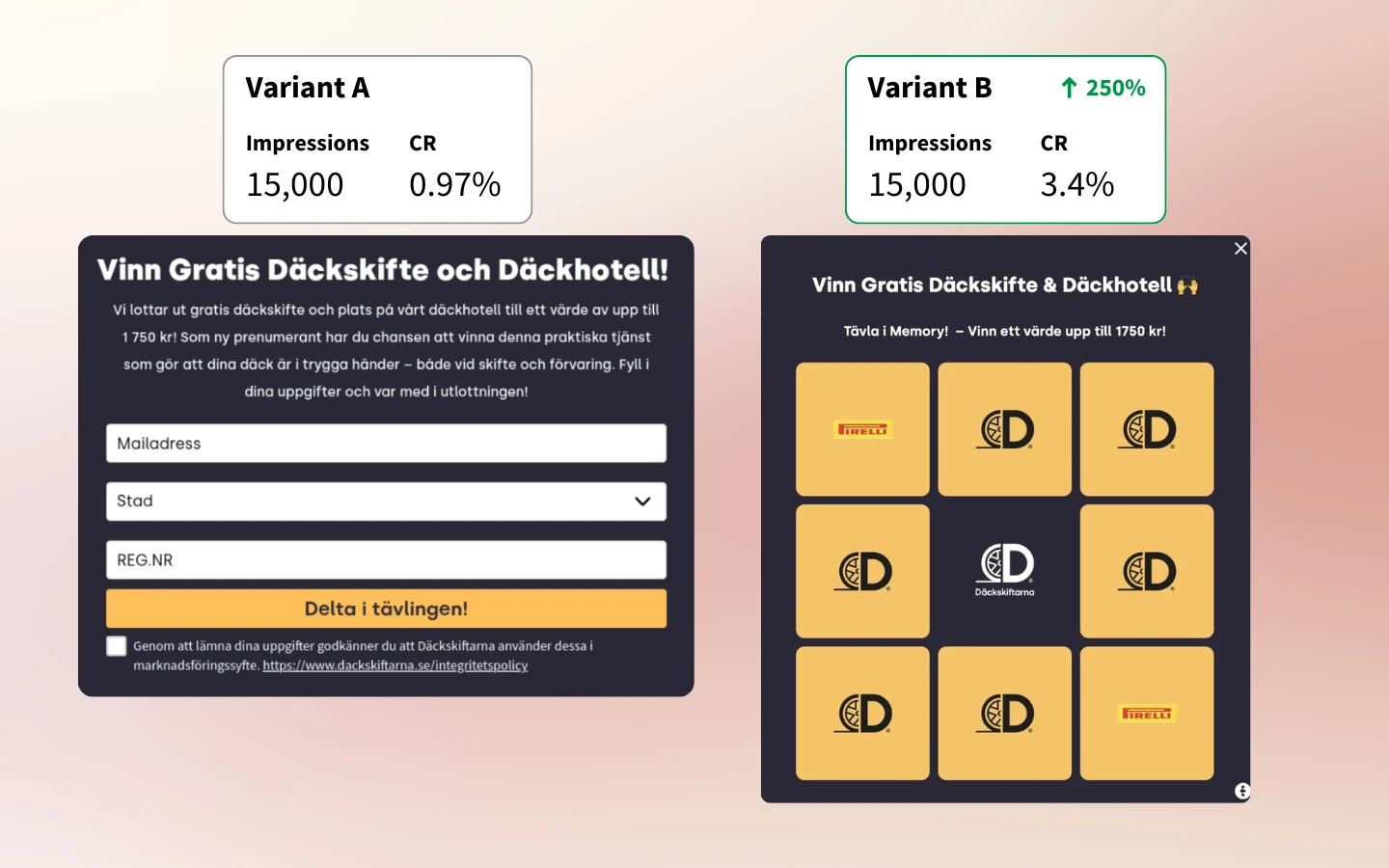
This quick test proved that adding a twist of gamification in combination with holding back the reward made users more likely to engage and submit their email.
In this article we’ll compare Poptin vs Triggerbee; two of the most powerful tools for onsite marketing, lead generation, gamification, and visitor engagement. Both offer strong features and accessible pricing, but they take different paths to helping you convert more visitors.
⚡ Feature Flexibility: Triggerbee offers full CRM-based targeting, Smart Embeds, and multi-step personalization flows. Poptin focuses on speed and simplicity.
💰 Pricing: Trigger is cheaper than Poptin at higher levels
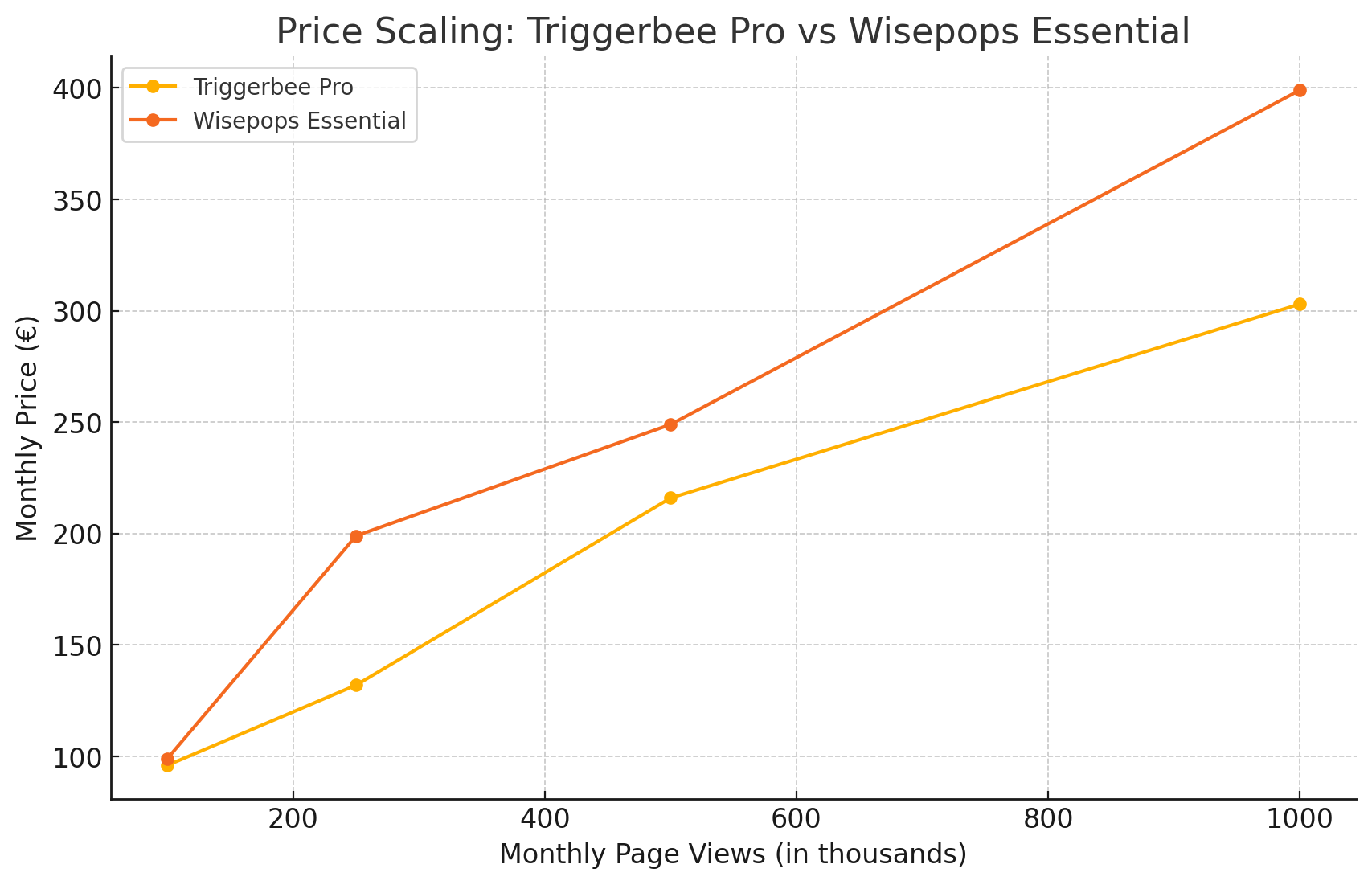
At 1M views, Triggerbee Pro is 29% cheaper than Poptin.
At 2M views, Triggerbee Pro saves you nearly 49% annually.
For lower traffic, Poptin offers strong value with a free plan and a $20 entry price.
📊 Analytics: Triggerbee includes revenue attribution, funnel insights, and visitor tracking out of the box. Poptin offers basic stats but no funnel or revenue linkage.
🧠 Summary: Choose Poptin if you want to launch fast and need the basics. Choose Triggerbee if you want to personalize, segment, and scale.
Poptin is focused on helping you get started quickly with stylish forms and built-in automation tools. It’s a solid choice for smaller brands or solo marketers who want fast results with minimal setup. Triggerbee, on the other hand, is built for brands that want full personalization and CRM-powered targeting. You can personalize entire sections of your site, trigger campaigns from CRM segments, and sync all your data in real time.
If you’re comparing Poptin vs Triggerbee, this guide will walk you through every key feature. We’ll go through everything from campaign types and personalization to integrations, analytics, and pricing – so you can choose the right tool for your goals.
Sleeknote vs Triggerbee: Summary
Feature
Triggerbee
Poptin
Data Storage
🇪🇺 EU
🇺🇸 US
Campaign Types (popups, embeds)
✅ Popups, Embeds, Callouts, Full screen, Banners
✅ Popups, Embedded forms, Full screen, Slide-ins
Forms
✅ Yes
✅ Yes
Promotions
✅ Yes
✅ Yes
Gamification
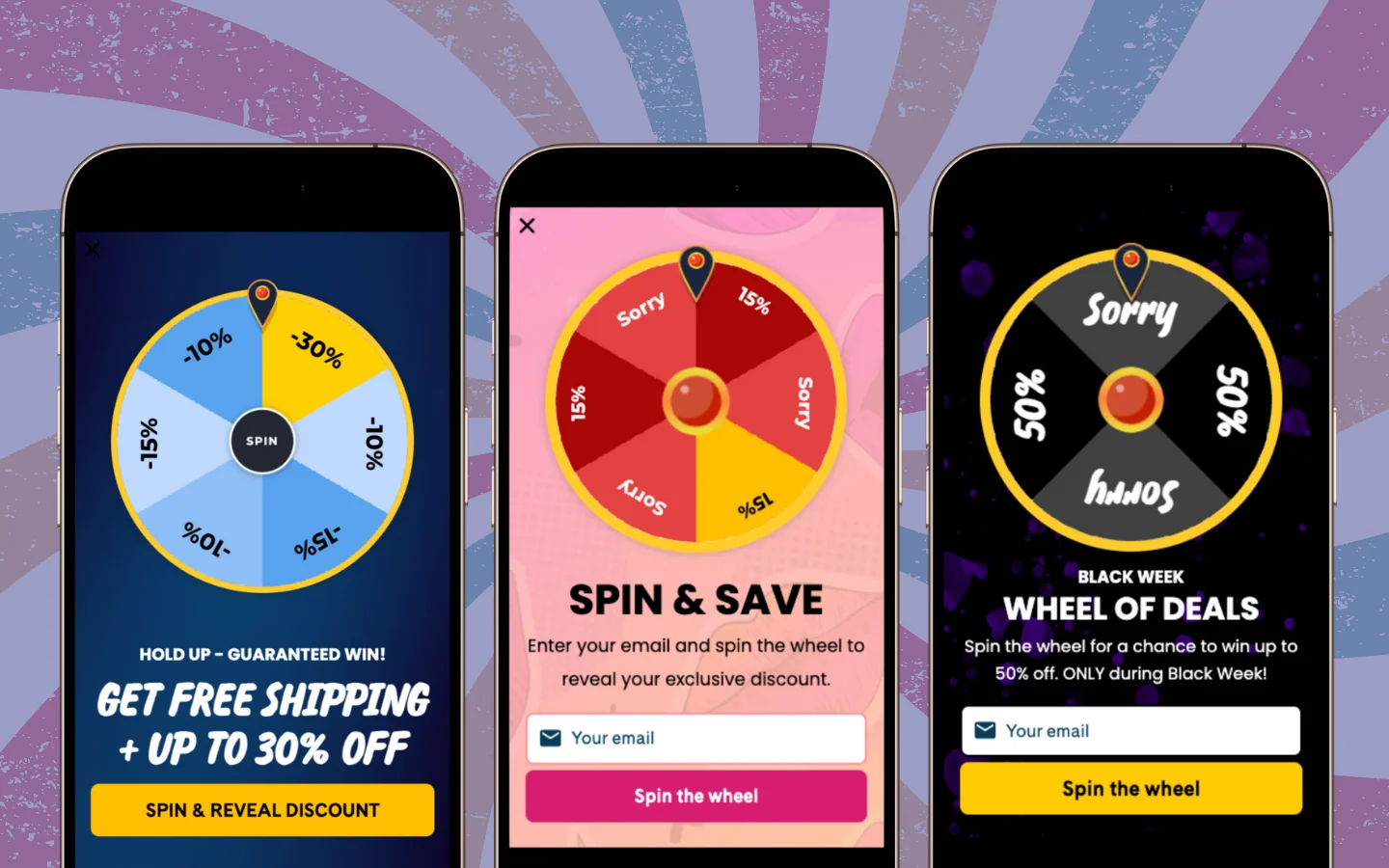
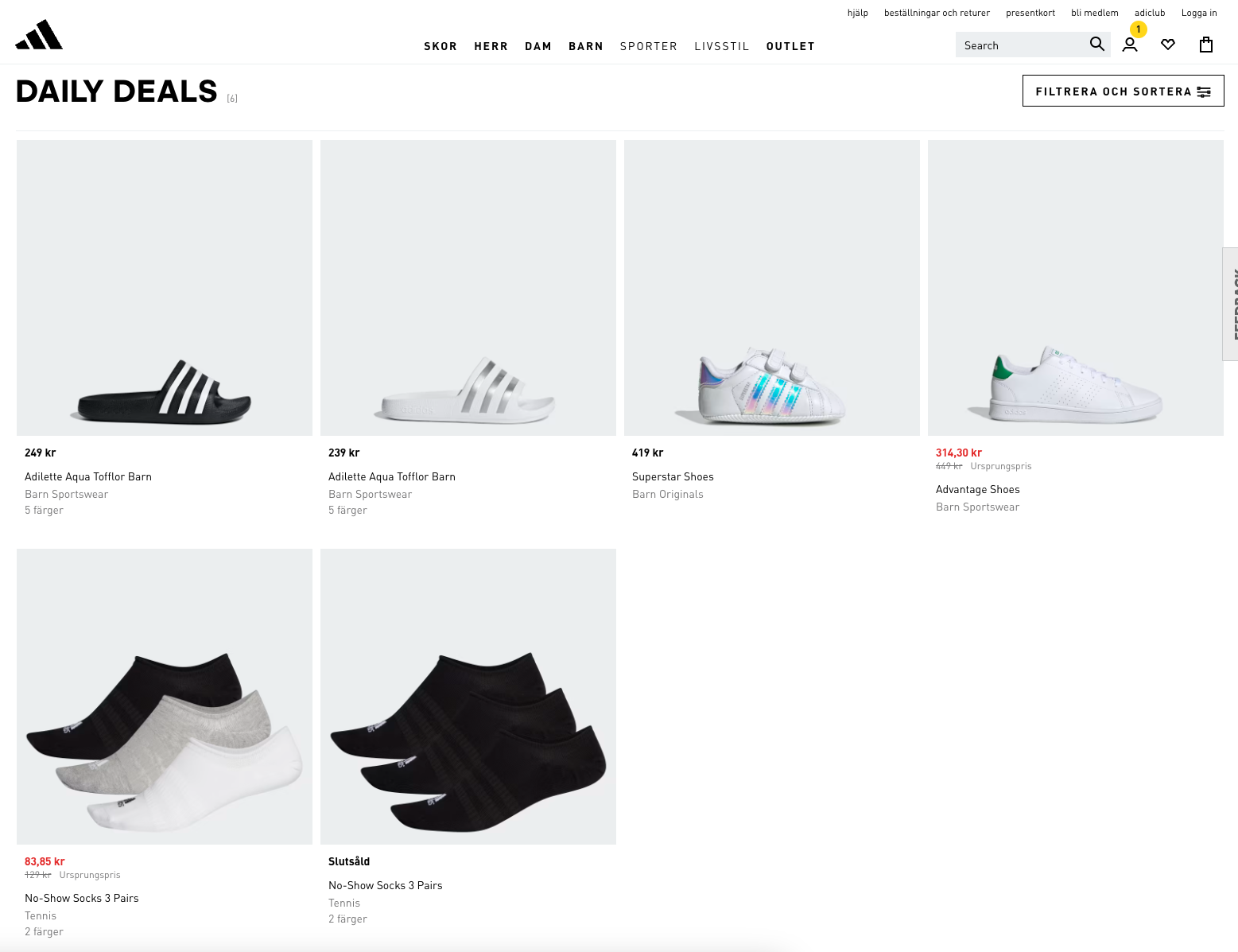
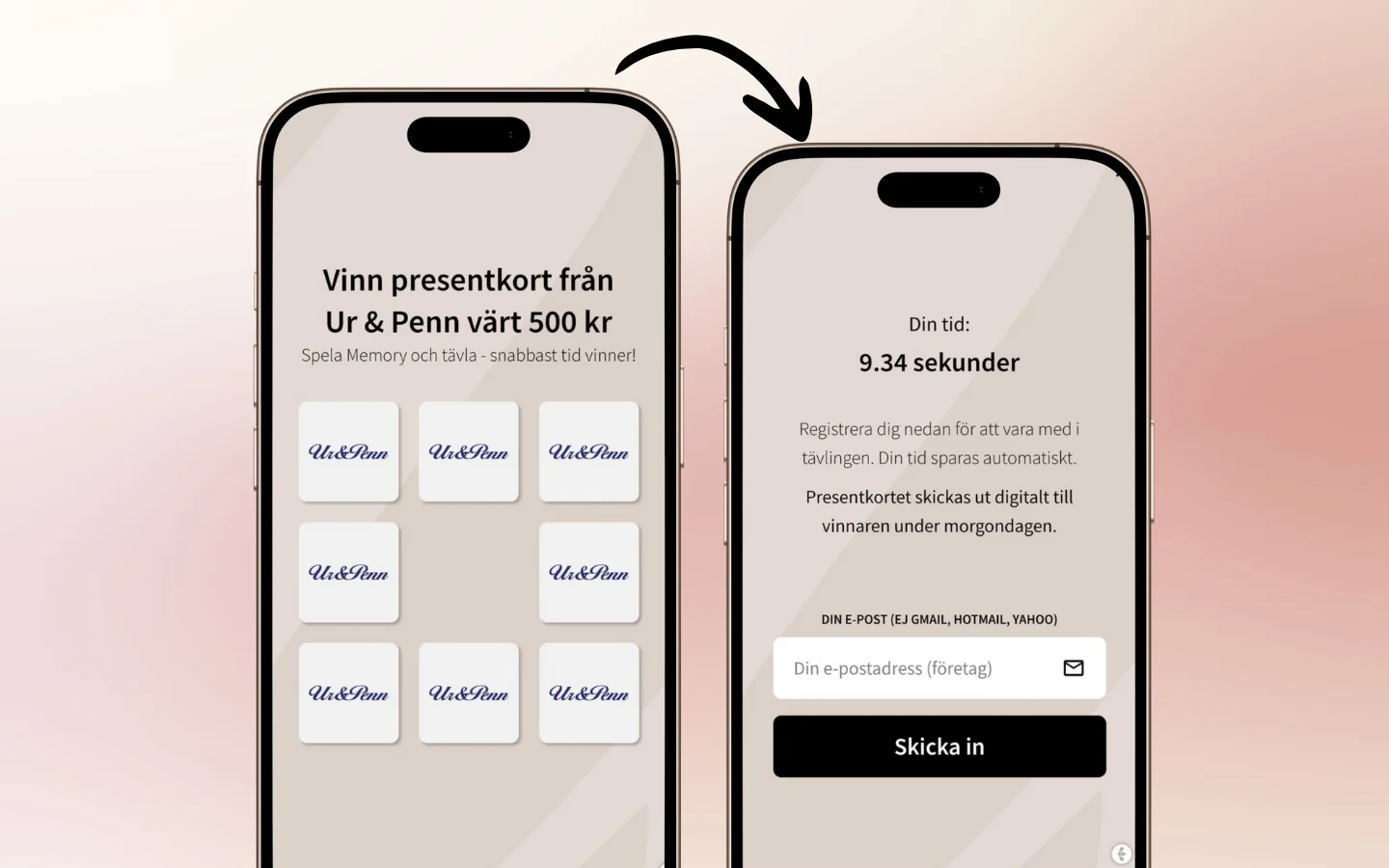
✅ Spin to win, Memory, Product quizzes, Calendars, Daily offers
✅ Spin to win, Scratch to win
Surveys
✅ CSAT & NPS with analytics, Ratings, Smileys, Thumbs, Stars + feedback field
❌ Basic forms only
Referral marketing
✅ Yes
❌ No
Targeting
✅ Session behavior, profile properties and events
✅ Time on site, scroll depth, exit intent, page visited
Advanced Onsite Targeting
✅ Weather targeting, Geolocation, CRM data
❌ No weather or CRM-based targeting
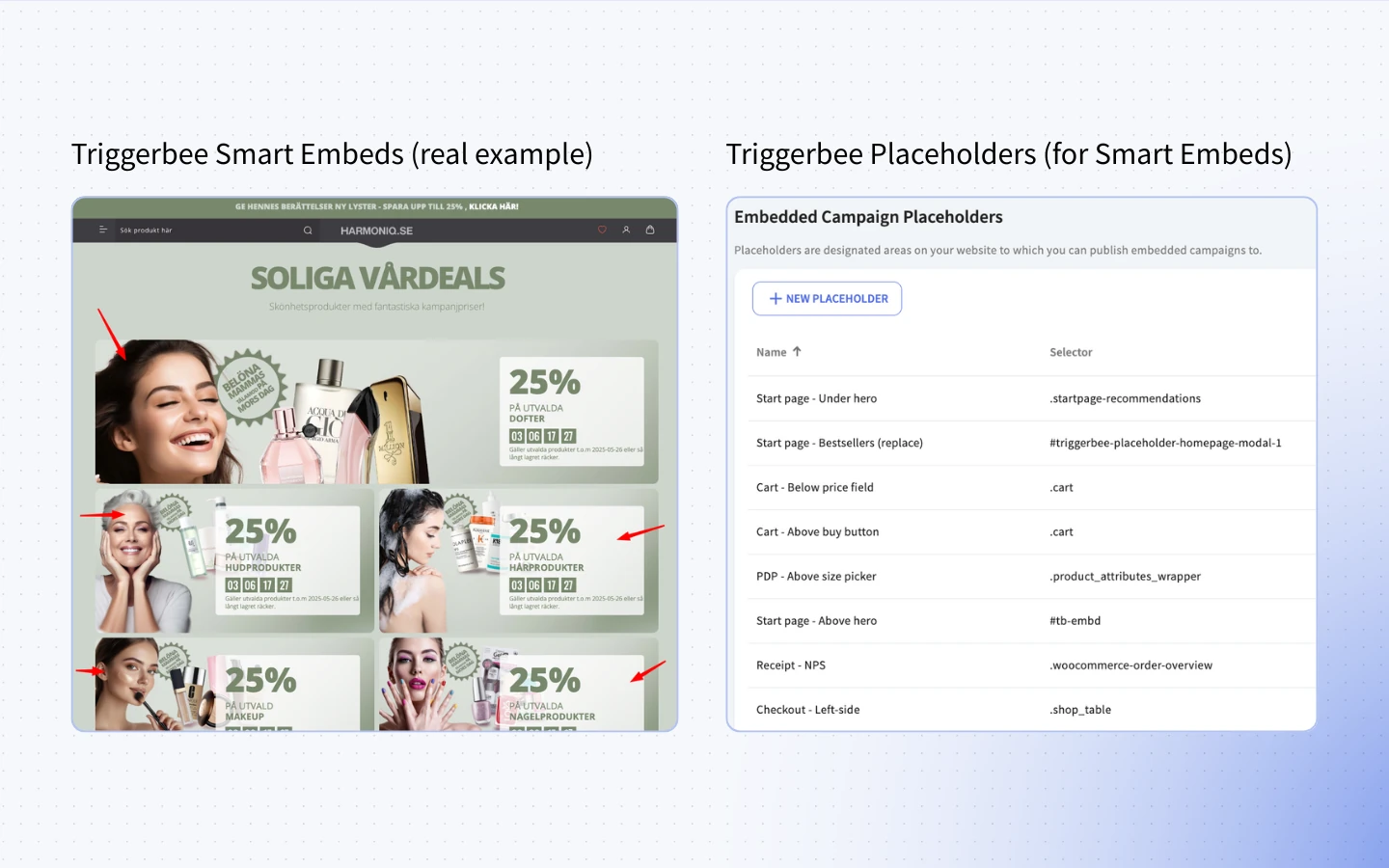
Smart Embeds
✅ Yes, audience-targeted content injected via CSS class
❌ No
Personalization Features
✅ CRM-targeting, Customer Profile Targeting
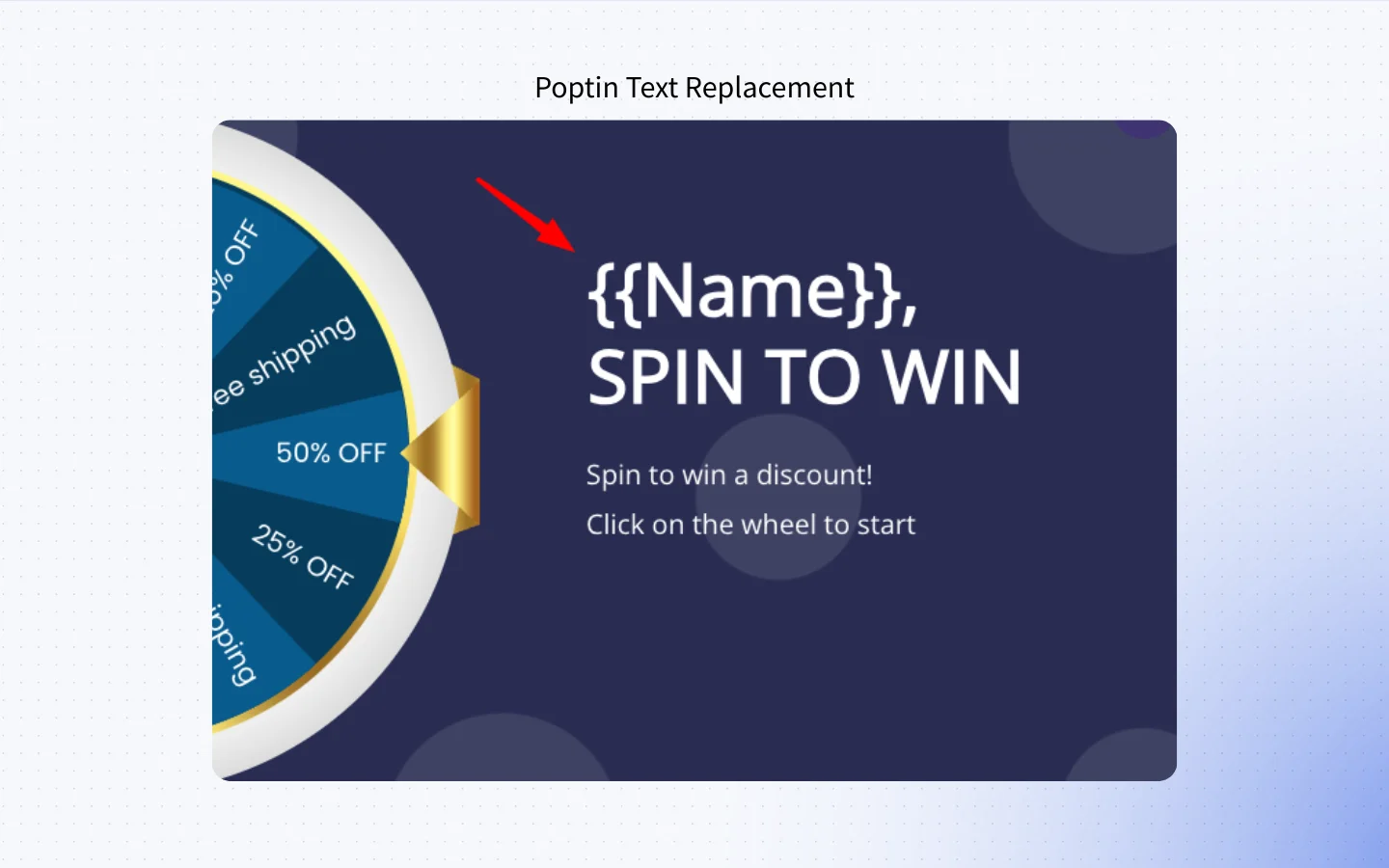
✅ Light text personalization (e.g. {{name}})
A/B Testing
✅ A + B
✅ Yes
Analytics & Reporting
✅ Revenue attribution, funnel analysis
✅ Basic stats: views, conversions, bounce rates
Product recommendations
✅ With integrations
❌ No built-in recommendation engine
Brand Default Styles
✅ Yes
❌ Limited brand style control
Integrations
✅ Multiple native + Zapier
✅ Zapier, Mailchimp, HubSpot, Pabbly, Webhooks
Freemium
❌ No
✅ Yes, up to 1,000 views/month
Free Trial
✅ 14 days with 250k page views
✅ Yes
Pricing
Starts at €39
Starts at $20/month
Best For
Brands that want more personalization, customization and CRM-based targeting
Small teams who want quick-launch popups with basic automation
1. Who Each Tool Is Best For
Choosing between Triggerbee and Poptin comes down to how far you want to go with personalization and how tightly you want to integrate onsite experiences with your CRM or email platform.
Both tools offer popup creation and lead capture, but they’re made for very different users:
Triggerbee: Built for CRM-first personalization and growth
Triggerbee is designed for marketing teams that want to go beyond simple popups. If you already use tools like Klaviyo, Rule, or Mailchimp and want to sync segments, inject targeted content on your website, or launch campaigns based on purchase history or data from your ESP / Marketing automation software; Triggerbee is for you.
Triggerbee is ideal for e-commerce brands, subscription businesses, and B2B teams who care about showing targeted content to the right audience at the right time on their website.
Built for teams who use CRM and behavioral data in daily marketing
Strong choice for brands focused on 1:1 personalization and revenue attribution
Flexible enough for cross-site campaigns, embedded content, and advanced forms
Why it matters: Triggerbee helps you personalize experiences based on who someone is and what they’ve done in the past – not just what page they’re on.
Poptin: Built for quick-launch campaigns and small teams
Poptin is a great starting point if you want to launch popups fast without getting into code, integrations, or data syncing. It’s especially well-suited for small ecommerce stores, solo marketers, and startup teams.
You get a large template library, a drag-and-drop builder, and built-in automation tools. You won’t be able to personalize content deeply or sync to CRM segments – but you can launch popups quickly and optimize them with basic A/B testing.
Ideal for teams focused on simple lead capture and promos
Helpful built-in triggers and editor for quick results
Great value at lower traffic tiers
What to expect: Fast results and ease of use – without CRM-level targeting or personalization.
2. Campaign Creation & Templates
Creating effective campaigns should be fast, flexible, and intuitive. Whether you’re building a simple popup or a multi-step flow with personalized offers, the right editor with a workflow that fits how you work makes all the difference.
Look for tools that offer both ready-made templates and the flexibility to build from scratch, with elements like countdown timers, gamification, product blocks, and mobile-first layouts.
The more control you have in the builder, the easier it is to match your brand and launch higher-converting ideas, faster.
Triggerbee: Campaign builder with advanced logic and layout control
Triggerbee’s campaign builder starts with a broad template gallery – designed for forms, promotions, surveys, and embedded content. Layout options include popups, callouts, panels, fullscreens, and Smart Embeds, giving teams full control over how and where campaigns appear.
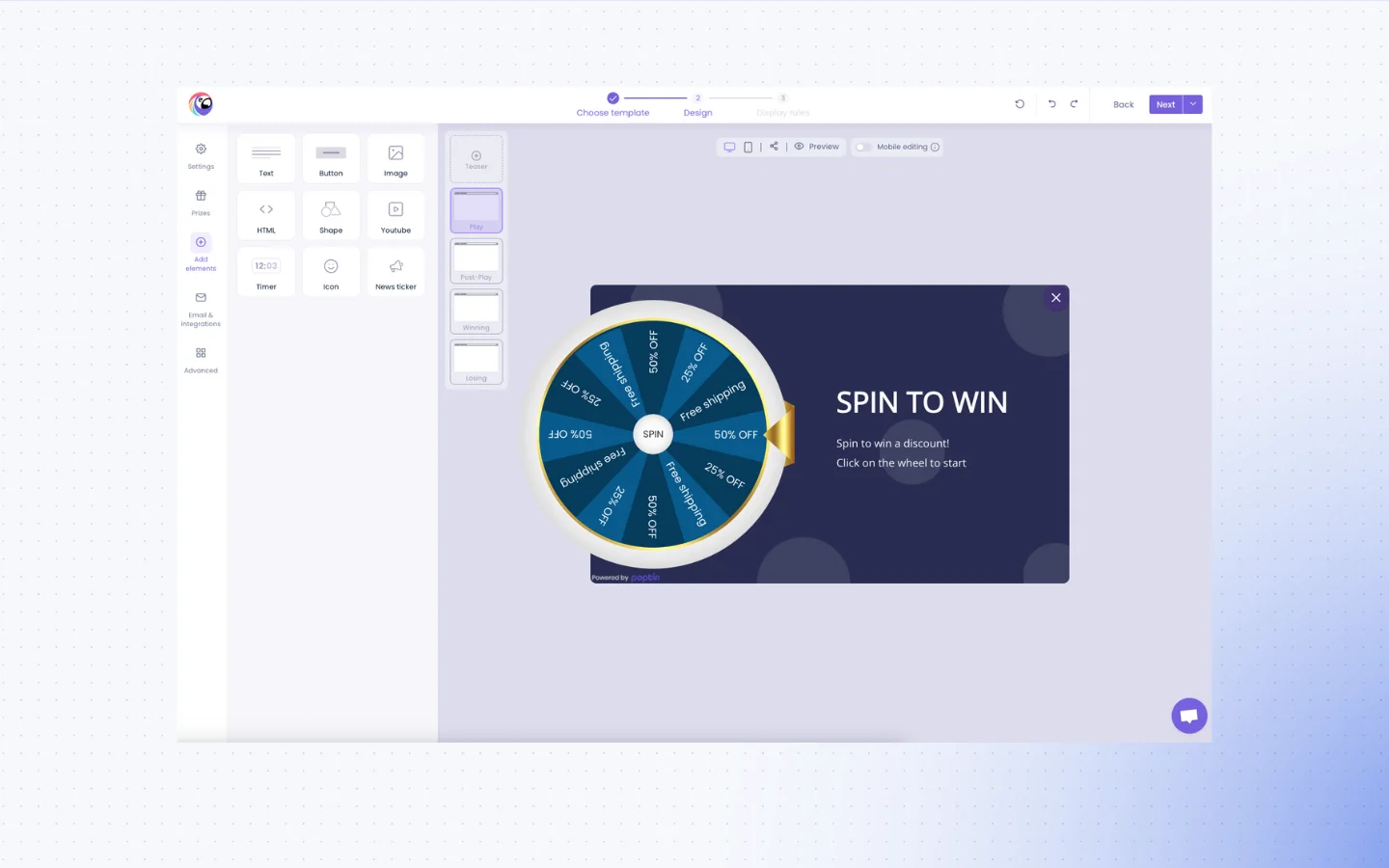
Templates are grouped by use case: grow your list, guide visitors, promote loyalty, highlight UTM traffic, or run gamified experiences like raffles or spin-to-wins. Once inside the builder, you can fully customize each campaign step using a drag-and-drop interface with:
Pre-built components like images, buttons, stickers, and two-button layouts
Advanced input types including radio buttons, dropdowns, international phone fields, and consent checkboxes
Gamification and dynamic elements like spin wheels, countdowns, and memory games
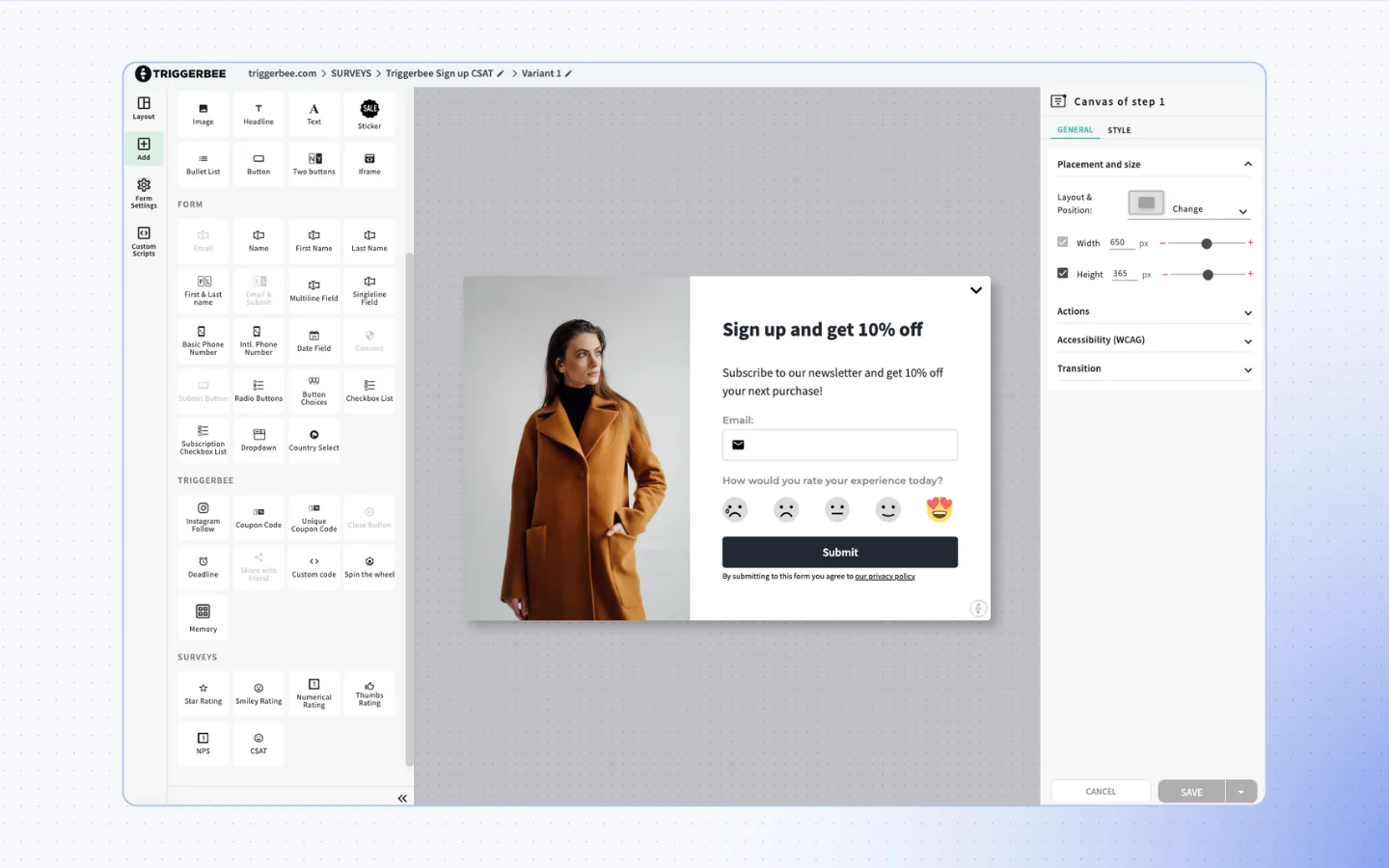
Embedded surveys with CSAT, NPS, smiley ratings, and more
Each campaign supports multi-step flows with full layout control over containers and variants. Form data can be synced directly with Triggerbee or routed in real time to tools like Rule, Klaviyo, Mailchimp, MailerLite, and more. Custom scripts and CSS are supported for advanced styling and logic.
Why it matters: Triggerbee gives teams the design freedom, segmentation depth, and technical power to build branded, high-converting campaigns at any stage of the customer journey.
Poptin: Templates-first editor with flexible layout tools
Poptin starts with a clear goal-based template gallery: grow your list, increase sales, announce offers, or capture more leads. From there, you can choose from a wide variety of popup types and formats – including full-screen overlays, slide-ins, and mobile-friendly layouts. These templates are visually polished and pre-optimized for common ecommerce use cases.
Once you choose a template, the builder lets you fully customize layout and content using a block-based system. You can drag and drop elements like:
Text, images, and buttons
Timers and countdowns
Embedded videos (YouTube)
Icons and shapes
News tickers and coupons
You can also adjust size, fonts, background, button effects, and popup behavior (like entry/exit animations) using the visual settings pane.
Poptin supports basic multi-step flows with teaser and main steps, and you can control the display logic between them. Input fields are easy to customize – including gender, country, and searchable dropdowns – but personalization logic is limited to static field display.
Advanced features like custom CSS are available, but only on paid plans. The editor is highly usable, making it ideal for marketers who want to launch campaigns quickly with decent flexibility.
3. Targeting & Triggers
The real power of targeting comes from combining context and intent. It’s not just about when a campaign appears, but why it appears, and who it’s shown to.
Good tools let you trigger campaigns based on behavior (like scroll depth or exit intent), session data (like time on site or device), or traffic source (like UTM tags).
But GREAT tools go further by layering in CRM data, purchase history, and audience segments so your targeting reflects both real-time behavior and long-term customer context. This is where the biggest performance lift often happens.
Triggerbee: Real-time audience segmentation with CRM and behavioral logic
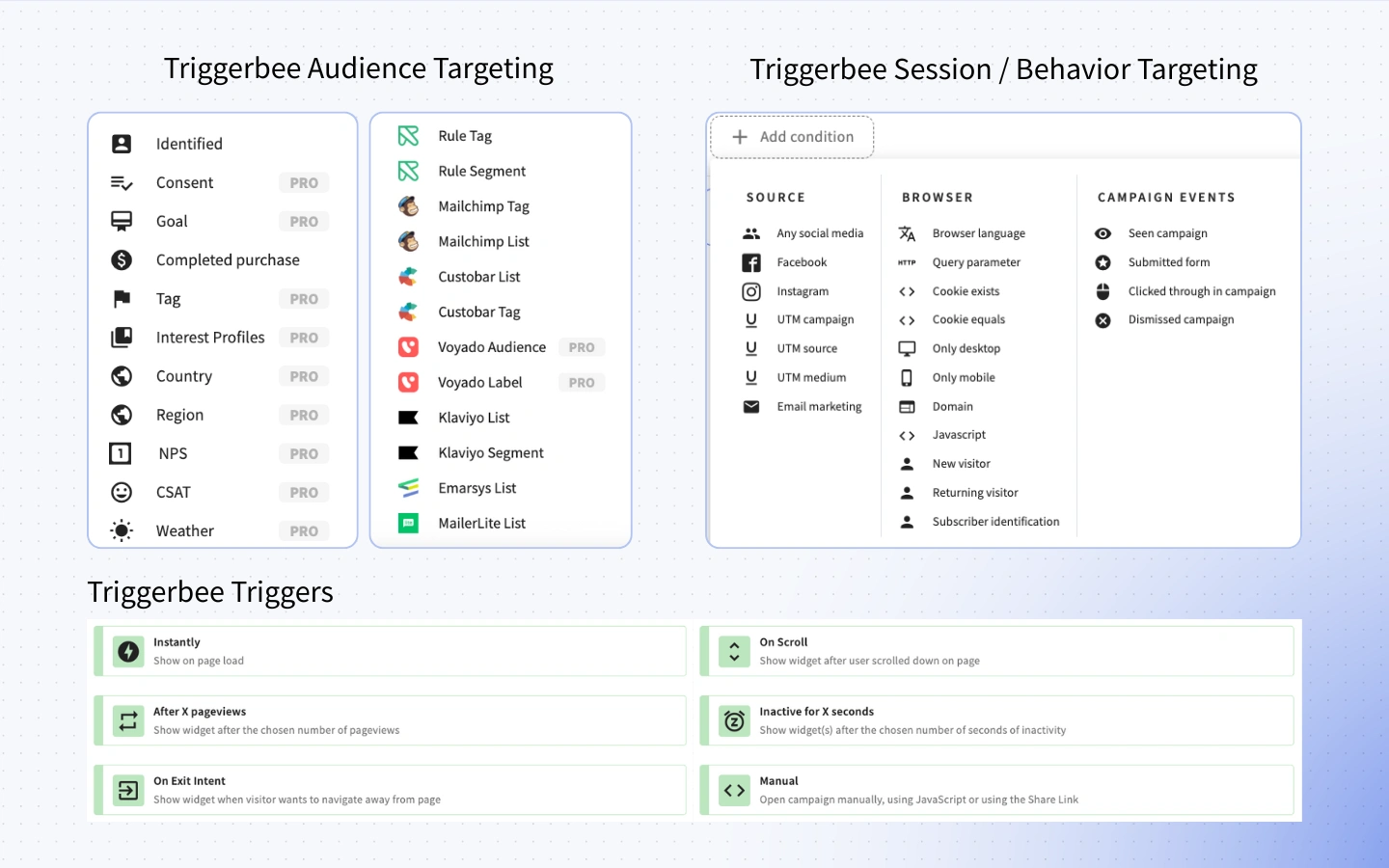
Triggerbee lets you build targeting logic using a powerful combination of persistent CRM data (called filters) and real-time browser/session data (called session conditions).
Together, these allow for dynamic campaigns that adapt to who someone is, what they’ve done, and where they’re visiting from.
Trigger types include:
Instantly (on page load)
Exit intent
On scroll
Inactivity (after X seconds)
Pageviews (after X views)
Manual (via JavaScript or link)
Targeting options include:
Device and browser targeting
UTM source, campaign, and medium
Cookie presence, query parameters, and JavaScript triggers
Visitor identity (new vs. returning, CRM tag, purchase history, NPS score, location)
You can also layer in geolocation (country, region), weather targeting, NPS/CSAT filters, interest profiles, and detailed campaign interaction logic (e.g., has seen a campaign, dismissed it, or clicked through).
Why it matters: Triggerbee delivers the most advanced onsite targeting in this category. You can run one-to-one campaigns that sync with your CRM, respond to session behavior, and match dynamic segments – without needing a separate CDP.
Poptin: Behavioral triggers with optional advanced filters
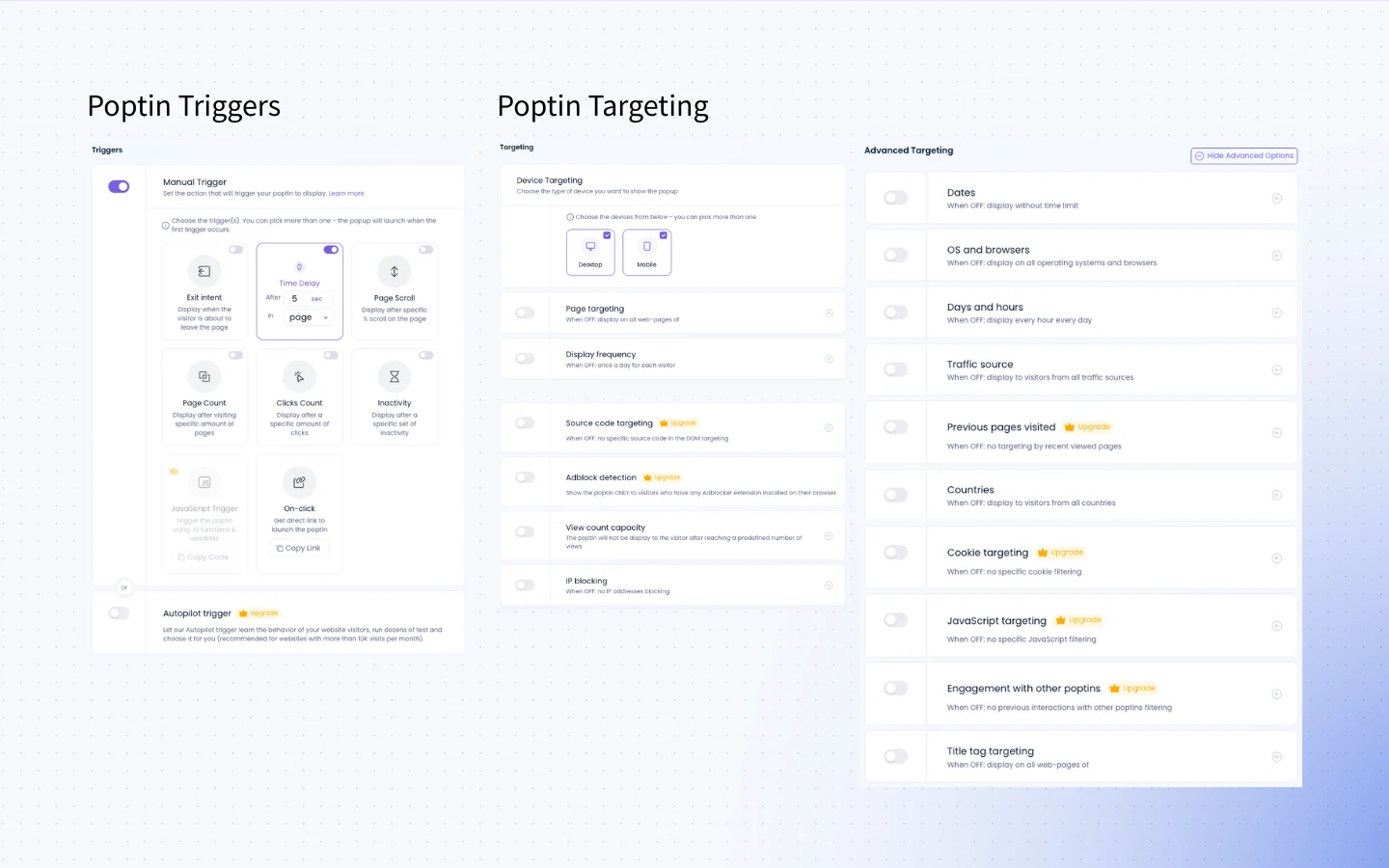
Poptin offers a wide variety of trigger types designed to cover common popup timing strategies. You can choose from:
Exit intent
Time delay
Scroll percentage
Page views
Click count
Inactivity
Manual click or link triggers
These can be combined to trigger popups when the first condition is met, giving you flexibility without complexity.
Targeting options include:
Device targeting (mobile vs. desktop)
Page-level targeting
Display frequency settings
Advanced targeting settings are available but often gated behind higher-tier plans. These include:
Traffic source and UTM targeting
Date, time, OS, browser, and country targeting
Cookie-based filters, JavaScript triggers, and IP blocking
Interaction-based filters like “engaged with other poptins”
What to expect: Great starter targeting for ecommerce and lead gen. CRM-based logic, segment filters, and deeper personalization require external tools or plan upgrades.
Quick Verdict
Use Poptin for lightweight popup targeting and standard behavioral triggers.
Use Triggerbee if you want to build audiences using CRM data, real-time behavior, and cross-session history – all from one interface.
4. Personalization options
Personalization is about delivering the right message, offer, or experience to each visitor based on who they are, what they’ve done, and what they’re likely to do next.
Strong personalization tools connect to your CRM or customer database, let you insert dynamic content into campaigns, and give you control over which segments see what.
Whether it’s showing different promotions to new vs. returning users or displaying loyalty points for logged-in members, your personalization engine should adapt to real people in real time.
Triggerbee: CRM-based personalization for targeted onsite content
Triggerbee personalizes content based on both real-time visitor behavior and persistent CRM data. This includes past purchases, subscriber tags, interest profiles, and location.
Key personalization tools include:
CRM-driven content logic: Show or hide elements based on tags, segments, or email platform data (e.g. Rule, Klaviyo, Mailchimp).
Smart Embeds: Inject personalized content blocks into fixed areas of your website (like product pages, checkout, or homepage panels) using CSS selectors and placeholder logic.
Dynamic audience targeting: Combine UTM, session behavior, and profile properties to create fully adaptive campaigns.
Triggerbee doesn’t support text replacement. Instead it uses deep targeting conditions to personalize which type of content should be displayed in order to tailor the full experience. You can swap offers, images, or messages based on who someone is and what they’ve done.
Why it matters: Triggerbee turns your site into a real-time personalization engine. From embedded promotions to custom flows for returning customers, you’re in control of every message and moment.
Poptin: Basic personalization through text merge tags
Poptin supports light personalization using merge tags and dynamic fields. You can display the visitor’s name, country, or selected field values inside your popup copy. These merge tags can be pulled from form inputs or set dynamically via URL parameters and session data.
This allows for basic content customization like:
“Hi {{name}}!” greetings
Inserting dynamic dates or field values (e.g., {{deal}} or {{country}})
However, Poptin doesn’t support targeting content based on CRM segments, past campaign behavior, or persistent visitor profiles. Personalization remains static – tied to what the user just entered or passed in via UTM.
What to expect: Simple, surface-level personalization that works for greetings and limited dynamic text.
Quick Verdict
Choose Poptin if text-level personalization (like “Hi {{name}}”) is enough.
Choose Triggerbee if you want to personalize full content blocks using CRM segments, behaviors, or embedded logic across your site.
5. Integrations
Your popup tool should fit into your existing tech stack, not work around it. The best platforms connect seamlessly to your CRM, email platform, and customer data sources.
Look for native integrations that support two-way syncing, audience targeting from your contact lists, and automated data handoffs. If you rely on real-time personalization or triggered emails, integration depth (not just quantity) becomes a key factor.
Poptin: Large integration library focused on lead sync
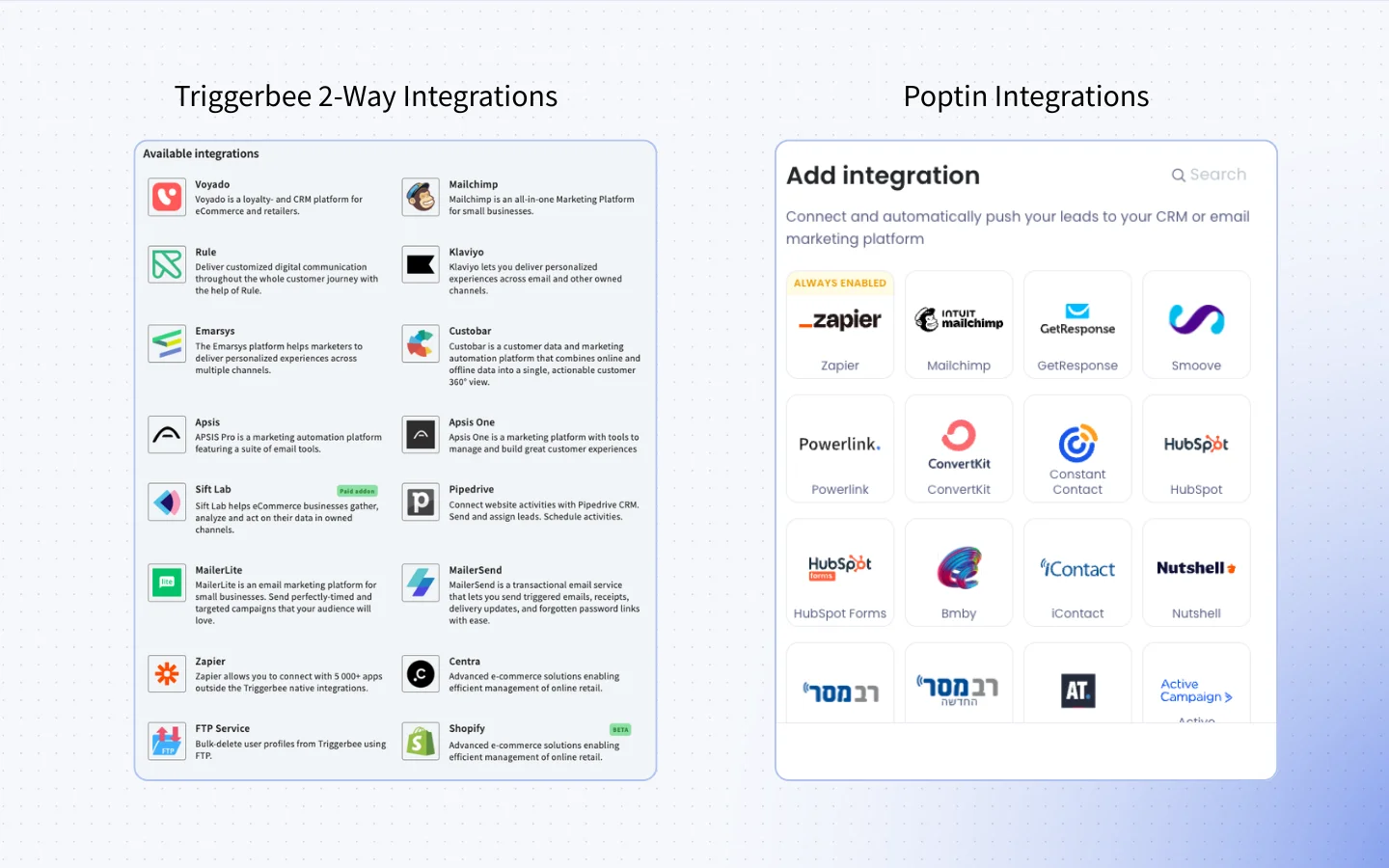
Poptin’s biggest strength lies in its sheer volume of out-of-the-box integrations. Whether you’re using a popular email marketing tool or a CRM platform, chances are Poptin supports it. This makes it easy to plug into your existing stack without relying on a developer or external workarounds.
However, the limitation of these integrations is that they’re all push-only. You can send form submissions to a tool, but you can’t segment users based on tags, status, or activity in that tool. This restricts the personalization potential and makes ongoing sync or automation difficult.
Triggerbee: Deep, two-way integrations with CRM and email tools
Triggerbee’s integration model is designed to support real-time marketing – not just data collection. Each integration allows you to both receive CRM data (like tags, segments, and behavior scores) and push new information back into your system of record. This enables full-circle personalization: from targeting and content variation to downstream email automation and lead scoring.
What sets Triggerbee apart is the level of context you can work with. Because CRM and campaign performance data are tied together, you can build smarter segments and understand which visitors are truly engaged, loyal, or ready to buy.
Why it matters: Triggerbee treats your CRM as a live data source, enabling true personalization and automated audience control.
Quick Verdict
Choose Poptin if you want broad but basic CRM and email connections for pushing leads.
Choose Triggerbee if syncing visitor behavior and CRM segments across tools is central to your strategy.
6. Analytics & Optimization
When evaluating popup and personalization tools, analytics is more than just a “nice to have.” It’s what tells you if your campaigns are working, who they’re working for, and where you’re losing people.
At a minimum, you’ll want to track:
Views and conversion rates – to measure basic performance.
Split test results – to optimize headlines, offers, and formats.
Funnel metrics / Drop-off points – especially in multi-step forms or quizzes.
Revenue attribution – so you know which campaigns actually drive sales.
Visitor-level insights – to understand how different segments behave.
The right tool gives you not just totals, but patterns. It should help you answer questions like: Which pages convert best? Are logged-in members more responsive? Which UTM campaigns produce the highest ROI?
Triggerbee: Full-funnel analytics with revenue attribution and visitor insights
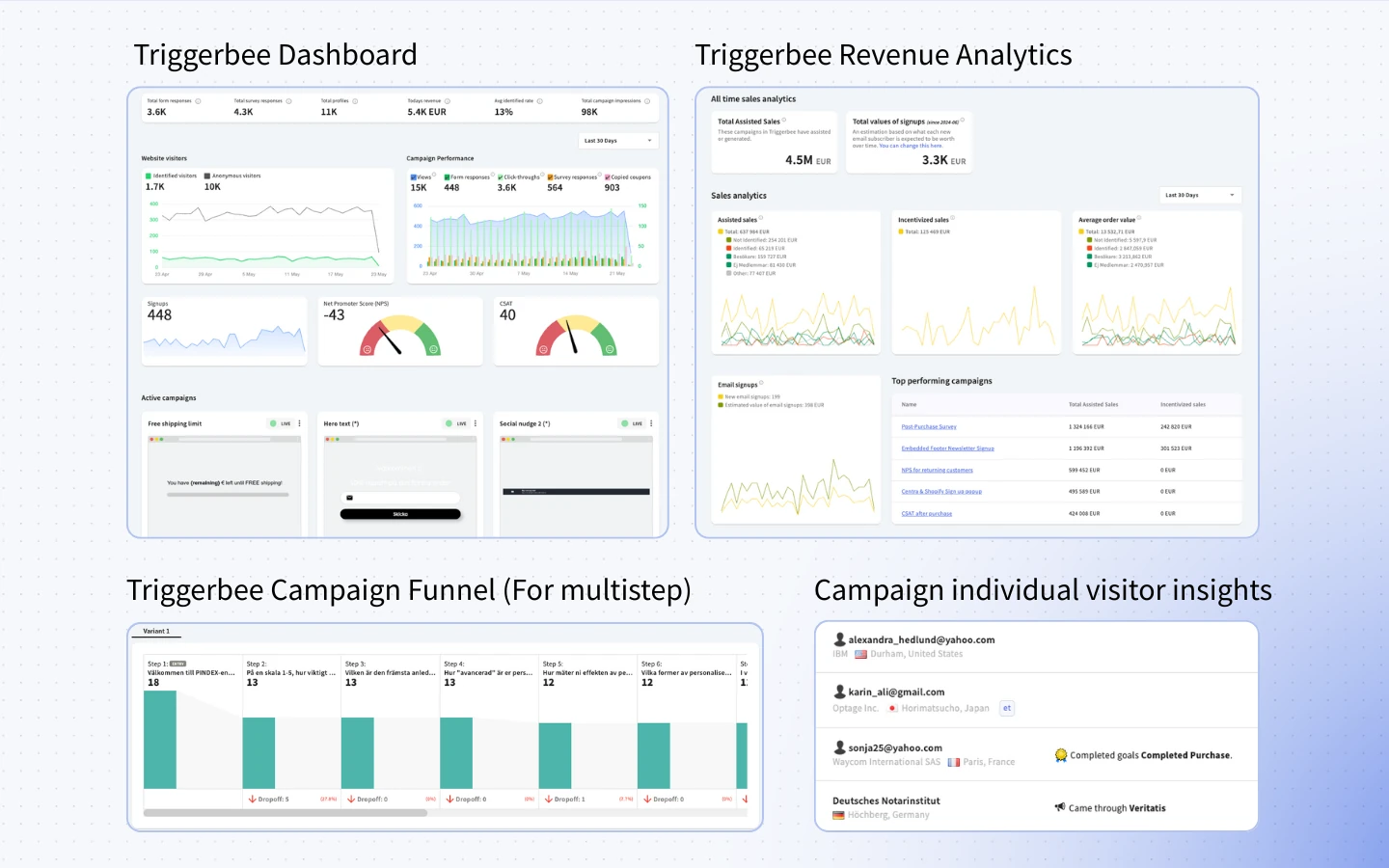
What sets Triggerbee apart is its ability to show both micro and macro performance insights. You can analyze how users move through your multistep campaigns, what percentage drop off, and which segments are converting at the highest rates. With assisted revenue data, you can tie engagement directly to purchases – even if conversion happens days later.
The platform also supports visitor-level timelines, letting you trace every pageview, popup view, and conversion event tied to a user. Combined with NPS/CSAT scoring, Triggerbee gives you a complete story of how your campaigns are performing – and how to improve them.
Why it matters: Triggerbee gives you full visibility into what’s working, who it’s working for, and how it affects your bottom line.
Poptin: Basic engagement metrics for performance monitoring
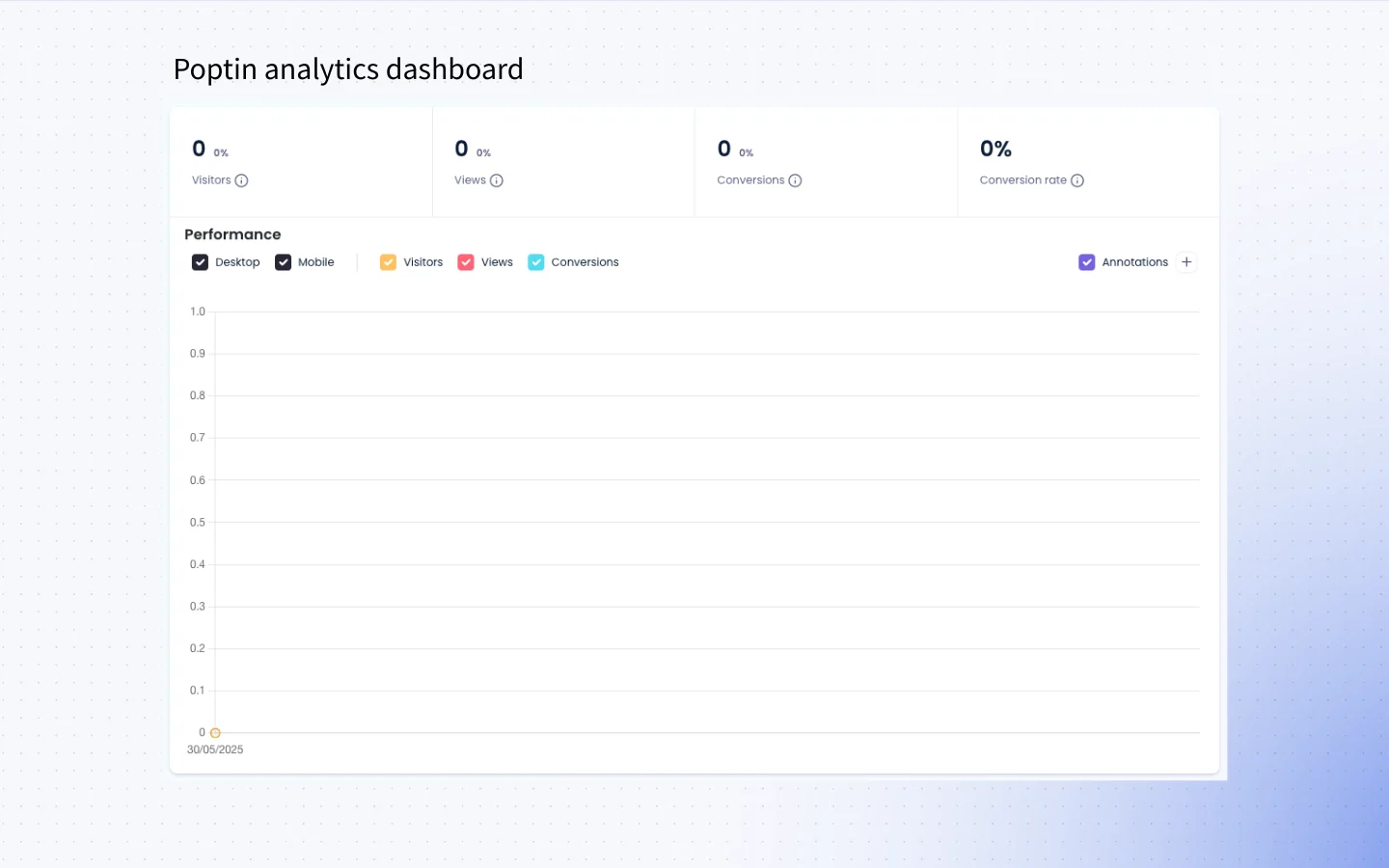
While it’s easy to navigate and gives a clean summary of activity, Poptin’s reporting is best suited for basic A/B testing and form optimization. You won’t be able to drill down by traffic source, track conversions across multiple touchpoints, or understand campaign impact beyond the form submit.
It’s helpful if your primary goal is monitoring impressions and collecting leads. But if you want to connect popups to revenue or explore segment-level results, you’ll need to rely on third-party analytics tools like Google Analytics or your CRM.
What to expect: A simple and effective dashboard for tracking top-level popup performance – but not designed for deep optimization or ROI analysis.
Quick Verdict
Choose Poptin if you just need campaign views and conversion tracking.
Choose Triggerbee if you want to optimize based on revenue, user behavior, and long-term segment performance.
7. Pricing & Plans Comparison
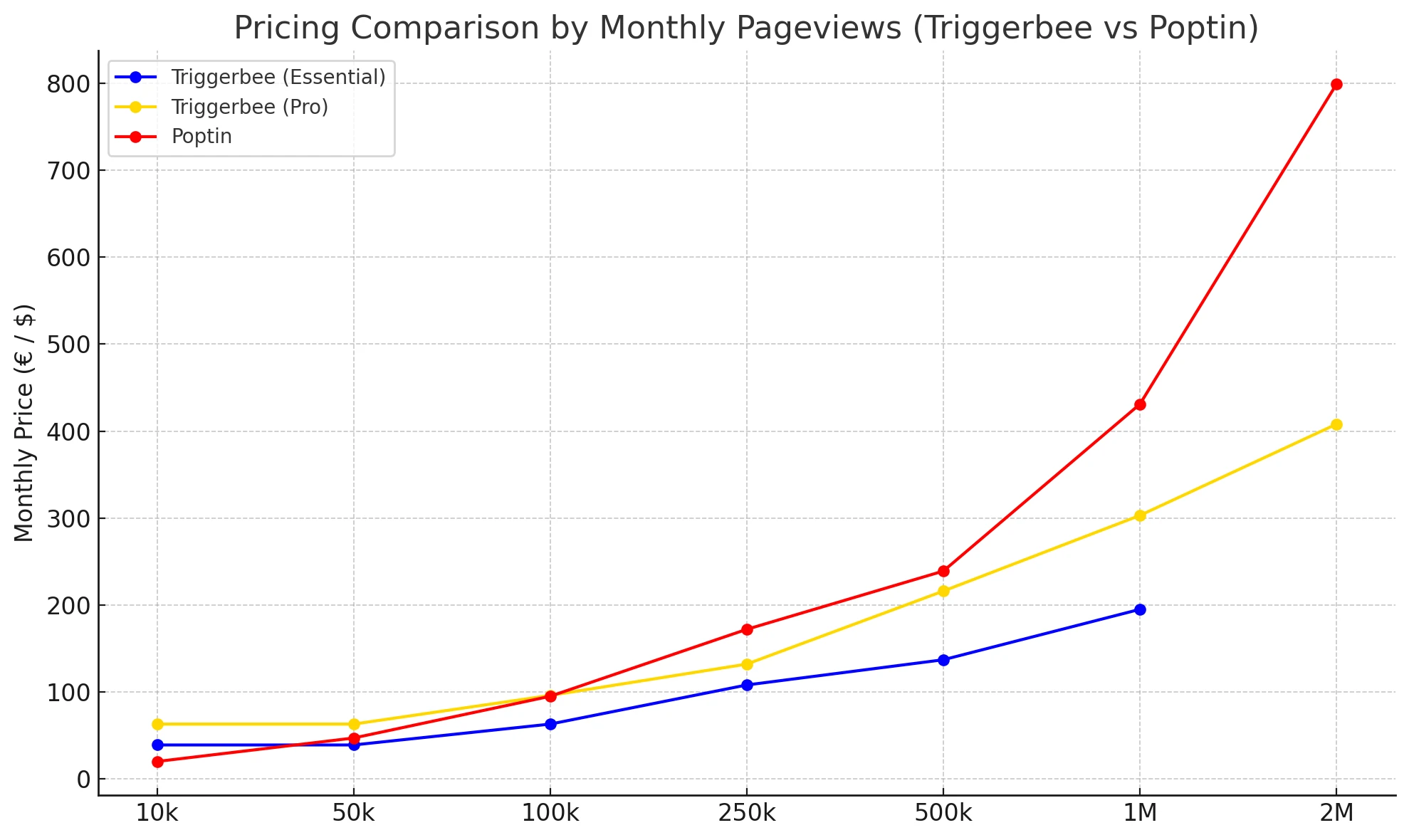
When comparing pricing across tiers, Triggerbee offers stronger value as traffic scales. While Poptin starts cheaper, Triggerbee’s Pro plan is significantly more cost-effective at higher levels:
At 1M views, Triggerbee Pro is €303 vs. Poptin’s €431 — a 29% savings
At 2M views, Triggerbee Pro is €408 vs. Poptin’s $799 — nearly 49% cheaper
For teams with lower traffic and no need for CRM-based personalization, Poptin’s $20 and $47 plans are affordable and effective. But for brands that want full targeting, syncing, and embedded content, Triggerbee’s Essential and Pro plans unlock more functionality at each tier.
Here’s how the two platforms compare:
Monthly Page Views
Triggerbee Pricing (€)
Poptin
10K
Essential: €39 | Pro: €63
€20
50k
Essential: €39 | Pro: €63
€47
100k
Essential: €63 | Pro: €96
$95 (150k views)
250k
Essential: €108 | Pro: €132
$172 (300k views)
500k
Essential: €137 | Pro: €216
€239
1M
Essential: €195 | Pro: €303
€431
2M
€408
$799
8. Pros & Cons
Triggerbee Pros
CRM-driven personalization and segmentation
Smart Embeds for embedded site content personalization
Revenue attribution and multistep funnel analytics
Two-way syncing with tools like Klaviyo, Rule, Mailchimp, and Voyado
Built-in surveys, gamification, and referral features
Highly customizable layout system with design defaults
Triggerbee Cons
No free plan available
Slightly higher pricing for lower tiers if you’re only using basic features
More setup time if you’re not already using a CRM or email platform
Poptin Pros
Free forever plan up to 1,000 visitors
Clean drag-and-drop editor with a large template library
Simple to use with fast campaign creation
Wide range of native integrations for lead syncing
Basic automation tools and autoresponders included in most plans
Poptin Cons
Limited to basic personalization (text merge tags only)
No Smart Embeds or embedded content personalization
All integrations are one-way (push only)
Most advanced features locked behind higher-tier plans
Lacks analytics depth and CRM-based audience control
9. Final Verdict
Both Triggerbee and Poptin offer strong value – but they’re made for very different goals.
Choose Poptin if:
You want to launch basic popups quickly without setup or technical work
You’re a small business or solo marketer working under 100,000 pageviews/month
CRM-level targeting and personalization aren’t necessary yet
Poptin is a reliable lead capture tool with good starter features, a generous free plan, and broad integration coverage – perfect for teams just getting started.
Choose Triggerbee if:
You need real personalization based on CRM data, segments, or visitor identity
You care about revenue attribution, embedded content, and onsite behavior insights
You already use tools like Klaviyo, Mailchimp, or Rule – and want to trigger campaigns based on that data
Triggerbee turns your website into a personalization platform. From embedded banners and targeted surveys to loyalty promotions and behavioral targeting, it’s built for brands ready to optimize the full onsite journey.
If you’re scaling or already working with segments, Triggerbee gives you a much deeper toolkit – and helps you act on your customer data in real time.
In this article we’ll compare Sleeknote vs Triggerbee, two of the most powerful softwares for onsite marketing, lead gen, gamification and visitor engagement on the market today. Both tools offer powerful capabilities, and while you can reach your goals with both tools, there are some differences you might want to know about.
This guide breaks down where each platform shines, and why many growing ecommerce brands looking for a Sleeknote alternative are turning to Triggerbee. With more personalization options, stronger analytics, and some serious cost-savings (up to €430 per year), Triggerbee might be the smarter choice for your team.
Sleeknote vs Triggerbee: Summary
Feature
Triggerbee
Sleeknote
Campaign Types (popups, embeds)
✅ Popups, Embeds, Callouts, Full screen, Banners
✅ Popups, Embeds, Full screen, Bars
Forms
✅ Yes
✅ Yes
Promotions
✅ Yes
✅ Yes
Gamification
✅ Spin to win, Memory, Product quizzes, Calendars, Daily offers
✅ Advent Calendar, Spin to win, Scratch to Win, Daily offers
Surveys
✅ CSAT & NPS with analytics, Ratings, Smileys, Thumbs, Stars + feedback field
✅ Simple surveys, NPS
Referral marketing
✅ Yes
❌ No
Targeting
✅ Session behavior, profile properties and events
✅ Behavioral triggers, page-level, SiteData
Advanced Onsite Targeting
✅ Weather targeting, Geolocation, CRM data
✅ Geolocation, SiteData
Smart Embeds
✅ Yes, audience-targeted content injected via CSS class
❌ Regular embeds
Personalization Features
✅ CRM-targeting, Customer Profile Targeting
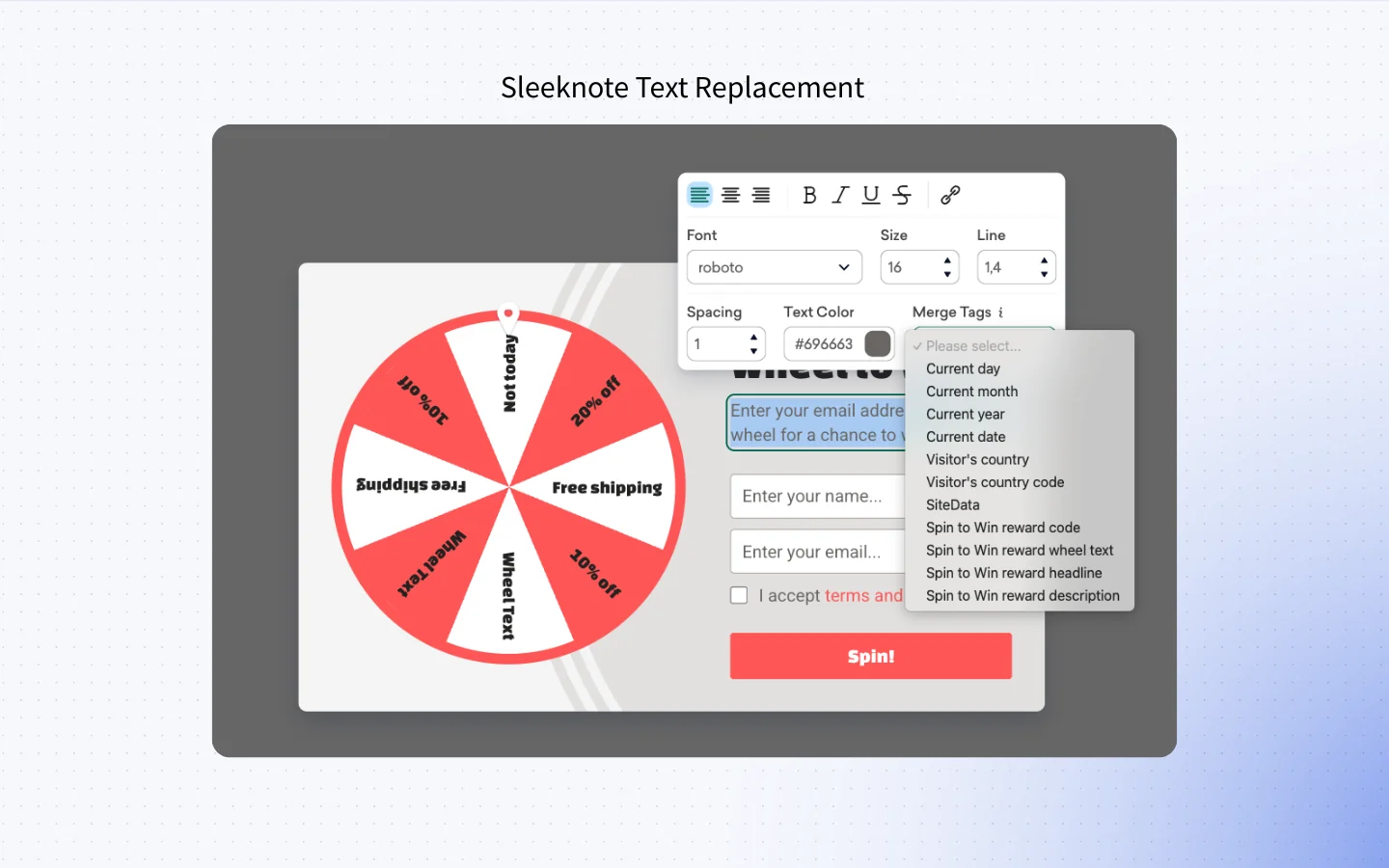
✅ Text replacement, SiteData
A/B Testing
✅ A + B
✅ Multivariate
Analytics & Reporting
✅ Revenue attribution, funnel analysis
✅ Simple conversion & engagement
Product recommendations
✅ With integrations
✅ Via Shopify, Clerk, Raptor, Hello Retail
Brand Default Styles
✅ Yes
❌ No
Integrations
✅ Multiple native + Zapier
✅ Multiple native + Zapier
Freemium
❌ No
❌ No
Free Trial
✅ 14 days and 250k page views
✅ 14 days
Pricing
Starts at €39
Starts at $49
Best For
Brands that want more personalization, customization and CRM-based targeting
SMBs that want popups, promotions and gamification
1. Who Each Tool Is Best For
Choosing between Sleeknote and Triggerbee depends on your goals, team size, and how far you want to go with personalization. Both tools cover the essentials of popup creation and lead capture, but they’re built with different users in mind. Sleeknote is ideal for marketers who want to move fast with polished templates and simple campaigns. Triggerbee is better suited for brands ready to use behavioral data and CRM insights to deliver personalized, high-converting experiences across their site.
Sleeknote is great for small to mid-sized SMB’s or ecommerce teams that want a fast, simple way to run popups, promotions, and lead forms. It’s ideal for marketers focused on lead capture without the need for deep personalization or CRM integration.
Triggerbee is built for growth-focused brands that want to improve their onsite experience. If you care about creating fully personalized, data-driven experiences for different audience segments – especially logged-in users – Triggerbee gives you more power, more control, and better results.
2. Campaign Creation & Templates
Creating effective campaigns should be fast, flexible, and intuitive. Whether you’re building a simple popup or a multi-step flow with personalized offers, the right editor makes all the difference.
Look for tools that offer both ready-made templates and the flexibility to build from scratch, with elements like countdown timers, gamification, product blocks, and mobile-first layouts.
The more control you have in the builder, the easier it is to match your brand and launch higher-converting ideas, faster.
Campaign creation in Triggerbee
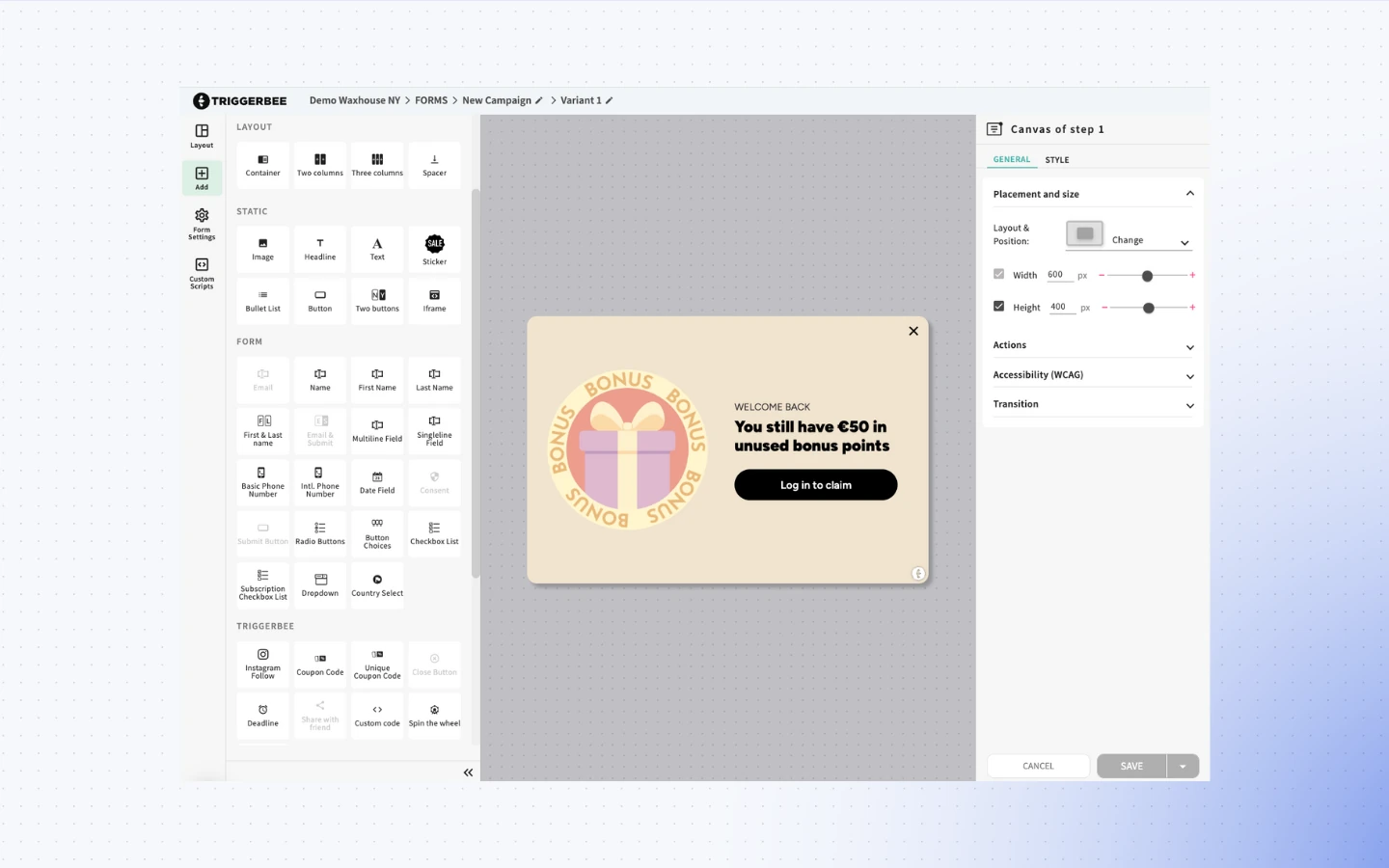
Triggerbee provides a more advanced design experience. The visual editor includes flexible drag-and-drop functionality and a full canvas interface. Layouts span Popups, Callouts, Panels, Fullscreen, and Embedded content. Templates are organized by use case (e.g., data collection, loyalty, UTM targeting), and you can start from scratch. Available elements go far beyond basics: surveys (NPS, CSAT), multistep forms, coupon delivery, personalized blocks, and CRM-synced fields – all fully editable and style-consistent with your brand profile.
Campaign creation in Sleeknote
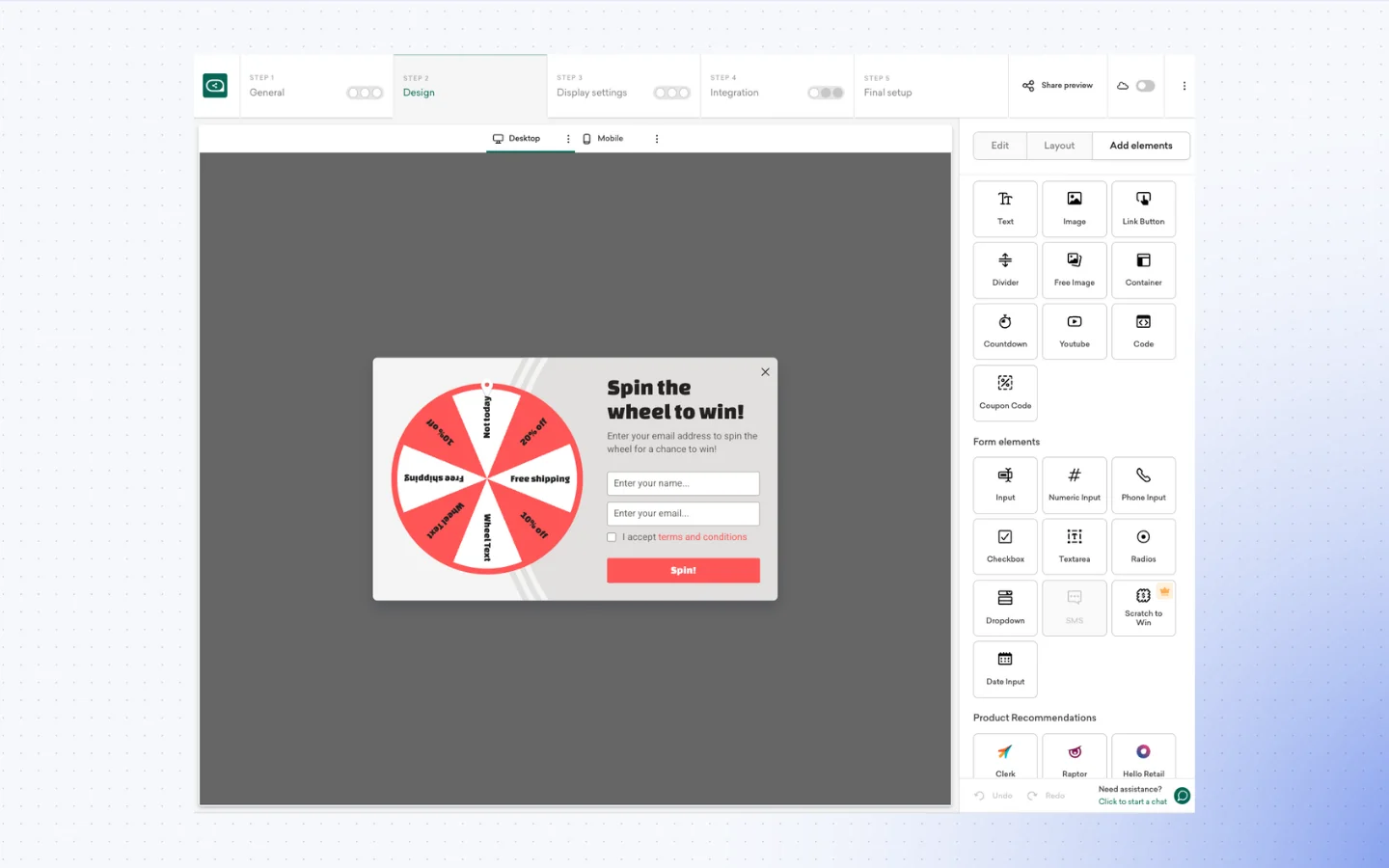
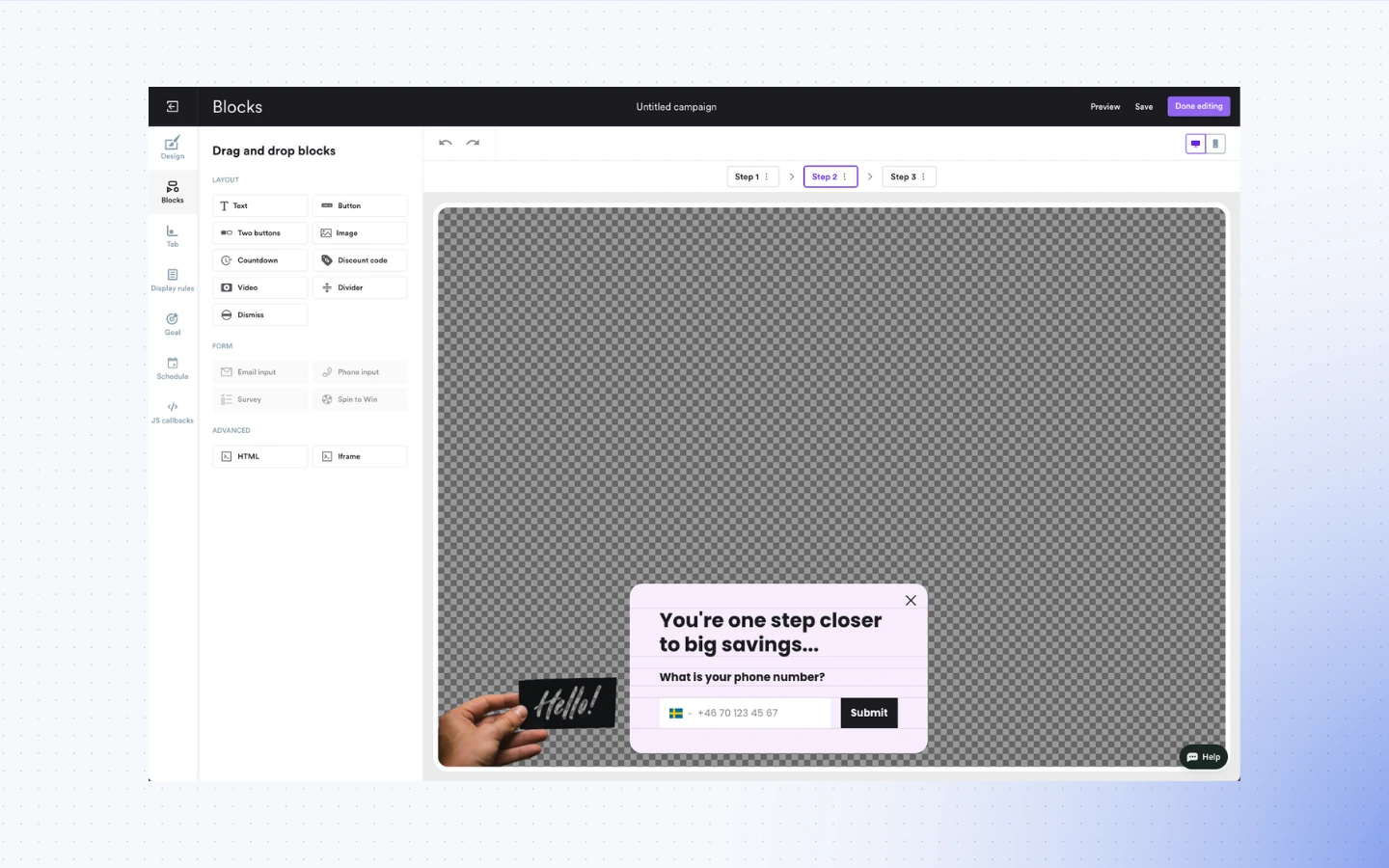
Sleeknote’s editor features a clean campaign builder with five steps: General, Design, Display Settings, Integration, and Final Setup. Layout options include Popup, Slide-In (left/right), and Embedded. Its drag-and-drop editor offers essential layout blocks – including buttons, forms, coupon fields, quizzes, countdowns, and Shopify-integrated product recommendations. It also provides prebuilt gamification campaigns such as Spin to Win, Scratch to Win, and Daily Offers – though some require higher-tier plans.
Verdict: Sleeknote is intuitive for quick setups, with strong ecommerce presets. But Triggerbee’s editor is more powerful and customizable – especially for brands that need layered flows, advanced fields, or personalized variants.
3. Targeting & Triggers
The real power of targeting comes from combining context and intent. It’s not just about when a campaign appears, but why it appears, and who it’s shown to.
Good tools let you trigger campaigns based on behavior (like scroll depth or exit intent), session data (like time on site or device), or traffic source (like UTM tags). But GREAT tools go further by layering in CRM data, purchase history, and audience segments so your targeting reflects both real-time behavior and long-term customer context. This is where the biggest performance lift often happens.
Targeting and Triggers in Triggerbee
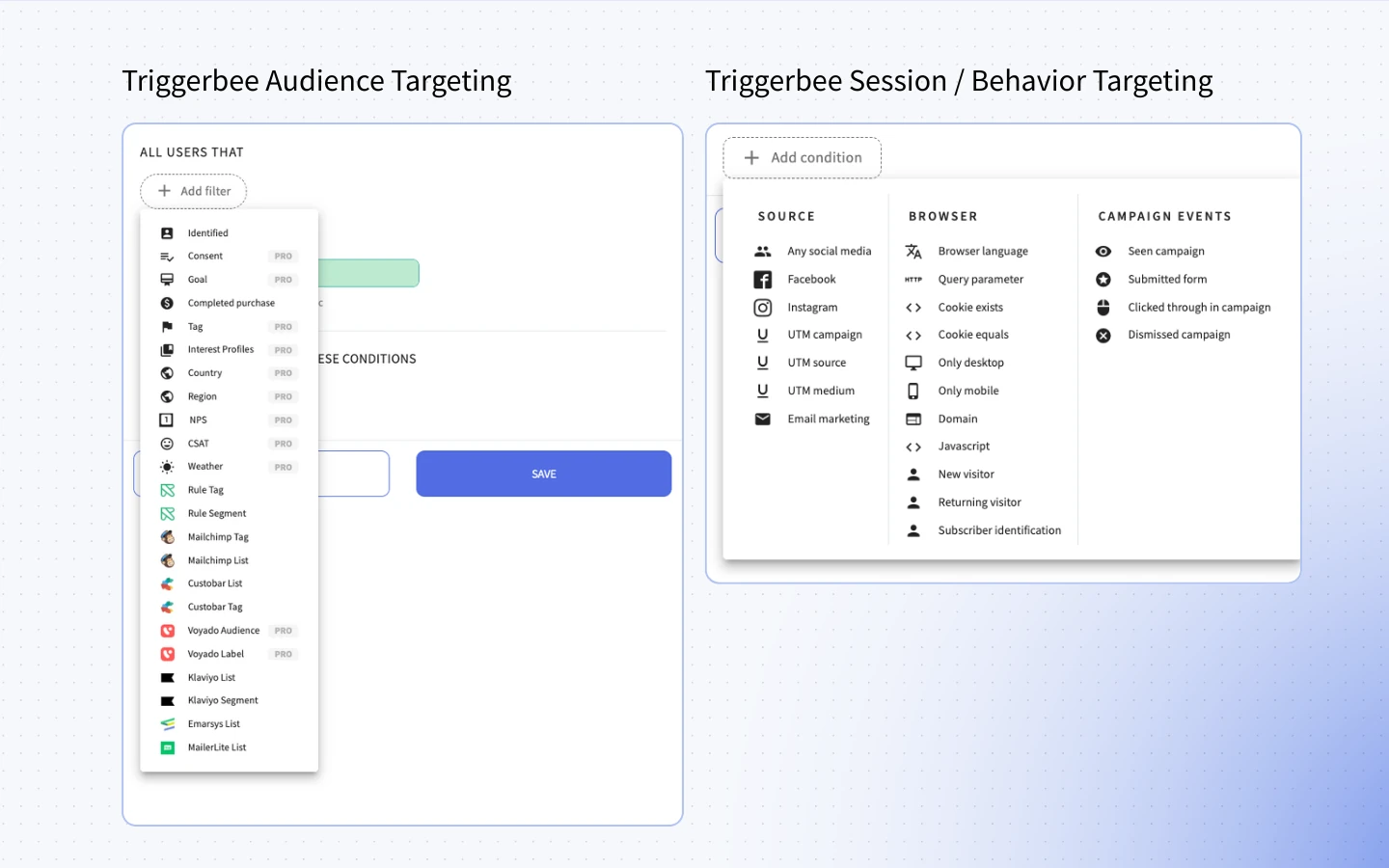
Triggerbee goes several levels deeper. Campaigns can be triggered by time, scroll, device type, inactivity, page path, UTM tag, cookie, or even custom JavaScript logic. But what sets Triggerbee apart is its hybrid model: you can combine real-time session data (like cart status or device) with persistent CRM filters (like membership status, purchase history, or survey scores). This enables pinpoint targeting such as:
“Show this to Gold Members who abandoned cart but haven’t purchased in 30 days”
“Only show to new visitors on mobile from Instagram ads”
“Hide this promo for people who already redeemed their bonus”
This dual-layer system – Audience Filters (customer profile) + Session Conditions (browsing behavior) – makes Triggerbee one of the most precise tools on the market for onsite personalization.
Targeting and Triggers in Sleeknote
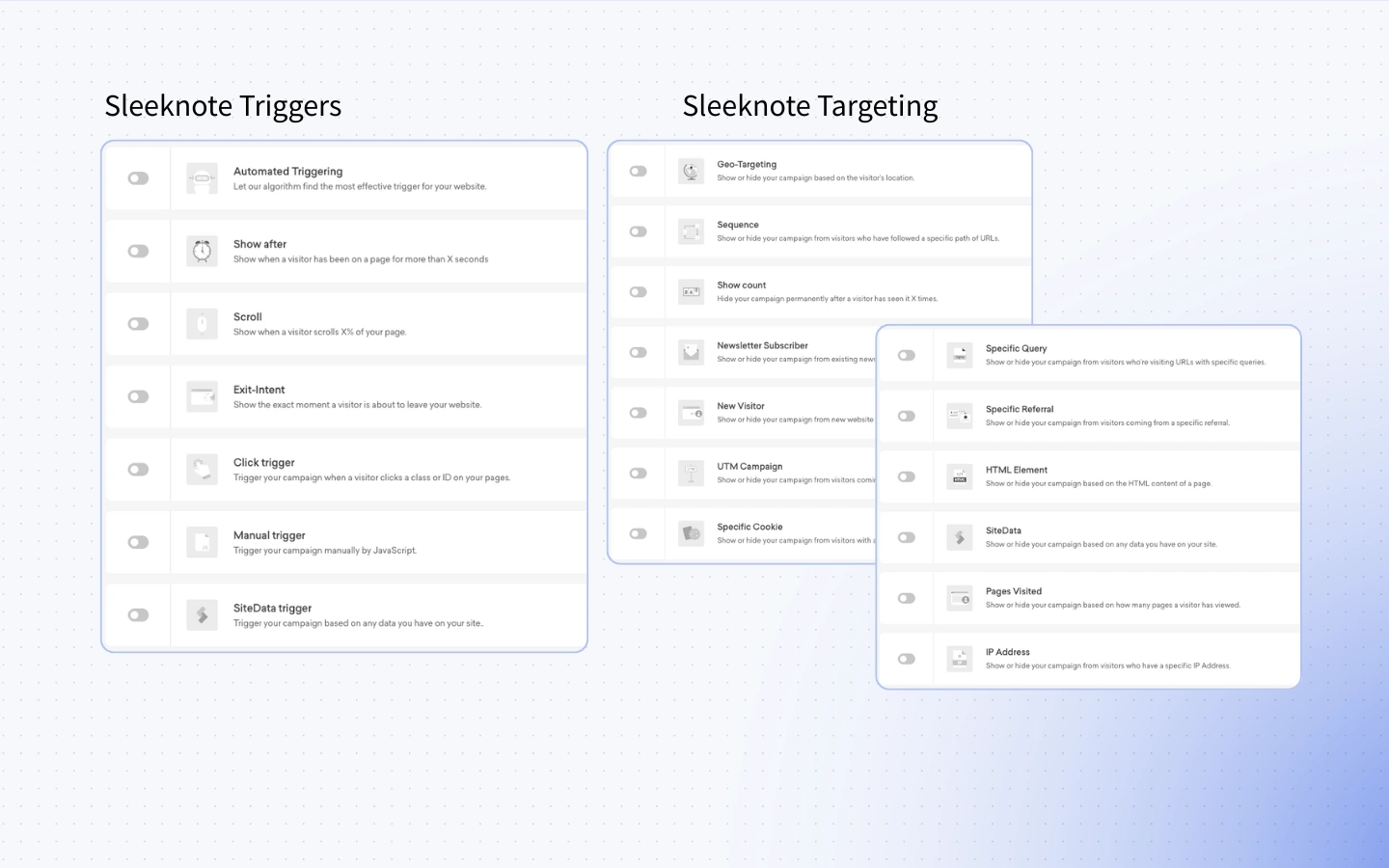
Sleeknote offers a solid range of targeting and trigger options. You can launch campaigns based on time on site, scroll depth, exit intent, click interactions, and JavaScript triggers. Targeting includes UTM campaigns, cookies, specific page visits, referrers, and geo-location. While useful, most of Sleeknote’s logic is session-based and doesn’t leverage persistent visitor profiles or CRM data. For example, a campaign can exclude users based on URL query parameters (e.g., newsletter subscribers) but cannot dynamically access CRM segments or past behavior.
Verdict: Sleeknote covers essential popup triggers and basic targeting. But if you want deeper segmentation based on user identity, CRM data, and behavior over time, Triggerbee offers unmatched targeting power.
4. Personalization Options
Personalization is about delivering the right message, offer, or experience to each visitor based on who they are, what they’ve done, and what they’re likely to do next.
Strong personalization tools connect to your CRM or customer database, let you insert dynamic content into campaigns, and give you control over which segments see what. Whether it’s showing different promotions to new vs. returning users or displaying loyalty points for logged-in members, your personalization engine should adapt to real people in real time.
Personalization in Triggerbee
Triggerbee is built from the ground up for persistent, identity-based personalization. Campaign content can include personalized greetings, loyalty points, past purchase data, survey responses, and more – all using CRM-synced MergeTags. Campaigns can adapt in real time based on both session behavior (scroll, inactivity, device) and long-term visitor properties (like birthday month, status, tags). With built-in tools for profile enrichment, smart targeting, and dynamic content delivery, Triggerbee goes far beyond standard merge tags.
Personalization in Sleeknote
Sleeknote supports basic personalization through its SiteData functionality. You can show or hide campaigns and insert merge tags based on visitor data you send via Google Tag Manager – such as cart value, items viewed, or browser language. This allows for some dynamic display logic and in-message customization. However, all SiteData is session-based and lost after the visit ends. It also requires manual setup in your tag manager, making it more technical to implement.
Verdict: Sleeknote’s SiteData gives you basic personalization if you’re willing to do the technical setup. But if you want full-profile personalization, persistent user memory, and true one-to-one onsite experiences, Triggerbee wins by a wide margin.
5. Integrations
Your popup tool should fit into your existing tech stack — not work around it. The best platforms connect seamlessly to your CRM, email platform, and customer data sources.
Look for native integrations that support two-way syncing, audience targeting from your contact lists, and automated data handoffs. If you rely on real-time personalization or triggered emails, integration depth (not just quantity) becomes a key factor.
Sleeknote’s integrations
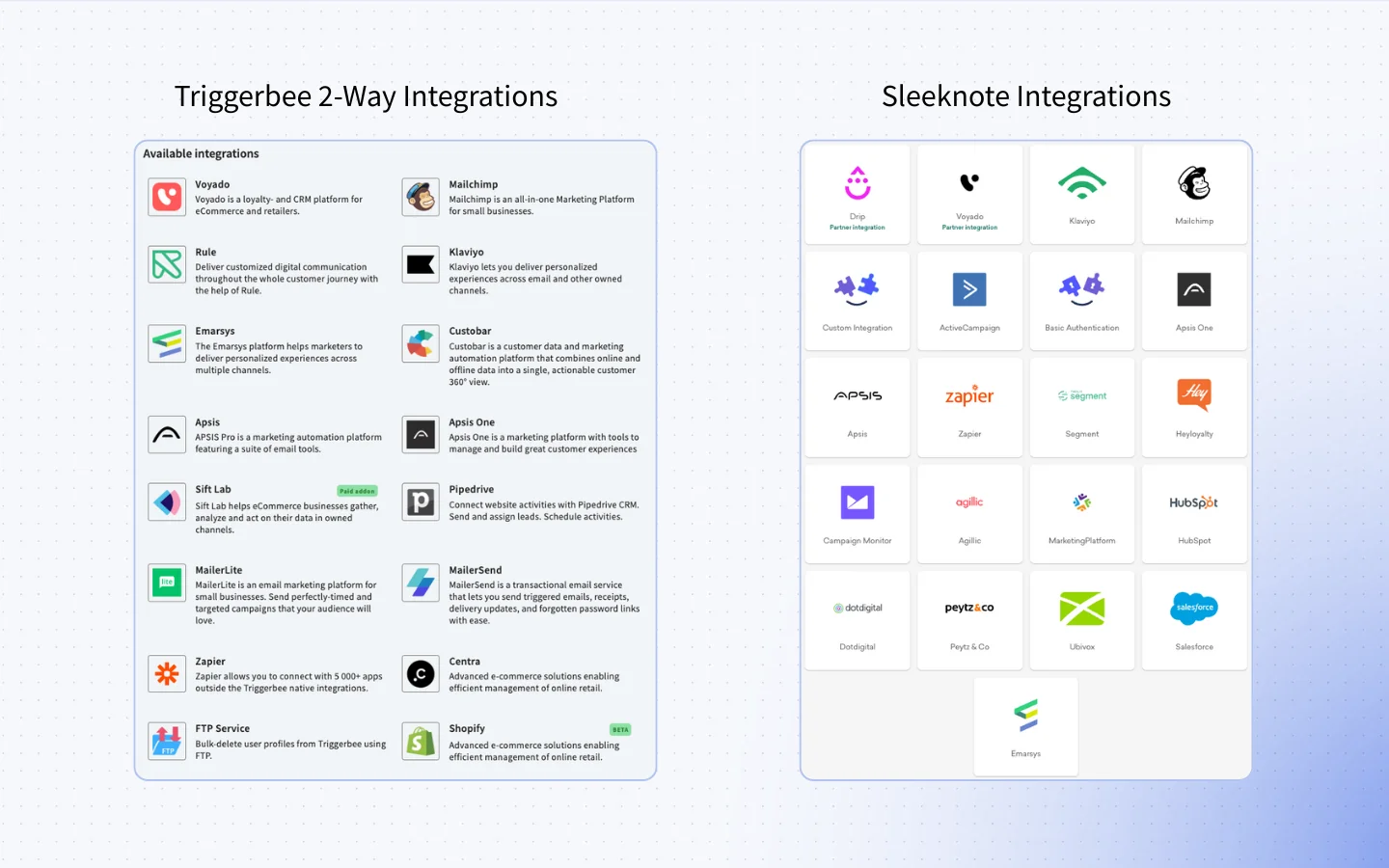
Sleeknote offers a wide range of ESPs and CRM systems commonly used in ecommerce. You’ll find native support for Shopify, Klaviyo, Mailchimp, ActiveCampaign, HubSpot, Drip, Apsis, Segment, and others – plus general connection options via Zapier, webhooks, and custom integrations.
Triggerbee’s integrations
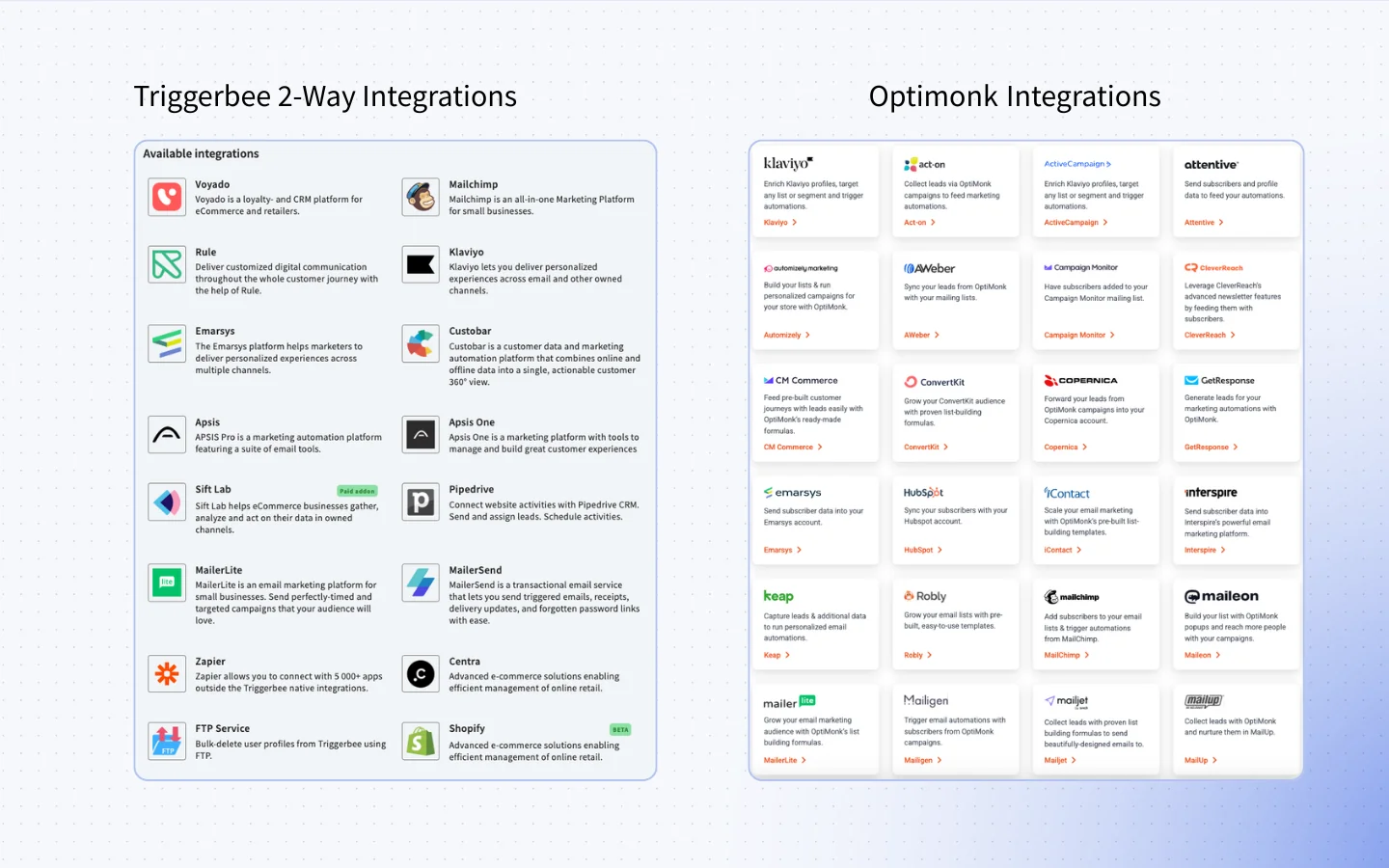
Triggerbee offers just as broad integrations, but with a deeper focus on CRM syncing and data-driven targeting. In addition to major email platforms like Mailchimp, Klaviyo, Rule, and MailerLite, it also supports CDPs like Custobar and Segment, marketing automation tools like Emarsys and Apsis, and CRMs such as Salesforce, HubSpot, and Pipedrive. You can even bulk delete or sync users through FTP or send detailed customer data to Sift Lab (for paid plans).
Verdict: Both tools offer strong native integrations and Zapier support. Sleeknote’s list is extensive and ecommerce-focused. Triggerbee adds deeper CRM and CDP connectivity, which makes it a better fit for brands that rely on real-time data and want synced personalization across their stack.
6. Analytics & Optimization
When evaluating popup and personalization tools, analytics is more than just a “nice to have.” It’s what tells you if your campaigns are working, who they’re working for, and where you’re losing people.
At a minimum, you’ll want to track:
Views and conversion rates – to measure basic performance.
Split test results – to optimize headlines, offers, and formats.
Funnel metrics / Drop-off points – especially in multi-step forms or quizzes.
Revenue attribution – so you know which campaigns actually drive sales.
Visitor-level insights – to understand how different segments behave.
The right tool gives you not just totals, but patterns. It should help you answer questions like: Which pages convert best? Are logged-in members more responsive? Which UTM campaigns produce the highest ROI?
Triggerbee’s analytics
Triggerbee delivers full-funnel visibility and attribution. You get campaign-level conversion stats, individual visitor insights, NPS/CSAT results, and even revenue analytics showing assisted sales and average order values. For multistep forms, Triggerbee also visualizes each step’s drop-off rate to help you optimize flows. Data is connected back to individual profiles or CRM segments, enabling more actionable decisions across marketing and sales.
Sleeknote’s analytics
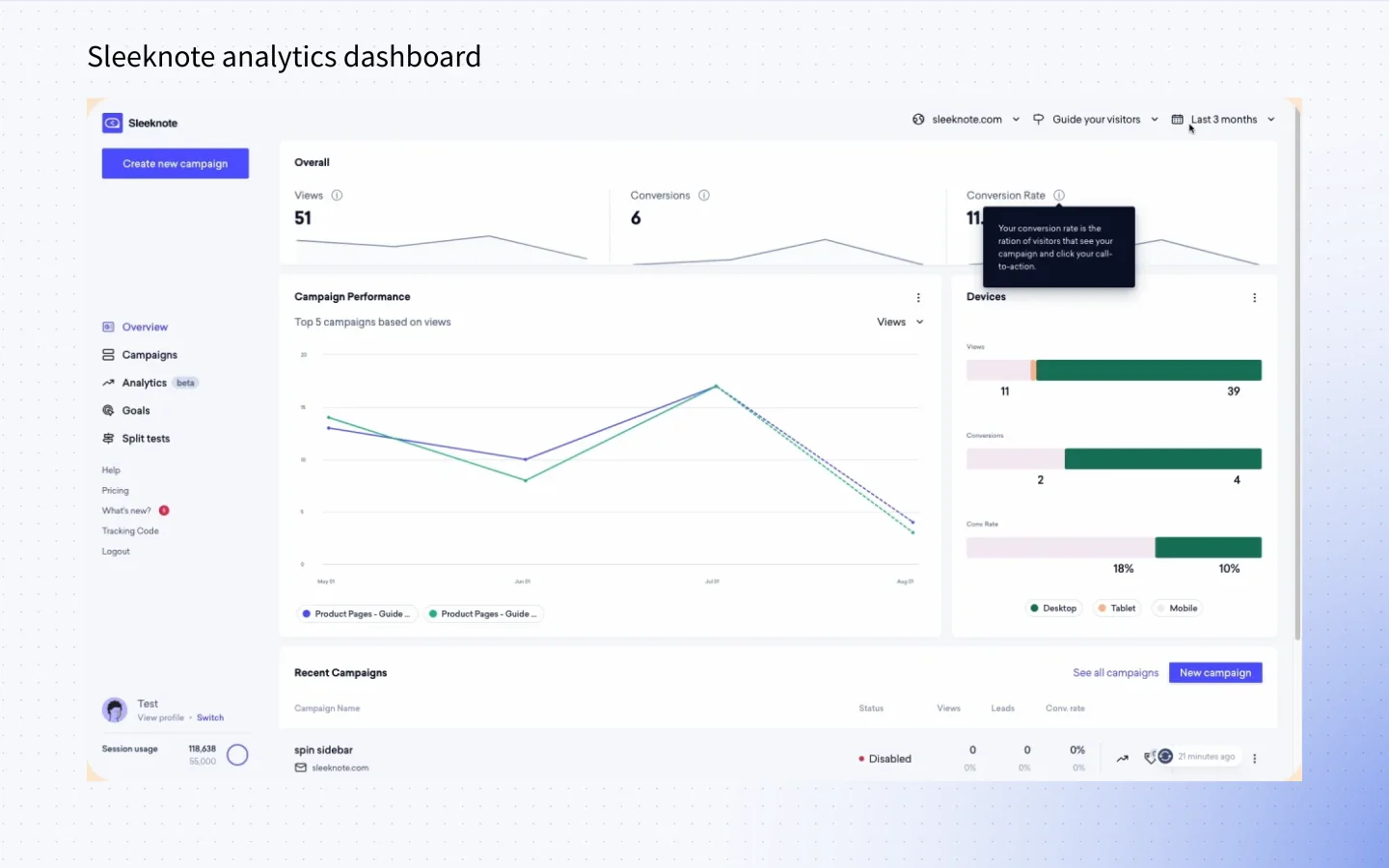
Sleeknote provides basic analytics for campaign performance. You can see overall views, conversions, and conversion rates across devices. It offers a clean visual breakdown of top campaigns, with simple tracking for goals and split testing. While it’s enough to measure general success, Sleeknote’s analytics do not include revenue attribution or detailed funnel metrics.
Verdict: Sleeknote handles the basics well for popup performance. But Triggerbee offers far more depth for serious optimization – including campaign funnels, revenue insights, and CRM-based analysis that helps you tie onsite activity to real business outcomes.
7. Pricing & Plans Comparison
Triggerbee and Sleeknote both offer scalable pricing based on traffic volume. But there’s a key difference: Sleeknote’s gamification features (like Spin to Win and Scratch to Win) are only available in a separate “Gamification” plan – which increases cost significantly.
Triggerbee, on the other hand, includes all features in both its Essential and Pro plans – so you never pay extra just to unlock interactive formats.
Here’s how the two platforms compare:
Monthly Page Views
Triggerbee Pricing (€)
Sleeknote Pricing (€)
50k
Essential: €39 | Pro: €63
Core: €49 | Gamification: €68
100k
Essential: €63 | Pro: €96
Core: €59 | Gamification: €80
250k
Essential: €108 | Pro: €132
Core: €114 | Gamification: €148
500k
Essential: €137 | Pro: €216
Contact Sales
1M
Essential: €195 | Pro: €303
Contact Sales
Verdict: Sleeknote’s gamification unlocks come at a premium. Triggerbee includes gamified formats, surveys, revenue attribution, and CRM personalization at no extra cost in either plan.
💡 Choosing Triggerbee can save you 27% or €430 annually.
Why it’s a better deal:
Triggerbee includes gamification, surveys, CRM-based targeting, and personalization in all plans – no need to upgrade tiers.
You get full revenue attribution and individual visitor tracking – features that are not available in Sleeknote.
Multistep forms, campaign funnels, and dynamic content are built in – no add-ons or hidden costs.
For any business scaling past 100k pageviews, Triggerbee offers a stronger return – both in feature depth and in cost efficiency.
8. Pros & Cons
Sleeknote Pros
Intuitive campaign builder with solid templates
Flexible visual editor with Shopify support
Strong preset triggers (scroll, exit, timers)
Sleeknote Cons
Gamification requires a more expensive plan
No persistent personalization or CRM targeting
Basic analytics with no revenue attribution
Triggerbee Pros
Includes all features – no feature gating or upsells
True one-to-one personalization with CRM sync
Deep campaign analytics and revenue attribution
Powerful targeting with session + profile logic
Seamless form builder, surveys, referral tools, and gamification
Triggerbee Cons
No freemium plan (but free trial available)
Best suited for teams ready to use full personalization power
9. Final Verdict
Sleeknote is a solid tool for basic onsite campaigns. If you’re mainly focused on capturing emails through popups and don’t need advanced targeting or analytics, it’s a reliable choice with an easy learning curve.
But if you’re scaling, working with CRM data, or want to build personalized experiences across your website – Triggerbee is the clear winner.
✅ Triggerbee includes all premium features in every plan – including gamification, surveys, dynamic content, and real-time personalization. The only exception is Referral Marketing, which is available for Pro users.
📉 You’ll save up to 27% annually compared to Sleeknote’s gamification plans, with no compromises on functionality.
📊 You’ll gain full visibility into what’s working – including funnel tracking, revenue attribution, and segment performance.
🎯 And you’ll do it all without relying on developers or expensive integrations.
Choose Triggerbee if you want to turn your website into a personalized conversion engine – with better targeting, deeper insights, and a lower total cost of ownership.
In this comparison, we’ll look at OptiMonk vs Triggerbee. Two powerful platforms for onsite marketing, lead capture, and customer engagement. Both tools offer popups, A/B testing, targeting rules, and a wide range of integrations – but the way they approach personalization, design control, and data syncing is different. If you’re looking for an Optimonk alternative, Triggerbee is a great choice.
Triggerbee: Built for teams who want full personalization and deep CRM targeting
Triggerbee isn’t just a popup tool. It’s a personalization engine. You can create fully branded campaigns, target visitors with CRM-based logic, and personalize content sitewide – from popups to embedded banners. It’s ideal for ecommerce, B2B, and subscription brands that want their website to reflect their customer data in real time.
Triggerbee is best for teams that care about advanced targeting, syncing with their marketing stack, and turning visitor behavior into personalized experiences that convert.
Optimonk: Easy to start, quick to scale
OptiMonk is built for teams that want fast results with minimal setup. You get a generous free plan, polished templates, and user-friendly targeting tools. It’s especially helpful for Shopify-based businesses thanks to its native integration and onboarding flows.
If your focus is launching campaigns quickly and testing ideas, Optimonk is a solid choice – especially if you run or work at a small to mid-sized ecommerce store.
Let’s dive in!
Optimonk vs Triggerbee Comparison
Feature
Triggerbee
OptiMonk
Campaign Types (popups, embeds)
✅ Popups, Embeds, Callouts, Full screen, Banners
✅ Popups, Embeds, Full screen, Bars
Forms
✅ Yes
✅ Yes
Promotions
✅ Yes
✅ Yes
Gamification
✅ Spin to win, Memory, Product quizzes, Calendars, Daily offers
✅ Spin to win
Surveys
✅ CSAT & NPS with analytics, Ratings, Smileys, Thumbs, Stars + feedback field
Brands that want more personalization, customization and CRM-based targeting
Ecommerce brands who want fast results and easy campaign setup
1. Who Each Tool Is Best For
Choosing between Optimonk and Triggerbee depends on your goals, team size, and how far you want to go with personalization. Both tools cover the essentials of popup creation and lead capture, but they’re built with different users in mind. Optimonk is ideal for marketers who want to move fast with polished templates and simple campaigns. Triggerbee is better suited for brands ready to use behavioral data and CRM insights to deliver personalized, high-converting experiences across their site.
Triggerbee: Built for brands that want full control and deeper targeting
Triggerbee is designed for marketing teams who don’t just want to launch popups-but want to personalize the entire experience. It’s a great fit for ecommerce, B2B, and membership-based businesses that already use CRM data and want to connect it directly to onsite campaigns.
Triggerbee lets you decide exactly who sees what, and when. That includes showing unique offers to logged-in users, subscribers with certain tags, or high-value shoppers. If you’re using tools like Rule, Klaviyo, or Mailchimp, you’ll be able to sync segments and trigger campaigns with zero guesswork.
It’s slightly more expensive at lower traffic volumes-but you get full personalization, targeting, and analytics from day one.
Optimonk: Great for quick wins and AI-powered optimization
OptiMonk is ideal if you want to set up high-converting popups fast. It gives you prebuilt templates, a friendly drag-and-drop builder, and built-in AI features to help improve performance over time.
The platform focuses more on ease of use than manual control. You won’t get deep CRM integrations or custom logic at the same level as Triggerbee-but for many small to mid-sized ecommerce stores, that’s not a dealbreaker.
You can start for free, and pricing stays competitive up until around 250,000 monthly views. After that, Triggerbee offers more flexibility without steep jumps in cost.
2. Campaign Creation & Templates
Creating effective campaigns should be fast, flexible, and intuitive. Whether you’re building a simple popup or a multi-step flow with personalized offers, the right editor makes all the difference.
Look for tools that offer both ready-made templates and the flexibility to build from scratch, with elements like countdown timers, gamification, product blocks, and mobile-first layouts.
The more control you have in the builder, the easier it is to match your brand and launch higher-converting ideas, faster.
Triggerbee: Visual builder with full control
Triggerbee gives you a drag-and-drop editor built for precision. You can create multistep campaigns, quizzes, surveys, or embedded banners and control exactly how they appear. Want to match your brand guidelines? Just set your fonts, colors, and spacing once – every campaign will follow them by default.
You also get access to advanced logic and design blocks like deadline counters, product cards, coupon codes, and conditional steps. If needed, you can go even further with custom code, HTML, or inline styles. It’s everything a design-conscious team needs to build campaigns that convert and still feel native to the site.
Why it matters: No design bottlenecks, no extra styling work, and no off-brand overlays.
Optimonk: Template-first builder that’s easy to use
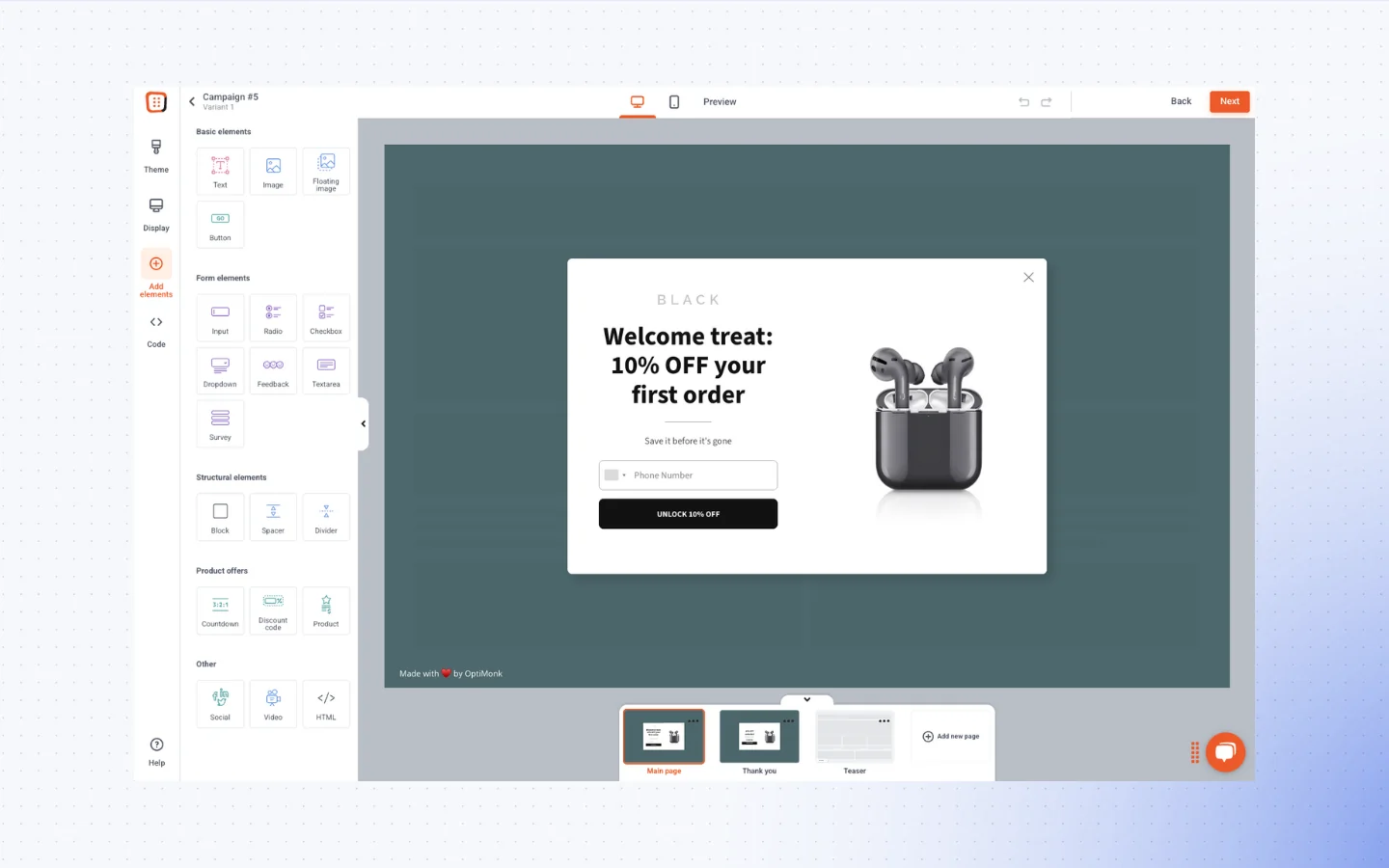
Optimonk makes it easy to launch a popup fast. You start with a clean template and a block-based builder that covers basic inputs, product showcases, and timers. You can build a thank-you step or teaser step using the built-in page flow, and tweak fonts and spacing to fit your brand – but with some limits.
The UI is polished and beginner-friendly, and the overall system is great for teams who want to move quickly. Just note that advanced layout logic and content personalization are more limited unless you rely on external data.
What to keep in mind: Fast and accessible, but not ideal for complex or fully branded campaign layouts. The UI is polished and beginner-friendly, but some styling and logic options are more rigid.
Quick verdict
Choose Triggerbee if you care about layout control, brand styling, and advanced flows. Choose Optimonk if you want a fast setup, great templates, and built-in AI for optimization.
3. Targeting & Triggers
The real power of targeting comes from combining context and intent. It’s not just about when a campaign appears, but why it appears, and who it’s shown to.
Good tools let you trigger campaigns based on behavior (like scroll depth or exit intent), session data (like time on site or device), or traffic source (like UTM tags). But GREAT tools go further by layering in CRM data, purchase history, and audience segments so your targeting reflects both real-time behavior and long-term customer context. This is where the biggest performance lift often happens.
Triggerbee: Deep segmentation with CRM, session, and context rules
Triggerbee gives you full control over who sees your campaigns. You can trigger messages based on session behavior, cart value, CRM data, or audience tags synced from tools like Klaviyo or Rule. It even supports weather-based targeting and geolocation if you want to adapt messaging to real-world conditions.
You also get full visibility into each targeting condition, and it’s easy to layer them using AND/OR logic. Want to show a campaign to subscribers in Sweden who visited a specific product twice? You can.
Why it matters: The more specific your targeting, the less you interrupt and the more you convert.
Optimonk: Smart rules for everyday use cases
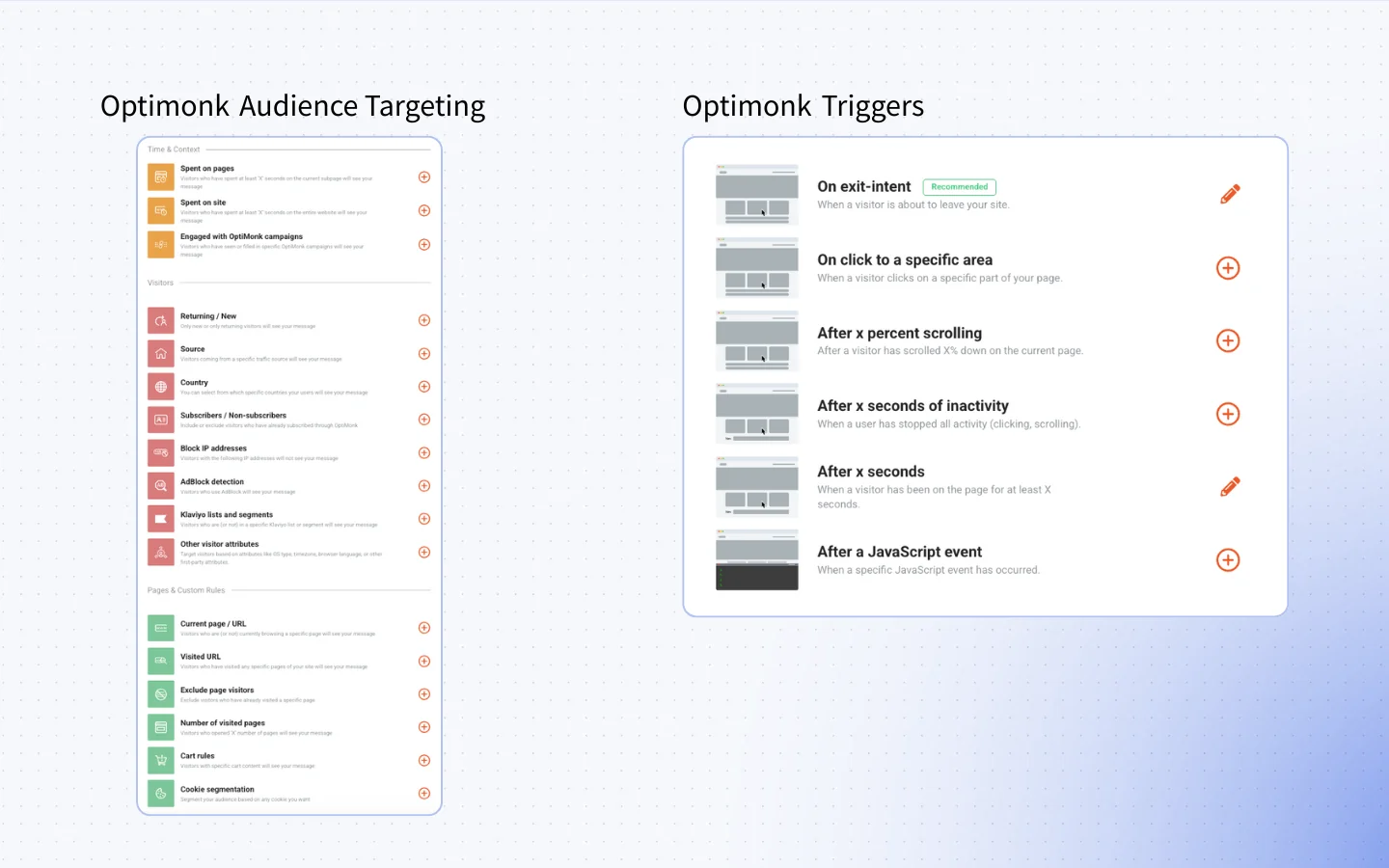
Optimonk comes with a strong library of behavioral targeting conditions: time on page, number of visits, referral source, device, and more. You can trigger campaigns based on exit intent, scroll depth, clicks, or inactivity, and use cart rules or UTM parameters to refine when popups appear.
While it supports external data like Klaviyo segments or IP blocking, it doesn’t connect as deeply into CRM fields or visitor property logic as Triggerbee. That said, it’s still a strong setup for teams who want to use standard targeting strategies without overcomplicating their workflow.
What to keep in mind: Easy to set up and flexible enough for most ecommerce use cases – just not quite as customizable at the data level.
Quick verdict
Choose Triggerbee if you want the most advanced targeting and CRM-driven rules available. Choose OptiMonk if your use cases are more common (cart abandoners, exit intent, mobile triggers) and you want speed without setup complexity.
4. Personalization Options
Personalization is about delivering the right message, offer, or experience to each visitor based on who they are, what they’ve done, and what they’re likely to do next.
Strong personalization tools connect to your CRM or customer database, let you insert dynamic content into campaigns, and give you control over which segments see what. Whether it’s showing different promotions to new vs. returning users or displaying loyalty points for logged-in members, your personalization engine should adapt to real people in real time.
Triggerbee: Personalized content that runs on CRM data and rules
Triggerbee lets you go beyond “Hi {{first name}}.” You can personalize the full content of a popup, banner, or embedded section based on a visitor’s location, session behavior, purchase history, or CRM segment. Campaigns can be shown or hidden based on dozens of data points, and you can preview every variation before going live.
You also get Smart Embeds – personalized campaigns placed directly inside your website’s layout using CSS selectors. This lets you personalize static content areas like product pages or checkout zones.
Why it matters: You don’t just change names. You change what people see – based on who they are.
Optimonk: Text replacement and light dynamic fields
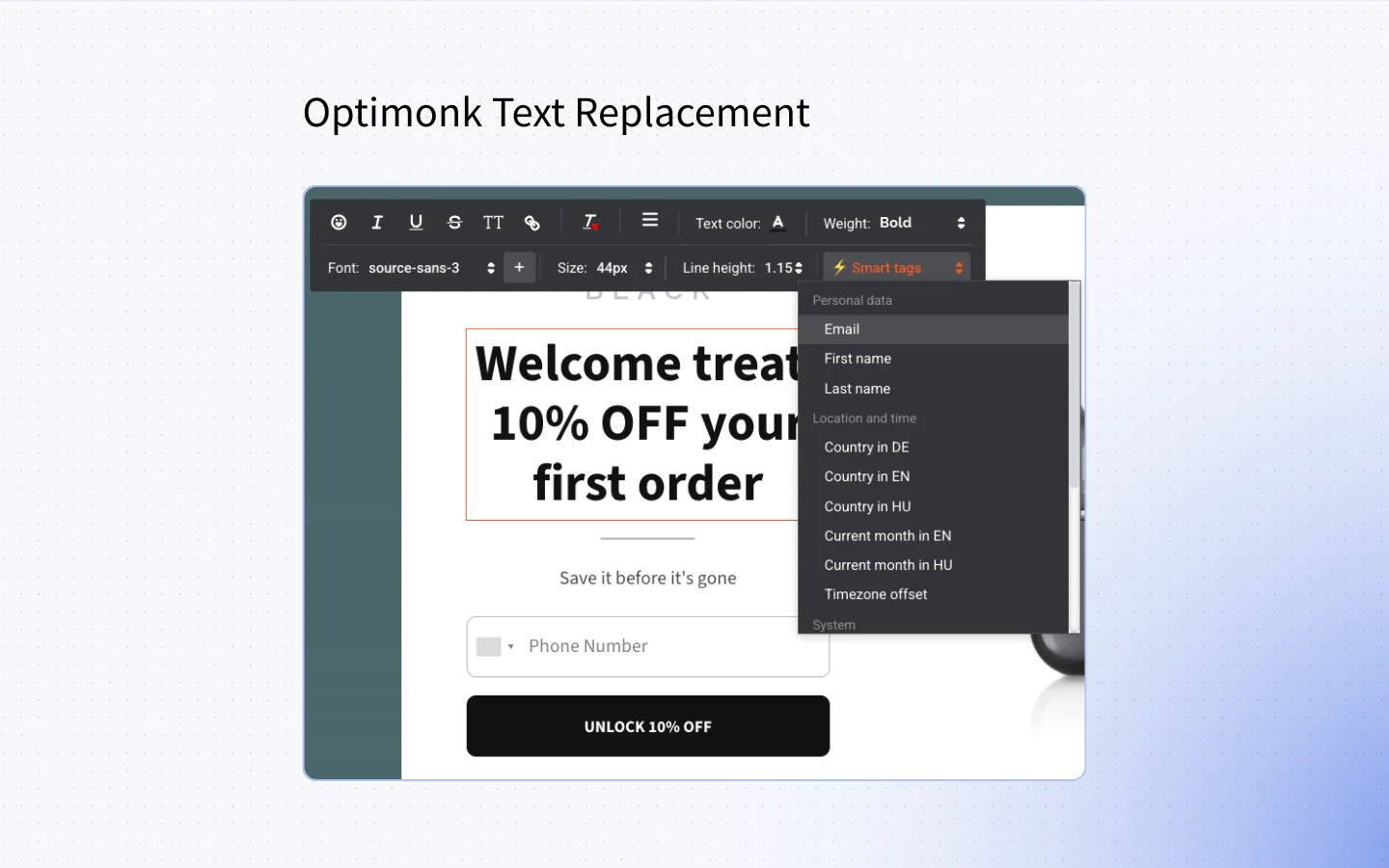
Optimonk includes personalization through “Smart Tags” – which let you dynamically insert first names, countries, current dates, and other visitor fields. It’s useful for customizing text, but does not extend to campaign logic or full content blocks unless you set up advanced integrations.
There’s no direct CRM connection for dynamic segments. If you want to change what users see based on past behavior, you’ll need to set up external syncing and maintain that data in other tools.
What to keep in mind: Personalization works well for surface-level changes, but not for complex or CRM-driven experiences.
Quick verdict
Pick Triggerbee when personalization is central to your strategy. Pick OptiMonk when name tags or location-based tweaks are enough.
5. Integrations
Your popup tool should fit into your existing tech stack — not work around it. The best platforms connect seamlessly to your CRM, email platform, and customer data sources.
Look for native integrations that support two-way syncing, audience targeting from your contact lists, and automated data handoffs. If you rely on real-time personalization or triggered emails, integration depth (not just quantity) becomes a key factor.
Triggerbee: Real-time, two-way integrations with CRM and email tools
Triggerbee offers deep native integrations with platforms like Rule, Klaviyo, Voyado, Mailchimp, MailerLite, and more. These aren’t just one-way lead captures – they’re full two-way syncs. You can both send and pull data from your CRM or email platform in real time.
That means your onsite campaigns can dynamically respond to things like tags, segments, goals, purchases, or even subscription status. If you’re already using these tools, Triggerbee becomes an extension of your tech stack.
Why it matters: Less time spent managing lists or exports. More time building experiences that fit each customer.
Optimonk: Large integration library with stronger Shopify features
Optimonk integrates with a long list of ecommerce and marketing tools, including Klaviyo, Mailchimp, HubSpot, ActiveCampaign, and many more. These integrations mostly focus on pushing leads into your connected platform – with fewer options for pulling data back in.
That said, Optimonk does have a dedicated Shopify app that unlocks extra controls and easier setup for store owners. If you run your business through Shopify, this tight integration is a definite advantage.
What to keep in mind: OptiMonk wins on quantity. Triggerbee wins on data depth and syncing flexibility.
Quick verdict
Use Triggerbee when your strategy depends on CRM and email data that flows both ways. Use OptiMonk when your priority is getting started quickly with Shopify or a broad set of lead sync options.
6. Analytics & Optimization
When evaluating popup and personalization tools, analytics is more than just a “nice to have.” It’s what tells you if your campaigns are working, who they’re working for, and where you’re losing people.
At a minimum, you’ll want to track:
Views and conversion rates – to measure basic performance.
Split test results – to optimize headlines, offers, and formats.
Funnel metrics / Drop-off points – especially in multi-step forms or quizzes.
Revenue attribution – so you know which campaigns actually drive sales.
Visitor-level insights – to understand how different segments behave.
The right tool gives you not just totals, but patterns. It should help you answer questions like: Which pages convert best? Are logged-in members more responsive? Which UTM campaigns produce the highest ROI?
Triggerbee: Built-in funnel analysis and revenue attribution
Triggerbee’s analytics go well beyond views and clicks. You can see assisted revenue, average order value, and campaign-specific funnel performance – all linked back to individual visitors and their behaviors. You also get clear reports on signups, engagement, and conversions.
This means you can track the full journey from visitor to conversion, including what campaigns moved the needle. It’s especially valuable for teams using CRM tools and needing to connect onsite behavior to long-term performance.
Why it matters: You get the full picture – not just which popups were clicked, but which ones contributed to actual revenue.
Optimonk: Clean conversion dashboard with built-in performance stats
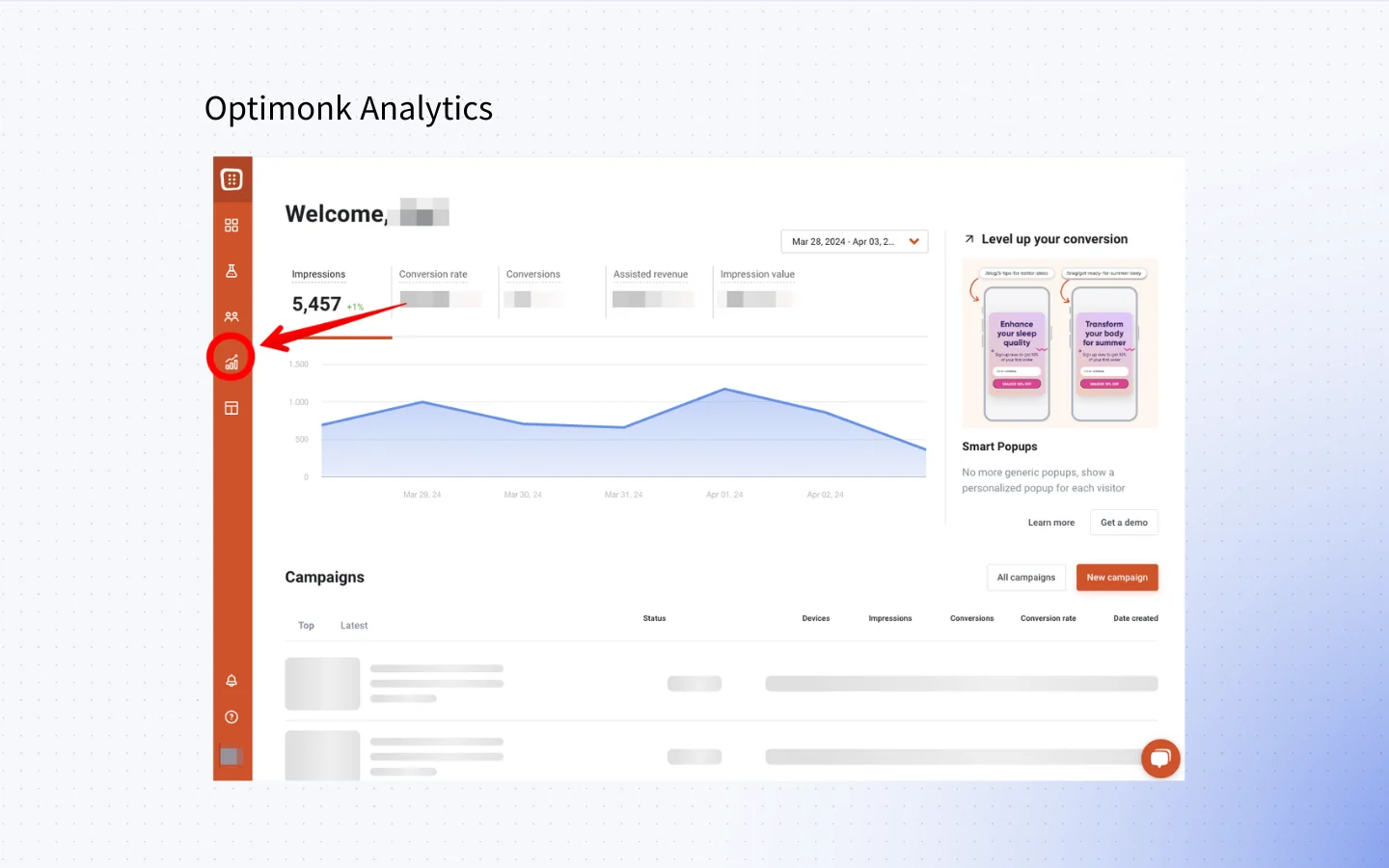
Optimonk includes an in-platform analytics dashboard where you can view impressions, conversions, conversion rate, assisted revenue, and impression value. You can filter by campaign or timeframe to see what’s working best.
While it gives a strong overview of engagement performance, it doesn’t offer visitor-level journey mapping or CRM-linked revenue breakdowns. Still, for most teams looking for popup insights, it covers the core metrics well.
What to keep in mind: Easy to understand, great for campaign-level feedback – but not as detailed when connecting data across tools.
Quick verdict
Use Triggerbee if you want deep funnel views, revenue attribution, and CRM-level reporting. Use Optimonk when clean, easy-to-use engagement stats are enough.
7. Pricing & Plans
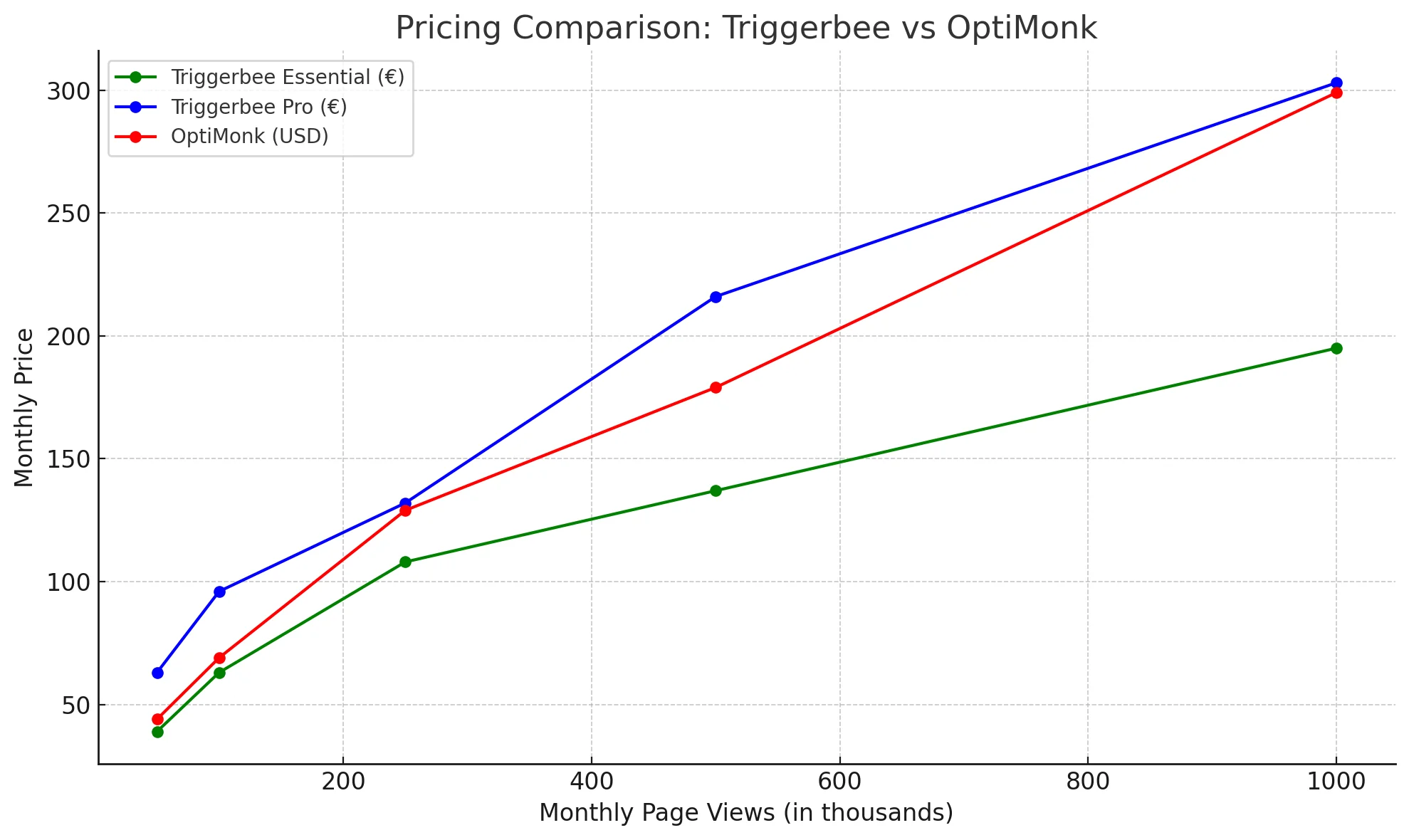
Here’s how pricing compares between Triggerbee and Optimonk across key traffic tiers:
Monthly Page Views
Triggerbee Pricing (€)
OptiMonk Pricing (USD)
50k
Essential: €39 | Pro: €63
$44
100k
Essential: €63 | Pro: €96
$69
250k
Essential: €108 | Pro: €132
$129
500k
Essential: €137 | Pro: €216
$179
1M
Essential: €195 | Pro: €303
$299
Triggerbee pricing
Triggerbee’s pricing starts at €39, but most customers choose the Pro plan to unlock all personalization features. Unlike many tools, all Pro users get access to referral marketing, advanced targeting, smart embeds (dynamic placeholders), and full CRM integrations. And as your traffic grows, the price curve stays predictable – you don’t get hit with sudden jumps.
Optimonk pricing
Optimonk starts strong with a free tier (10k pageviews), and offers an affordable Essential plan for smaller brands. But once your traffic crosses 250k, the monthly price rises quickly. Advanced optimization and some Shopify-specific tools are only available on higher plans.
Pricing verdict: Feature depth stays consistent at every level
While Optimonk offers a lower entry price, Triggerbee’s pricing stays predictable even as traffic scales. Triggerbee’s Essential plan has all the basic features you need if you’re just looking for smart forms with great features and some gamification capabilities. It includes CRM sync and full personalization which are features that often require a higher-tier plan elsewhere.
For teams looking for reliable access to advanced targeting and one-to-one marketing at any scale, Triggerbee delivers consistent value without needing add-ons or upgrades.
8. Pros & Cons
Triggerbee Pros
CRM-driven personalization and segmentation
Built-in revenue and campaign funnel analytics
Smart Embeds for onsite content personalization
Two-way syncing with Klaviyo, Rule, Mailchimp, Voyado etc.
Full control over brand styles and logic
Triggerbee Cons
No free tier
Slightly higher price at lower traffic levels
More advanced setup if you’re not already using CRM data
Optimonk Pros
Free plan up to 10,000 pageviews
Large template library and simple campaign builder
Dedicated Shopify integration
Light learning curve for small teams
Helpful Smart Tags and behavioral targeting
Optimonk Cons
Most CRM integrations are one-way lead sync
Limited layout/design flexibility
Full personalization and analytics require higher plans
9. Final Verdict
Choose Optimonk if you want something that’s easy to launch, affordable at lower traffic levels, and plays well with Shopify out of the box. It’s a great solution for ecommerce stores that need to move fast and want good performance without a lot of setup.
Choose Triggerbee if you need advanced targeting, real-time CRM syncing, or the ability to personalize the entire customer experience based on who someone is and what they do. It gives you more control, deeper integrations, and full funnel analytics.
Triggerbee offers slightly more advanced segmentation, personalization, and reporting.
In terms of the editing experience and capabilities, both tools are nearly identical with the exception for Triggerbee offering specific survey features and analytics.
✦ Klaviyo vs Triggerbee Overview
Klaviyo is great for email and SMS, but its onsite forms are basic. Triggerbee enhances Klaviyo’s existing feature set dynamic campaigns, advanced targeting, and real-time personalization built for your website. It lets you run quizzes, show different messages to different visitors, and connect CRM data to every onsite experience. Use both together to turn more visits into conversions and give your visitors the experience they are waiting for.
Klaviyo: Built for off-website flows and automations
Klaviyo is a real powerhouse for email and SMS automation. If you’re focused on post-visit communication and driving revenue through data-driven campaigns, Klaviyo does an excellent job. But when your goal is to personalize your website experience — not just the inbox — it starts to show its limits.
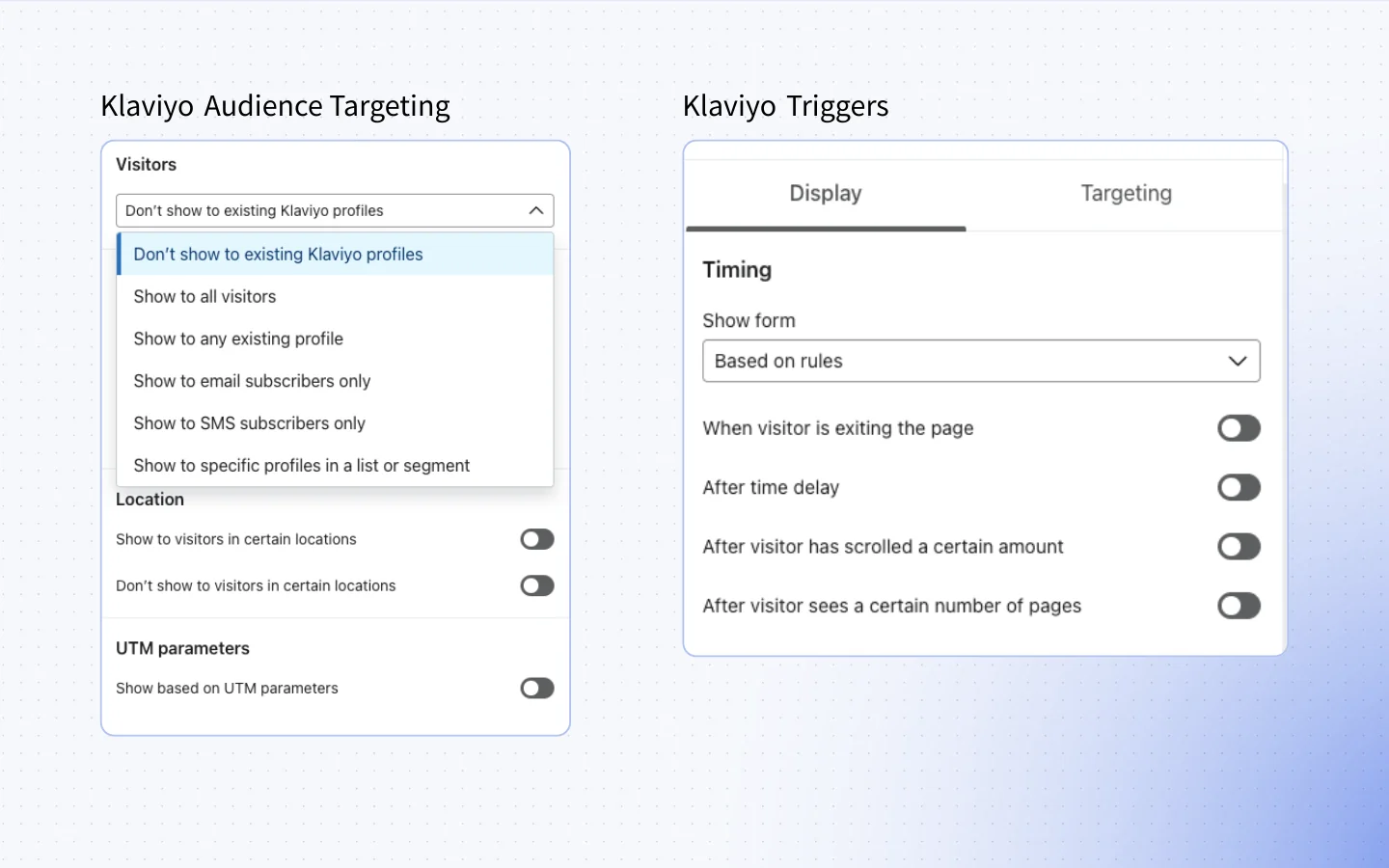
You can create basic forms and popups in Klaviyo to collect emails or display offers. You can exclude existing profiles and use standard rules like time on page or UTM source, but that’s about it — there’s little flexibility to build dynamic, deeply targeted campaigns onsite.
Triggerbee: Built for teams who want to personalize their website experience
Triggerbee is built for you if you’re looking to turn your website into a high-converting, personalized experience. With real-time targeting, dynamic content, and deep CRM sync — including a powerful 2-way Klaviyo integration — you can deliver onsite campaigns that feel like a 1-to-1 journey for every visitor. Plus, if you’re an EU-brand, it can be comforting to know that Triggerbee stores all data in EU while Klaviyo stores all their customers data on AWS Servers in North Virginia, US
In this guide, you’ll see how Triggerbee compares to Klaviyo when it comes to onsite marketing. If you’re already using Klaviyo for email, this will help you understand what’s missing and how you can close the gap with Triggerbee.
Klaviyo vs Triggerbee Feature Comparison
Before we dive into the details, here’s a quick overview of how Triggerbee and Klaviyo compare when it comes to onsite marketing:
Feature
Triggerbee
Klaviyo
Data storage region
🇪🇺 EU
🇺🇸 US (Klaviyo Privacy FAQ)
Campaign Types (popups, embeds)
✅ Popups, Embeds, Callouts, Full screen, Banners
✅ Popup, Full page, Flyout, Embedded
Forms
✅ Yes
✅ Yes
Promotions
✅ Yes
✅ Yes, basic
Gamification
✅ Spin to win, Memory, Product quizzes, Calendars, Daily offers
✅ Spin to win
Surveys
✅ CSAT & NPS with analytics, Ratings, Smileys, Thumbs, Stars + feedback field
❌ Basic forms only
Referral marketing
✅ Yes
❌ No
Targeting
✅ Session behavior, profile properties and events
✅ URL, location, UTM, device
Advanced Onsite Targeting
✅ Weather targeting, Geolocation, CRM data
❌ Exclude/include subscribers
Smart Embeds
✅ Yes, audience-targeted content injected via CSS class
❌ No
Personalization Features
✅ CRM-targeting, Customer Profile Targeting
❌ No
A/B Testing
✅ A + B
✅ Simple w/ advanced options for enterprise
Analytics & Reporting
✅ Revenue attribution, funnel analysis
✅ Revenue attribution
Product recommendations
✅ With integrations
✅ Email only
Brand Default Styles
✅ Yes
❌ No
Integrations
✅ Multiple native + Zapier
✅ CRM / CMS / E-com platforms (none related to forms)
Freemium
❌ No
✅ Yes
Free Trial
✅ 14 days and 250k page views
✅ Yes
Pricing
Starts at €39
Paid plans starts at $20 for 500 contacts
Best For
Brands that want more personalization, customization and CRM-based targeting
Teams focused on email and automation
Who Each Tool Is Best For
Klaviyo is built to drive revenue through data-powered email and SMS marketing. With one of the best visual flow builders and direct integrations with leading eCommerce platforms, Klaviyo is the go-to tool for lifecycle marketing outside of the website. With smart segmentation and automation capabilities, you can deliver personalized messages at scale and many online brands report that Klaviyo accounts for 20% or more of their total revenue.
Klaviyo also includes basic onsite tools like popups and forms, but these features are a small extension of its core email offering and lack the depth and flexibility you’ll find in specialized onsite platforms like Triggerbee, Optimonk, and Sleeknote.
Triggerbee, on the other hand, is purpose-built for onsite engagement. It offers the same kind of advanced segmentation and personalization Klaviyo brings to the inbox — but applied in real time, directly on your website.
With Triggerbee, you can:
Combine CRM and session data to personalize for every visitor, from new visitors to loyal members
Launch campaigns that adapt in real time based on behavior, identity, UTM source, or even past engagement
Use brand variables to automatically apply your design styles and save time
Prevent coupon abuse with built-in email verification and suppress offers for existing subscribers
Enrich Klaviyo with customer profiles built from onsite behavior which enables deeper segmentation in email flows & SMS campaigns
Add gamified campaigns like Memory games, product quizzes, or spin-to-win to drive interaction and signup rates
Targeting based on weather, custom JavaScript logic, or unique loyalty segments — all without a developer
Triggerbee is the better choice if your priority is improving your website experience and converting more of your traffic into leads, members, or customers.
Verdict: Use both together for maximum impact. Klaviyo for nurturing, email promotions, and post-visit communication, Triggerbee for real-time, onsite engagement.
Editors, Campaign Types & Creative Options
Klaviyo’s editor and creative options
Klaviyo’s form builder offers basic popup formats like full-page takeovers, flyouts, and embedded forms. You can use these layouts to collect emails, announce offers, or deliver coupon codes.
Recently, Klaviyo added spin to win templates to their forms offering, which is GREAT, but since their onsite product is not their main offering, the customizability options are limited.
Their editor is template-based, supports drag and drop editing and multi-step forms. But it has limited options for deeper customization.
Triggerbee’s editor and creative options
Triggerbee’s campaign editor is built for onsite creativity. You can launch overlays like callouts, corner boxes, banners, and full-page campaigns plus Smart Embeds that inject dynamic content directly into your site design.
With brand variables, your style guide is automatically applied to every campaign. That means less manual design work and more time spent refining content.
Want multistep flows, quizzes, or personalized banners? You can do that effortlessly in Triggerbee without touching any code.
You can also reuse design blocks, add logic to show different steps or variants, and control campaigns per segment or identity to get full creative flexibility across the entire user journey.
One more benefit of Triggerbee is that you can have multiple variants in one campaign. This means you can build two (or more) versions of the same form targeted to different audiences. New visitors might se a “Claim your 10% off” form, while returning customers might see a callout that says “Welcome back! You still haven’t used your 10% off coupon”.
Verdict: Triggerbee offers far greater campaign variety and creative control. It’s purpose-built for you if you want your campaigns to match your brand perfectly and react to how your visitors behave. With Triggerbee, you’re not just showing static popups — you’re delivering meaningful, timely experiences that drive action.
Targeting & Triggers
Klaviyo includes basic targeting
Klaviyo’s popup targeting engine is functional but limited. You can trigger forms on exit intent, after a scroll, time delay, or page views — and you can suppress campaigns for existing Klaviyo profiles or certain list members. Conditions like device type, UTM parameters, and general location are available, but more advanced logic is out of reach without custom development.
Triggerbee gives you full control
Triggerbee combines persistent visitor data (like tags, past purchases, or NPS scores) with real-time session behavior (like scroll depth, inactivity, or JavaScript-triggered conditions). You can:
Target based on campaign history: seen, clicked, submitted, dismissed
Use custom JS or cookie values for advanced logic — without a developer
Leverage filters like “Not identified,” “Gold member,” or Klaviyo list membership
Trigger campaigns instantly, after time delays, on scroll, or inactivity
Set up variants for mobile vs desktop, new vs returning, or logged-in vs anonymous
In short, Triggerbee gives you the same kind of targeting power you’d expect from Klaviyo’s email flows, but on your website (onsite), and in real time.
Verdict: Triggerbee delivers targeting flexibility that’s both deeper and easier to use. Whether you want to respond to behavior instantly or personalize based on identity, Triggerbee gives you the tools — no devs needed.
Personalization & Embedded Experiences
Triggerbee’s Smart Embeds
Inject personalized content into any part of your website — based on real-time session behavior, visitor identity, or CRM segments
Show different variants to different visitors in the same CSS location, allowing you to A/B test or tailor messages for anonymous vs identified users
Display unique content for logged-in users, VIP segments, or loyalty tiers — without custom dev work
Automatically apply your brand’s fonts, colors, and styles across campaigns using Brand Variables
Recognize and personalize for anonymous visitors who return to your site — even if they haven’t converted yet
Sync behavior and form responses directly to Klaviyo, enabling richer segmentation in your email and SMS campaigns
With Triggerbee, you’re not just building forms. You’re designing an experience that adapts to your visitors in real time. You can layer in session conditions (like scroll depth, cart contents, or referral source) and audience filters (like NPS score or past campaign engagement) to make sure the right people see the right content, at the right time.
It doesn’t matter if you’re nudging first-time visitors, greeting loyal customers, or promoting a referral program to subscribers — Triggerbee helps you do it all natively, and with full creative control.
Klaviyo forms, by contrast, are static. You can choose to include or exclude visitors based on Klaviyo profiles, but that only works if the visitor is already identified. And while you can hide popups from email or SMS subscribers, you can’t dynamically change what those subscribers see — or personalize forms for new vs returning visitors in the same campaign.
There’s no way to inject personalized content into a page or create campaign variants based on behavior, location, or loyalty status unless you do it manually with custom code.
Verdict: If you want to personalize your website like you personalize your email flows, Triggerbee is the tool for you. It brings the same level of flexibility, logic, and customization to the onsite experience — and works whether your visitors are identified or not.
Verdict: If you want true onsite personalization and embedded logic, Triggerbee is the clear winner.
Analytics & Optimization
Klaviyo provides basic reporting
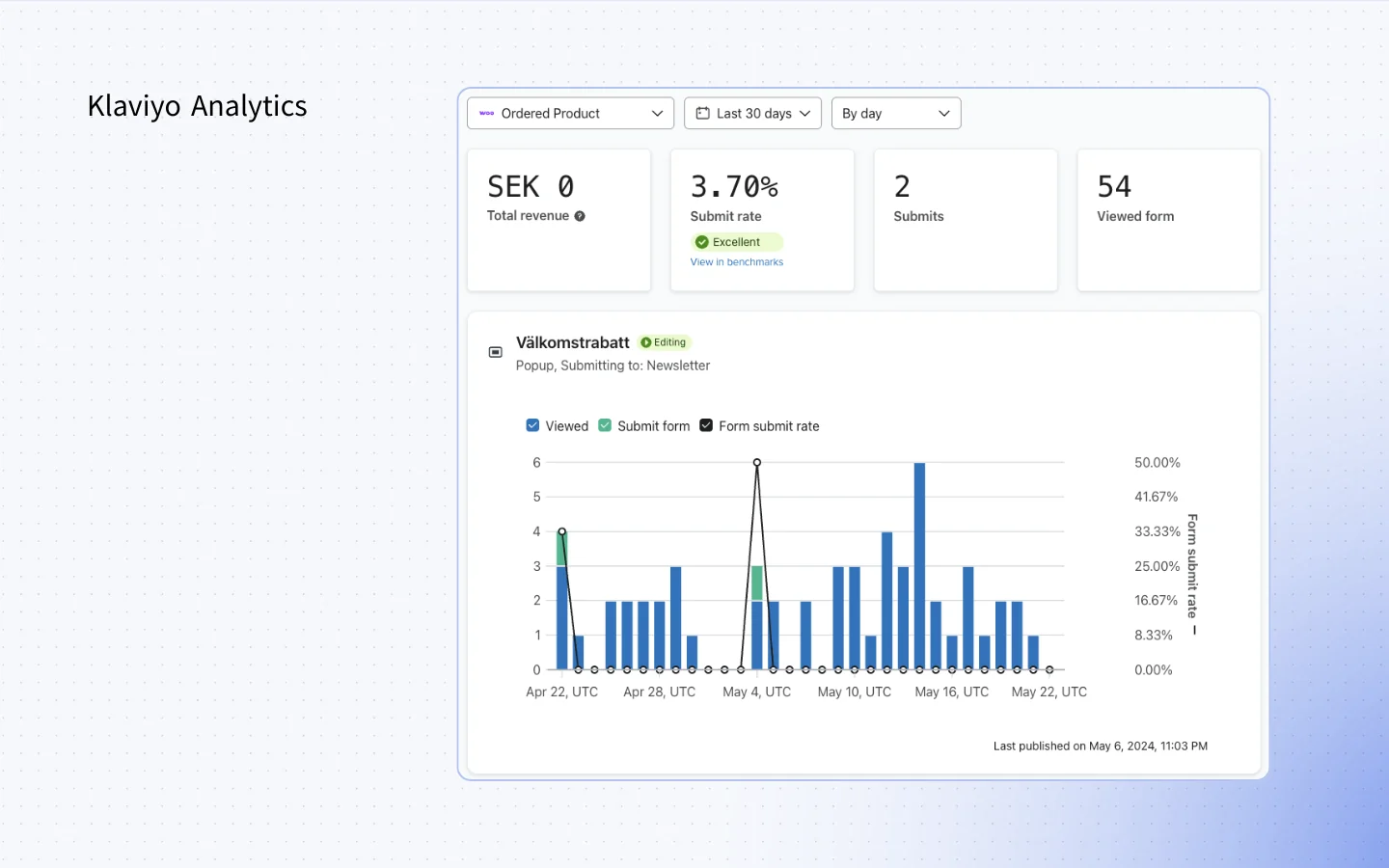
You can see form views, submissions, and simple conversion rates. For basic list-building, this may be enough. But Klaviyo doesn’t show you what happens after the form — there’s no funnel analysis, no step-by-step performance breakdown, and no way to attribute form conversions to revenue without advanced workarounds.
This means you’re flying blind if you’re trying to understand how onsite campaigns affect actual business outcomes. There’s no visibility into drop-off points, or what content or audience delivered the most value.
Triggerbee’s analytics gives you full-funnel insights
Triggerbee’s built-in dashboards go far beyond form tracking. You get a complete view of how your campaigns influence visitor behavior — and ultimately, revenue. Whether you’re running a popup, Smart Embed, or multi-step flow, Triggerbee tracks every step a visitor takes: when they saw a campaign, whether they interacted with it, and if it led to a conversion.
You’ll see exactly where people drop off in multi-step forms, how engagement changes over time, and which audience segments respond best. Campaigns are automatically tied to revenue, so you can finally connect onsite activity to actual business outcomes.
Even better, you can dig into individual visitor journeys. See what a specific person viewed, clicked, and completed — giving you full transparency into campaign impact and helping you continuously optimize performance.
If you’re working to improve conversion rates, reduce bounce, or better understand what messaging works — Triggerbee gives you everything you need, right out of the box.
With Triggerbee, you can track not just who submitted a form, but also who saw each step, where they dropped off, and what actions led to purchases.
The built-in dashboards in Triggerbee show:
Revenue attribution per campaign (even for multi-step or embedded content)
Submit rates and engagement trends over time
Multi-step campaign funnels to spot where visitors bounce or convert
NPS and CSAT scores tied to specific campaigns
Visitor-level performance insights: who clicked, what they saw, and what goals they triggered
Segment-based reporting so you can compare how different audiences respond
This level of granularity gives you real clarity on what’s working and why — so you can double down on the right message, placement, or segment.
Verdict: If you’re serious about optimizing your onsite marketing, Triggerbee gives you the data you need to act. You’ll not only see how each campaign performs — you’ll understand how to make every next one even better.
Verdict: If you care about which campaigns convert and why, Triggerbee gives you the data.
Pricing & Plans
Klaviyo’s pricing is based on the number of contacts in your database and how many emails or SMS messages you send each month. Plans start at $45/month for email and $60/month for email + SMS if you have around 1,000–1,500 active profiles. The free tier supports up to 250 contacts, but once you pass that limit, you’re quickly moved into paid plans — even if you only want to use the form builder.
The majority of features — especially around automation, segmentation, and analytics — are designed for email and SMS, not for onsite forms. If you’re using Klaviyo purely for popups and onsite interactions, you may find yourself paying more for features you don’t actually need.
Triggerbee’s pricing is based on monthly pageviews, which makes more sense if your focus is optimizing the website experience. You’re not charged based on the number of leads you collect. You only pay for traffic volume and get full access to all formats, targeting options, and analytics.
Plans start at €39/month for up to 50k pageviews, and even the entry-level plan includes gamification, form-building, brand styling, basic integrations, and full design flexibility. Pro plans add referral marketing, advanced targeting, customer profiles, and campaign analytics. There’s also a Success plan with tailored onboarding and strategic services for brands running high-volume or loyalty-focused operations.
The best part? You can try it all free for 14 days and there is no credit card needed for signing up.
Verdict: While Klaviyo’s pricing makes sense if you’re focused on email and SMS, Triggerbee is the better choice if your priority is personalizing and converting visitors on your website. You’re not paying for unused channels, and you get far more control and customization where it matters: onsite. Triggerbee gives you more value for onsite personalization even without a freemium tier.
Final Verdict
Use Klaviyo if:
Your primary focus is email and SMS marketing
You want robust automations and lifecycle flows off-site
You’re already deeply invested in the Klaviyo ecosystem and just need basic list-building on your website
Use Triggerbee if:
You want to personalize your entire website experience in real time
You need powerful targeting and segmentation onsite — even for anonymous or returning visitors
You care about creative flexibility and brand consistency across all campaigns
You want deep analytics to understand what converts, why, and for whom
You’re running loyalty programs, seasonal campaigns, or member promotions that require dynamic onsite messaging
Use both together for the best of both worlds:
Triggerbee brings the same segmentation logic you love in Klaviyo to your website, while Klaviyo picks up the journey in the inbox. Together, they give you full-funnel personalization — from the first visit to the final conversion and every moment in between.
In this comparison, we’ll look at Wisepops vs Triggerbee, two of the top onsite marketing platforms for popups, targeting, and lead capture. If you’re searching for a Wisepops alternative, Triggerbee stands out with similar core features like drag-and-drop campaign design, A/B testing, and integrations—but with more advanced personalization options and CRM-level targeting.
One key difference? Triggerbee can save you up to 34% on monthly costs compared to Wisepops, without sacrificing functionality.
Triggerbee is built for ecommerce/retail brands, B2B companies, and publishers that want deep personalization and real-time audience targeting. Wisepops is a better fit for small to mid-sized teams who need something quick, simple, and easy to launch.
Both are GREAT tools to use for onsite engagement, so in the end it’s really up to you, which types of integrations matter to you (Wisepops offers slightly more integrations) and what type of features you need in your business.
Let’s dive in!
Triggerbee: Built for brands that want more from personalization
If you’re not just running popups but running a marketing strategy, Triggerbee is built for you. It’s designed for brands that already work with CRM data and want their website to reflect that same level of personalization.
Triggerbee lets you target visitors in real time based on what they do and who they are. Logged‑in user? Cart abandoner? VIP customer? You can show each person something different. No code or developer needed.
That makes it a great fit for ecommerce teams, B2B marketers, and subscription businesses that care about delivering experiences that convert.
Wisepops: Great when you want something simple and fast
Wisepops is a good pick if you’re focused on speed and don’t need all the bells and whistles. It’s easy to use, comes with ready‑to‑go templates, and helps you launch campaigns in minutes.
If you’re a small to mid‑sized business and need a reliable popup tool that gets the job done without adding complexity, Wisepops is a solid choice. It is built more for capturing leads than personalizing experiences.
Quick comparison
Feature
Triggerbee
Wisepops
Data Storage
🇪🇺 EU
🇺🇸 US
Campaign Types (popups, embeds)
✅ Popups, Embeds, Callouts, Full screen, Banners
✅ Popups, Embeds, Callouts, Full screen, Banners
Forms
✅ Yes
✅ Yes
Promotions
✅ Yes
✅ Yes
Gamification
✅ Spin to win, Memory, Product quizzes, Calendars, Daily offers
✅ Spin to win
Surveys
✅ CSAT & NPS with analytics, Ratings, Smileys, Thumbs, Stars + feedback field
✅ NPS – But no dedicated survey insights
Referral marketing
✅ Yes
❌ No
Targeting
✅ Session behavior, profile properties and events
✅ Page-level, simple session conditons
Advanced Onsite Targeting
✅ Weather targeting, Geolocation, CRM data
❌ Geolocation
Smart Embeds
✅ Yes, audience-targeted content injected via CSS class
❌ Embeds yes, but not dynamic insertion
Personalization Features
✅ CRM-targeting, Customer Profile Targeting
❌ No
A/B Testing
✅ A + B
✅ Multivariate
Analytics & Reporting
✅ Revenue attribution, funnel analysis
✅ Simple conversion & engagement
Product recommendations
✅ With integrations
✅ For Shopify only
Brand Default Styles
✅ Yes
❌ No
Integrations
✅ Multiple native + Zapier
✅ Multiple native + Zapier
Freemium
❌ No
❌ No
Free Trial
✅ 14 days with 250k page views
✅ 14 days
Pricing
Starts at €39
Starts at €99
Best For
Brands that want more personalization, customization and CRM-based targeting
SMBs that want popups and promotions.
2. Campaign Creation & Templates
Creating effective campaigns should be fast, flexible, and intuitive. Whether you’re building a simple popup or a multi-step flow with personalized offers, the right editor makes all the difference.
Look for tools that offer both ready-made templates and the flexibility to build from scratch, with elements like countdown timers, gamification, product blocks, and mobile-first layouts.
The more control you have in the builder, the easier it is to match your brand and launch higher-converting ideas, faster.
Triggerbee: Visual builder with full control
Triggerbee gives you a true what‑you‑see‑is‑what‑you‑get editor. You drag blocks into place and style everything to match your brand. Need multistep flows or custom HTML? The builder handles both so you can collect all the zero-party data you need and keep the design on-brand.
One of the major benefits with Triggerbee is that you get to set up your default brand styles and colors from one place. Upload your own fonts, set colors, font sizes, letter spacing, etc, and all the campaigns you create will have your specific brand styles as default.
That is one feature that saves A LOT of time.
Why it matters: You launch polished campaigns that feel native to your site without relying on a designer.
Wisepops: Fast drag and drop with preset layouts
Wisepops focuses on speed. Choose a template, tweak the text, hit publish. The interface feels light and keeps the options to what you need for a quick campaign.
It covers the essentials with popups, bars, and full‑screen overlays, and lets you customize the look and feel of your campaign. Advanced layout tweaks are fairly limited, but it’s fine if you only need a simple lead capture.
What to keep in mind: You trade deep customization for speed. That’s perfect when you need a last‑minute promotion, less so when brand design guidelines are strict.
Quick verdict
Use Triggerbee when brand look and advanced flows are important. Use Wisepops when you need a clean popup live before lunch.
3. Targeting & Triggers
The real power of targeting comes from combining context and intent. It’s not just about when a campaign appears, but why it appears, and who it’s shown to.
Good tools let you trigger campaigns based on behavior (like scroll depth or exit intent), session data (like time on site or device), or traffic source (like UTM tags). But GREAT tools go further by layering in CRM data, purchase history, and audience segments so your targeting reflects both real-time behavior and long-term customer context. This is where the biggest performance lift often happens.
Triggerbee: Precision targeting with real time data
Triggerbee tracks every click and scroll and lets you use it for triggering onsite messages. You can build targeting rules based on session behavior, cart value, CRM segments, and even custom events.
And you can also build audiences if you want to target users who belong to an email list in your Marketing Automation system.
You can, for example, combine session and audience rules to show a one time discount only to logged in customers who viewed a product twice. That’s how specific you can get with Triggerbee.
As a Triggerbee Pro user, you get geotargeting and weather targeting which are two quite unusual targeting rules.
Wisepops: Reliable triggers for everyday campaigns
Wisepops covers core triggers like scroll percentage, time on page, exit intent, and pages viewed. You pick a trigger, set a threshold, and publish. It also offers contextual segmentation for location or device which helps keep messages relevant.
Keep in mind that deeper data connections such as CRM based rules are not available in Wisepops, and most CRM / Email marketing integrations are one-way lead sync connections.
Quick verdict
Choose Triggerbee if you need granular control over who sees what, right down to individual customer segments. Choose Wisepops when standard triggers are all you need for timely popups.
4. Personalization Options
Personalization is about delivering the right message, offer, or experience to each visitor based on who they are, what they’ve done, and what they’re likely to do next.
Strong personalization tools connect to your CRM or customer database, let you insert dynamic content into campaigns, and give you control over which segments see what. Whether it’s showing different promotions to new vs. returning users or displaying loyalty points for logged-in members, your personalization engine should adapt to real people in real time.
Triggerbee: True one-to-one experiences
Triggerbee lets you swap content and offers based on visitor data in real time.
You can use CRM data like purchase history, tags, or membership status to show or hide campaigns to the right person. The visual editor shows you exactly how each variant looks so you can preview before you launch.
You can also nest rules for returning visitors or high-value customers. That way you deliver tailored experiences that feel personal and relevant.
Why it matters: Personalized messages drive higher engagement and better conversion rates.
Wisepops: Basic dynamic text replacement
Wisepops offers simple personalization like inserting a visitor’s first name or showing a message based on page category. It works well for small tweaks but does not use the context from your CRM data without extra setup.
If you want custom segments or advanced data-driven offers, you must connect Wisepops to Shopify and maintain those segments outside the platform.
What to keep in mind: Wisepops personalization is great for surface level tweaks but not for full one-to-one marketing.
Quick verdict
Pick Triggerbee when personalization is central to your strategy. Pick Wisepops when name tags or basic text swaps are enough.
5. Integrations
Your popup tool should fit into your existing tech stack — not work around it. The best platforms connect seamlessly to your CRM, email platform, and customer data sources.
Look for native integrations that support two-way syncing, audience targeting from your contact lists, and automated data handoffs. If you rely on real-time personalization or triggered emails, integration depth (not just quantity) becomes a key factor.
Triggerbee: Connects deeply with your stack
Triggerbee offers native connections to platforms like Klaviyo, Mailchimp, Voyado, Mailerlite, Rule, and more. You install with a few clicks, map the fields you need, and see data flow both ways.
This two way sync means your CRM segments stay fresh and your onsite campaigns can pull live customer data without manual exports.
Why it matters: You keep one source of truth and avoid juggling spreadsheets.
Wisepops: Broad list of marketing tools
Wisepops integrates with popular email and commerce platforms like Klaviyo, Mailchimp, Shopify, and Pipedrive. Most connections push new leads one way, but some can also pull tags for basic segmentation.
Setup is fast. You copy an API key or install the Wisepops app from the Shopify store. If you rely on a niche CRM you may need Zapier or Make to fill the gap.
Quick verdict
Choose Triggerbee if you need rich two way data and deeper CRM targeting off the shelf. Choose Wisepops if a simple lead push to your email tool is all you need.
6. Analytics & Optimization
When evaluating popup and personalization tools, analytics is more than just a “nice to have.” It’s what tells you if your campaigns are working, who they’re working for, and where you’re losing people.
At a minimum, you’ll want to track:
Views and conversion rates – to measure basic performance.
Split test results – to optimize headlines, offers, and formats.
Funnel metrics / Drop-off points – especially in multi-step forms or quizzes.
Revenue attribution – so you know which campaigns actually drive sales.
Visitor-level insights – to understand how different segments behave.
The right tool gives you not just totals, but patterns. It should help you answer questions like: Which pages convert best? Are logged-in members more responsive? Which UTM campaigns produce the highest ROI?
Triggerbee: Insights that link directly to revenue
Triggerbee tracks every form and campaign impression, clicks, and submissions, and can track attribution to sales or sign ups in your CRM.
You get funnel views per campaign, assisted revenue attribution, and clear A/B test results. This gives you the confidence to keep what works and pause what does not.
Wisepops: Clear metrics for displays and conversions
Wisepops offers a built-in dashboard that shows displays, clicks, conversions, and even a map view of performance by country.
You can also run A/B tests and review the results in the same reporting area.
Quick verdict
Choose Triggerbee if you need revenue level insights and full funnel optimization. Choose Wisepops when basic engagement metrics are enough to guide your decisions.
7. Pricing & Plans
Monthly Page Views
Triggerbee Pricing (€)
Wisepops
50k
Essential: €39 | Pro: €63
—
100k
Essential: €63 | Pro: €96
€99
250k
Essential: €108 | Pro: €132
€199
500k
Essential: €137 | Pro: €216
€249
1M
Essential: €195 | Pro: €303
€399
*Triggerbee Success starts from €280 and scales with traffic.
Triggerbee pricing
With Triggerbee starting at €39 / month, it’s perfect for smaller businesses looking to get started with onsite marketing. The Pro plan unlocks every feature on day one.
Wisepops pricing
Wisepops starts at €99 at first then moves up in clear steps. Advanced optimisation tools sit outside the regular plan and need a higher tier or custom quote.
Pricing verdict – Save up to 34% with Triggerbee (without losing features).
Going with Triggerbee means more features for less money and more budget left for the rest of your marketing.
Triggerbee Pro stays below Wisepops Essential at every traffic level above 100 k page views. At 250 k you pay €132 with Triggerbee versus €199 with Wisepops, saving you about 34 % while gaining deeper personalisation and built‑in CRM syncing. Even at 1 M views you still save roughly 24 %.
Triggerbee Pros
Deep real-time personalisation from CRM and behaviour data
Visual builder with multistep flows and full design control
Two-way integrations with Rule, Voyado, Mailchimp, Klaviyo, Mailerlite and more
Built-in revenue attribution and funnel analytics
Triggerbee Cons
No freemium plan
Advanced setup can take longer than very “plug-and-play” popup tools
Wisepops Pros
Very quick to launch with nice out-of-the-box templates
Solid triggers and audience targeting
Has product recommendations for Shopify
Works well for small sites that just need clean, simple lead capture forms
Wisepops Cons
Limited personalisation unless you add external tools
Price climbs steeply as traffic grows
9. Final Verdict
Choose Wisepops if you need to launch simple popups fast and want a low entry price with a permanent free option.
Choose Triggerbee if you care about deep personalisation, two‑way CRM data, and full revenue attribution while still saving up to 34 % as your traffic scales.
Triggerbee brings the flexibility of a popup builder and the power of an onsite personalisation engine into one tool so you can grow conversions and keep control of your budget.
Our consultants drive measurable growth in e-commerce and CRM with a data-driven approach. We optimize website conversion, CRM strategy, and marketing automation while providing hands-on support for campaign management, SEO, retention, and more. With deep digital expertise, we enhance customer lifetime value through strategic insights and execution. Our services cover analysis, strategy, implementation, and evaluation – tailored to boost profitability and long-term success.
What is weather-based marketing?
Weather-based marketing is a strategy that uses local weather data to tailor ads, website content, and other marketing messages. One major advantage with using weather as a trigger is that you can use both temperature and weather conditions (rainy, sunny, cloudy, etc) to tailor your messages. Weather-based marketing is one of the easiest ways to make your marketing more relevant and effective without having to use personal data.
How weather-based marketing works
Weather-based marketing relies on real-time weather data and geolocation.
For example, when a visitor lands on your site, their location will be used as a basis for extracting weather conditions. That information is used in your marketing system, whether it’s Triggerbee, Google Ads, or your email tool, which then decides which content or message to show.
It could be a popup promoting t-shirts when the temperature is above +10C, or a transactional email that gets sent out to visitors in a location where rain is expected in the next 7 days.
This type of marketing works wonders because weather has a huge impact on our behavior. Both emotionally and rationally.
In Sweden for example, most people are ecstatic when the spring weather starts coming through because we have long and cold winters. So when you go from 0C to +10C, people’s moods change and they start planning for outdoor activities.
Weather-based targeting means targeting users with different content tailored to different weather conditions. It could be on your website, in ads, or even in emails. If someone’s location is experiencing heavy rain, they might see a promo for waterproof jackets instead of summer dresses.
Geolocation targeting
Geolocation targeting means targeting users who are located in a specific city, region, or country. In order to get accurate weather conditions, geolocation is required.
Dynamic content
The “magic” behind weather-based marketing. Dynamic content means your website, ads, or emails change automatically based on the weather. If it’s rain, show content A. If it’s above or below 10C, show content B, etc.
Temperature breakpoints
Using temperature breakpoints as triggers for deciding which content should be shown is a very smart way to use weather-based marketing. First, if your brand is mainly present in countries with seasons the temperature has a bigger emotional impact compared to whether it’s sunny, rainy, or cloudy. Second, temperature breakpoints let you set specific rules. You might decide that when the weather changes from below to above 10°C it’s time to push light jackets. But when the temperature drops from above to below 5°C, winter coats take over.
Forecast-based marketing
Instead of reacting to current weather, forecast-based marketing is proactive. If a heatwave is coming in three days, start promoting air conditioners now. If snow is expected in the coming 7 days, winter gear gets a promotion.
Is weather-based marketing useful for all brands?
Weather-based marketing isn’t just for specific industries, however certain niches and products obviously benefit more from weather-tailored content.
Truth is that weather-based marketing is useful for almost any business selling products or services affected by the weather. For example:
retailers
travel companies
sports brands
beauty brands
food retailers
Fashion brands do this all the time. They push summer collections when the weather starts getting warm, and layering essentials when fall arrives.
Home and garden stores use weather-based marketing to decide when to promote outdoor furniture and plants.
Travel agencies take advantage of the weather by selling vacations to warmer destinations during winter.
Food retailers stock seasonal products and leverage weather data to for example push barbeque items when the barbeque season starts.
If the weather influences what your customers buy, then weather-based marketing makes sense for you.
Which channels are best suited for weather-based marketing?
Certain channels are better suited for weather-based marketing than others.
Your website is one of the best channels for weather-based marketing, since your website visitors are already engaged. So a well-placed banner, popup, or product recommendation that matches the weather can make a HUGE difference in sales.
Paid ads are another powerful channel for weather-based marketing. Think platforms like Google Ads and Facebook. Instead of running random category sales, you can adjust offers based on local weather conditions.
Email and SMS campaigns also benefit. Sending an offer based on the forecasted weather makes a message feel incredibly relevant. “Looks like rain season is starting… stay dry with 20% off raincoats” is way more compelling than a generic discount campaign.
And of course, let’s not forget push notifications. If someone has your app, a weather-based nudge will drive immediate engagement.
Why use weather-based marketing?
Your customers don’t shop in a vacuum. Their decisions are shaped by what’s happening around them.
Using weather-based marketing makes your communication feel relevant and natural. Instead of pushing products randomly or coming up with weak reasons for running a promotion, you’re using real-world conditions.
When you align your reasons for having a promotion to a real-world condition that your customers naturally follow and are affected by (literally everyone has a weather app on their phone), it’s almost like your marketing transforms from push-based to permission-based.
And the best part? Weather-based marketing is also privacy-friendly. You’re not using personal data and you don’t have to track people’s behavior first. All you need is your visitors’ location and weather conditions.
How to use weather-based marketing in your marketing strategy
Whether you’re trying to attract new customers or convert existing ones, weather-based marketing can be used in different parts of your funnel.
For brand awareness, weather-triggered ads grab attention.
For consideration-stage marketing, email and content marketing play a role. Blog posts and guides on “best coats for winter” or “how to stay cool in a heatwave” help drive interest before purchase.
For conversions, website personalization is important. A real-time popup pushing relevant products when someone lands on your site creates instant engagement. If they’re already in the buying mindset, the right weather-based nudge can seal the deal.
What is gamification?
Gamification is one of those things you’ve seen a hundred times but might not think about. It’s everywhere. The idea of gamification is super simple. It’s to turn the regular, boring stuff into something people actually want to engage with.
How does gamification work
Gamification taps into core human psychology. People love progress. We love winning. And we really hate missing out.
Progress and achievement. A progress bar, a tiered system, a leaderboard. When people see how far they’ve come, they are more motivated to continue.
Curiosity and surprise. Spin to win popups. Scratch off discounts. Mystery rewards. People have to know what they’ll get.
Loss aversion. Streaks, points, VIP tiers. Once you’ve earned something, you don’t want to lose it.
Social proof and competition. Leaderboards. Referral challenges. Your friend just unlocked a reward. Can you keep up?
Examples of gamification in different industries
It’s not just e-commerce. Gamification works in any industry where you want people to stay engaged.
E-commerce gamification
Retail brands use gamification to make online shopping interactive. You can learn more about how to do this in our article about e-commerce gamification.
Tiered loyalty programs. The more you spend, the better the perks. And once someone reaches a high tier, they’ll keep spending just to stay there.
Referral challenges. Invite friends, earn bigger rewards. First referral, free shipping. Three referrals, a gift. Ten referrals, VIP status.
Airlines
Airlines have been using gamification forever. Their secret is simple.
Tiered status levels. Economy, Silver, Gold, Platinum. The more you fly, the better the perks. And once you reach a tier, you don’t want to drop back down.
Mileage challenges. Fly a certain distance in a year to unlock rewards. It makes travel feel like a game.
Points that expire. If you don’t use them, you lose them. It’s that simple.
Fitness apps
Apps like Strava, Nike Run Club, and Apple Fitness have made working out addictive. How?
Streaks and badges. Run three times a week, and you get a badge. Work out every day, and your streak keeps climbing. Miss a day? Feels awful.
Leaderboards and challenges. Compete against friends or the global community. The best part? Even casual users feel motivated just to stay on the board.
VIP Tiers and progress bars. Seeing improvement, even if it’s in the same session, makes people come back for more
Best practices for gamification
Keep it simple. If users have to think too hard about how to win, they’ll lose interest.
Make progress visible. Show progress bars, levels, or streaks. Seeing growth keeps people engaged.
Use real rewards. Nobody gets excited about 5 percent off. Give something valuable. Exclusive access, free shipping, VIP perks.
Tap into loss aversion. Streaks, expiring points, limited time challenges. If there’s a risk of losing progress, people stay committed.
Add surprise elements. Mystery rewards, spin the wheel discounts, random bonus points. Uncertainty makes the experience fun.
Tools that help you gamify
E-commerce
Triggerbee. Personalized popups with gamification. Spin to win, memory games, calendar campaigns, and more.
Smile.io. Loyalty programs with points, tiers, and VIP rewards.
Yes. When done right, it increases engagement, boosts retention, and drives conversions. Just look at airlines, fitness apps, and loyalty programs. Here is a case study of swedish auto brand Däckskiftarna who used a memory game which boosted their sign up rate by 250%.
Is gamification just for millennials and Gen Z?
Nope. It works on everyone. Airlines and hotels have been using status tiers forever. Grocery stores have been running stamp card programs for decades. Gamification is just human psychology at work.
What are the downsides of gamification?
Bad gamification feels forced. If rewards aren’t valuable or if the game feels like a trick, people will ignore it. Worse, if you take away progress too easily, like Snapchat’s broken streaks, users might just quit.
How do I start gamifying my business?
Start small. Add a progress bar to your checkout. Test a spin to win popup. Run a limited time leaderboard challenge. You don’t need to overhaul everything, just experiment and see what sticks.
Every time you check your Starbucks app to see if you’ve earned a free coffee, open your Sephora account to redeem a reward, or spin a wheel for a discount, you’re engaging with e-commerce gamification.
Nike Run Club rewards users for completing challenges. McDonald’s Monopoly game drives millions in extra sales.
Progress bars. Limited-time coupons. Random surprises. It’s all deliberate.
These strategies are carefully designed behavior loops meant to grab attention and keep customers engaged.
Nir Eyal’s book Hooked: How to Build Habit-Forming Products breaks down exactly why people keep using certain apps, websites, and services. And almost all of those concepts can be applied to e-commerce gamification:
Triggers – External triggers (like a spin-the-wheel popup) grab attention. Internal triggers (like wanting to complete a loyalty challenge) keep people coming back.
Action – The simpler the action, the more likely a customer is to take it. Clicking a button to claim a reward or playing a scratch card for a discount is effortless and risk-free.
Variable Rewards – The element of surprise makes rewards way more compelling. Spinning a wheel or unlocking a mystery discount creates the same psychological pull as a slot machine.
Investment – The more time, effort, or money a customer puts into a program, the harder it is to leave. That’s why tiered loyalty rewards keep people spending. No one wants to abandon their progress.
In this article, you’ll see a bunch of powerful examples of e-commerce gamification that use these strategies to increase engagement, sales, and customer loyalty. Let’s break them down.
Popups are easy to ignore. But the second you make them fun, something interesting happens. People stay, engage, and don’t instinctively shut them down. Spin-to-Win popups don’t feel like a regular popup (or maybe they do, but at least people want to click them).
Why it works
You’ve seen it before. A wheel. A spin. A prize. And an almost irresistible format.
It’s the movement, the colors, the chance to win something better than the usual 10% off. But most of all? Curiosity. Once they see the wheel they need to know what they’ll get.
That’s why it works. The second someone spins they’re engaged. They’ve already played so why waste the prize? Even if they land on something small it feels earned. And when something feels earned they’re more likely to use it.
Here’s how to make it work:
Give away real rewards (Nope, a 5% off won’t cut it).
Make every spin feel like a win. Give them an extra spin or a second chance to make it even more exciting.
Time it right. Show it after a visitor has been on the site for a while not the same second they arrive.
A spinning wheel is instantly engaging
A simple pop-up is easy to ignore, but a spinning wheel? You have to see what happens. It taps into the psychology of variable rewards—the same reason slot machines and social media notifications are so addictive. Customers don’t know what they’ll win, which makes them more likely to play.
Spin to win triggers a psychological commitment
The second someone spins, they’re invested. They earned their discount, and now they don’t want to waste it. And if there’s a time limit? Even better. They’re more likely to act before the deal disappears.
Spin to win popups increases email & SMS signups
Most spin-to-win popups ask for an email or phone number before spinning. But by switching it up and letting your customers win something before they can claim it, you can boost your conversions even more. Either way it’s one of the best list-building strategies out there.
Spin to win boosts conversions with urgency
Ever seen a countdown timer next to a prize? A 15-minute window to claim a discount? That’s loss aversion at work. If customers feel like they might lose their reward they’re far more likely to use it immediately.
Makes discounts feel special
A generic “10% off” coupon on a banner? Boring. Winning a discount through a game? That feels like a win. And when something feels won, people are way more likely to use it.
2. E-commerce quizzes
Instead of making customers browse through endless products, you ask them a few questions and recommend exactly what they need. It’s like having a personal shopper—just automated.
And the results? They speak for themselves. When done right, quizzes don’t just engage visitors. They boost conversions, increase average order value, and make shopping feel effortless.
Case 1: Care Of Gerd’s Personalized Skincare Guide
Care Of Gerd wanted to recreate the in-store consultation experience online. Shoppers needed guidance, just like they would in a physical store.
So with the help of their marketing agency Extend Marketing, they launched a 13-question skincare guide, built with Triggerbee. Customers answered simple questions about their skin type, concerns, and preferences. At the end? They got a fully personalized product recommendation.
The results?
79% of customers who started the quiz completed it.
87.9% clicked through to view their recommended product.
That’s huge. And it makes sense. When customers see a product that feels made for them they’re way more likely to buy.
Case 2: Apohem’s Sunblock Finder Quiz
Apohem took a similar approach—but for sunblock. Instead of making customers scroll through dozens of SPF options, they built a multi-step quiz that instantly recommended the right product based on their needs.
7.3% of visitors started the quiz.
15% bought something after completing it.
42% bought their recommended product.
No opt-in required. The whole point was to give their users a frictionless experience and guide them to the right choice without forcing them to sign up for anything.
Why it works
Personalizes the shopping experience
Instead of customers guessing what to buy, the quiz tells them exactly what fits their needs. No decision fatigue. No endless scrolling. Just a straight path to the perfect product.
Increases conversion rates
When people get personalized recommendations, they’re way more likely to buy. Apohem’s 42% conversion rate for recommended products proves it.
Improves the shopping experience
A skincare routine? Picked out for you. The right sunscreen? Already matched to your skin. Customers don’t have to think. They just follow the results.
Works for almost any niche
Skincare. Supplements. Clothing. Fitness. Whether it’s finding the right pair of jeans or choosing a protein powder, quizzes guide customers to exactly what they need.
And the best part?
You can use quizzes for way more than just recommendations. Build an “Are you a VIP?” quiz to gamify loyalty. Use style quizzes to upsell entire outfits. Or create a gift finder during the holidays.
3. Mystery Rewards
Mystery rewards are all about psychology. Humans hate not knowing what’s hiding behind the curtain. That’s why surprise rewards work so well.
Instead of just handing out a discount, you make it a mystery. Customers click, tap, or pick a hidden reward. Could be 10% off. Could be free shipping. Could be something way better. And that’s the whole point. The uncertainty makes it impossible to ignore.
Why it works
Instant curiosity
If there’s one thing we need to do, it’s uncover secrets. When customers see a hidden reward, they have to check what’s inside. It’s why scratch-off tickets and loot boxes are so addictive. The not knowing makes it exciting.
Boosts engagement without feeling forced
Nobody wants to feel tricked into interacting with a brand. A mystery reward flips that. Instead of being a hard sell, it’s an invitation. Customers want to play because they feel like they’re getting something special.
Makes discounts feel more valuable
A 10% off banner? Meh. A 10% discount inside a mystery box? Now we’re talking. It’s the same discount, but packaged in a way that makes it feel completely different. And when people feel like they won something, they’re way more likely to use it.
Encourages repeat visits
Some mystery offers reset daily or weekly. Customers who miss out will check back just in case something better is waiting. It’s the same trigger that keeps people using Instagram and Tiktok on a daily basis.
And the best part?
You can run these in so many ways. Hide a daily reward in an Easter egg hunt. Offer mystery discounts in exchange for an email signup. Or gamify free gifts with a “Pick a Box” campaign. The core gamification mechanic stays the same, but the execution of it is very flexible.
4. Scratch & Save
Imagine a scratch-off ticket, but digital. Instead of handing out a standard discount you let customers reveal their own deal. And that tiny bit of effort makes it both engaging and rewarding.
People love scratch cards. The act of slowly revealing the reward introduces excitement, even if it’s the same 10% off you’d normally give away.
Why it works
Taps into curiosity & the need to reveal
When people see something hidden they have to know what’s underneath. It’s the same psychological pull that makes mystery boxes, lottery tickets, and even advent calendars so satisfying.
Makes discounts feel more valuable
A popup that says “Here’s 15% off” is boring. Everyone and their aunt uses these. But a scratch card where you uncover 15% off feels like a win and it’s way more exciting.
Encourages instant action
Most Scratch & Save campaigns come with an expiration date. Simply adding a ticking clock adds urgency and make customers act fast before their deal disappears.
Turns discounts into an experience
Compared to a standard form where you just sign up and receive a coupon code, the act of scratching turns it into a micro experience. I mean, you can’t start scratching off the top layer and stop halfway through. And once they’ve revealed the prize? They’re way more likely to use it.
And the best part?
It works for almost any campaign. Run it as a Black Friday special. Use it to boost email signups. Or make it exclusive for VIP customers. The format stays the same, but the angle of it can be tweaked endlessly.
5. Daily Deals & Challenges
If you are looking for repeat engagement, then daily deals are the way to go. Instead of a one-time discount, your customers get a reason to return every single day. Whether it’s a new deal, a challenge to complete, or another chance to win. It builds a habit.
Power, a Swedish retailer, nailed this with their Wheel of Deals campaign during Black Week. Customers could spin the wheel three times a day, then come back for three more spins the next day. The result? People checked in daily, hoping to score a bigger deal.
Why it works
Encourages repeat visits
If today’s deal is good, tomorrow’s might be better. That’s the hook. Customers return just to see what’s next, and every time they come back they’re one step closer to buying.
Triggers FOMO
Miss a day, miss a deal. That feeling of losing out is a powerful driver. Whether it’s limited-time discounts or an exclusive challenge, people don’t want to be the ones who could have saved more.
Turns shopping into a daily habit
Ever opened a shopping app just to check for new deals? You want to create a reason for your customers to build a routine of checking in (even if they don’t plan to buy). Because when the right deal hits they’re ready to make a purchase.
Perfect for multi-day holidays
Daily deal campaigns shine when shoppers are already in buying mode. Black Week, Christmas season, Summer sales. Power’s multi-day spin-to-win strategy kept customers engaged the entire Black Week, not just on Black Friday.
But the best part about daily deals?
You can run this in so many ways. A daily scratch card. A progress-based challenge where customers unlock bigger rewards. Or even a mystery deal where the discount changes every 24 hours. The key is to make every visit worth it.
6. Memory & Puzzles
Memory games are super intuitive and most people know exactly what to do:
They see a bunch of cards
Find the pairs
Win the reward
Everyone’s played memory or find the pairs as a kid. It’s second nature. No instructions needed.
Däckskiftarna’s Memory signup campaign: A 250% lift in signups
Däckskiftarna, together with their marketing partner Extend Marketing, wanted to test a simple question:
Variant A: Traditional Popup – A classic signup form with a simple message: Win a free tire change & tire hotel! This variant had a 0.97% conversion rate.
Variant B: Memory Game Signup – Same message and same prize. But instead of showing a sign up form, they started by letting their visitors play a game of memory. The result? A 3.4% conversion rate and a 250% increase compared to the non-gamified version.
Why it works
Instantly grabs attention
A normal signup form is forgettable. A memory game? That’s something people stop for. The moment they start flipping tiles they’re invested. And once you’ve found a pair it’s very hard to stop halfway through.
Makes signups feel like a reward
Instead of just handing over their email, customers earn their signup reward. And when something feels earned, people value it more.
Boosts conversions (without feeling like a hard sell)
Regular popups are annoying. People want to be entertained, and with a game like Memory, they’re way more open to handing over their contact details.
Turns regular forms into interactive experiences
Regular sign up forms are everywhere, and people find them annoying. Memory games and puzzles make them fun. And fun gets remembered.
And the best part?
You can tweak the angle in infinite ways. Instead of saying it’s a memory game, say it’s a quick puzzle. Make visitors match icons to unlock a deal. Or create a challenge where the memory acts as a discount booster. The format is super flexible.
7. Reward Points
You shop, you earn points, you get rewards. It’s the simplest gamification model there is and it works.
Why? Because it taps into commitment and sunk cost psychology. The more points your customers collect, the harder it is to not use them. If you are close to a reward, you’ll want to make another purchase.
Loyalty points are literally everywhere. Starbucks Stars. Sephora Beauty Insider. Airlines. Gyms. Coffee shops. Points programs have been used for decades because they do one thing better than anything else… they keep customers coming back.
Why it works
Encourages repeat purchases
When customers know they’re earning something extra with every order they choose to buy from the same store instead of looking elsewhere.
Builds long-term loyalty
Points works because they track progress. If you’ve spent months collecting points, you’re not going to abandon them and start over with another brand. This is exactly why people RAVE about their American Express points.
Makes spending feel justified
If customers know their purchase gets them closer to a freebie, that little nudge can push them to spend a little more than they planned.
But here’s an important thing to remember…
Points don’t matter if people forget about them. Here are a few tactics, or “Loyalty boosters” as we call them, you can use to remind people of their points:
Loyalty boosters: How to get customers to use their points and rewards
Most brands set up loyalty programs and just assume customers will redeem their points. But most people have no idea what their point status are. So they let rewards expire, because they have other stuff to think about.
Smart brands fix that with reminders, nudges, and personalized popups that bring those unused points back into the customer’s mind at the right time.
Identified members with unredeemed coupons in their CRM.
Synced that data with Triggerbee to create a targeted audience.
Designed a personalized popup that appeared when those members visited Apohem.se.
And it worked.
19.11% clicked the reminder.
28.6% went straight to purchase.
Just by reminding customers what they already had they got a huge lift in conversions.
How to boost engagement in any points program
The biggest mistake 9/10 loyalty programs commit is to let points sit unused.
Here’s how to make sure customers use them:
Send reminders before points expire. Urgency works because no one wants to waste rewards.
Show available points on-site. A small banner saying “You have 1,200 points. Redeem now!” can be the push they need.
Offer special “points-only” deals. Let customers spend points on exclusive products or limited-time offers.
Send tier-based nudges. If they’re this close to the next reward level, remind them how much they need to spend to get there.
Loyalty programs work great, but only if customers remember to use the points. The right reminders at the right time? That’s what turns potential sales into real revenue.
8. VIP Tiers & Progress Bars
People love feeling like VIPs. They want to be part of the inner circle, get exclusive perks, and see visible proof that they’re moving up. That’s why tiered membership levels with progress bars work so well.
Instead of just collecting points, customers level up. They go from Bronze to Silver, Silver to Gold. Every purchase brings them closer to better rewards. And that small shift, from “earn points” to “unlock status”, completely changes the way people engage with loyalty programs.
Why it works
Makes loyalty feel like an achievement
A basic points system is passive. But VIP tiers gamify the experience.
Taps into exclusivity & status
Getting to the next tier is all about access. Early product drops, VIP sales, faster shipping. These types of rewards feel premium. And once someone reaches a higher tier they’re not going to let that status go.
Triggers loss aversion
If customers know they need to spend a little more to stay in the Gold tier next year, they’ll do it. Nobody wants to be downgraded. It’s the same mechanic that keeps people renewing airline status, gym memberships, and VIP programs.
Progress bars make everything more addictive
Ever noticed how you’re way more motivated to finish something when you can see your progress? That’s why progress bars work. If someone sees they’re 80% to the next VIP level, they need to close the gap.
How brands use it
Most big loyalty programs use tiered rewards because they work.
Airline Status Programs – Keep flying or lose your perks. A classic.
Nike Membership – Special access to drops, events, and exclusive content based on loyalty.
And e-commerce brands can use this just as easily.
Show customers their current tier and how close they are to the next one.
Offer VIP-only perks that feel exclusive. Early access, premium support, invite-only sales.
Add a countdown so customers feel the urgency to shop again before they drop down a level.
VIP Progress in Action
One of the easiest ways to boost engagement in VIP programs is with reminders and progress tracking. Here’s an example of how KICKS constantly reminds their customers about how many points they have left until the next tier.
9. Leaderboards & Social Competition
Leaderboards tap into a deep human desire… The need to win. The need to see our name at the top.
And the second you turn shopping into a competition, people are hooked.
Leaderboards and social competitions make customers feel like they’re part of something bigger. Instead of just asking customers to buy or refer people randomly, leaderboards create a reason to act. And if they’re close to the top you know they’ll push harder to win.
Why it works
Creates friendly competition
Nobody wants to be in last place. Even if there’s no massive prize, just seeing your name on a leaderboard makes you want to climb higher.
Builds social proof
A leaderboard full of top referrers or buyers sends a strong message—people love this brand. It makes others want to join in too.
Rewards the most engaged customers
The people at the top of the leaderboard are your biggest fans. Give them VIP perks, exclusive rewards, or early access, and they’ll keep coming back.
10. Gamified referrals
Referrals are nothing new. “Share this code with a friend and get 10% off.” You have seen it before, I have seen it before, we’ve ALL seen it before.
But gamified referrals? That’s *almost* completely different.
Instead of a basic “get a discount” setup, gamified referrals turn sharing into a challenge, a race, or a progress-based reward system. The more you refer, the bigger and better your rewards.
Why it works
Organic expansion of your customer base
A friend’s recommendation beats any ad. When customers refer people, they bring in highly qualified leads who already trust your brand.
Keeps customers engaged after their first purchase
A standard referral program is a one-time thing. But when you gamify it? Customers come back again and again to check their progress, climb the ranks, and unlock more rewards.
Rewards loyalty and drives growth
You’re not just acquiring new customers—you’re keeping existing ones actively involved in your brand. That’s what makes referral gamification so powerful.
How you can gamify referrals
Gamified referral programs go one step further from the ordinary “share this link” setup. Here’s how to make your referral program more addictive:
Add tiered rewards – The more people you refer, the better your reward. One referral gets you 10% off, but five gets you exclusive VIP perks.
Leaderboards – See where you rank among top referrers and compete for top prizes.
Add milestone bonuses – Unlock extra points or surprise gifts at referral milestones like 3, 5, or 10 signups.
Countdown challenges – Limited-time referral contests that push customers to act fast.
Platforms that do this well
Want to gamify your referrals? These platforms make it easy:
Triggerbee – Can integrate with loyalty programs to reward top referrers dynamically.
Viral Loops – Great for leaderboard-based referral programs.
ReferralCandy – Simple and effective for tiered referral rewards.
11. Badges & Achievements
It’s a simple trick but incredibly effective. A well-designed badge system turns passive shopping into active participation. Customers are unlocking achievements. They’re progressing. And once that mindset kicks in their engagement usually skyrockets.
Why it works
Recognizes customer efforts
People love feeling appreciated. Whether it’s a “First Purchase” badge or an “Elite VIP” title, small rewards make customers feel seen and valued.
Encourages continued engagement
The moment someone earns one badge, they need to get the next one. It’s the same reason video games keep players grinding to unlock new levels.
Turns shopping into a game
Earning rewards just for buying feels like getting something extra. It makes every purchase more fun and memorable.
How E-Commerce brands use badges
Badges drive real engagement.
Hööks: Uses Gamifiera to reward loyal customers with badges for purchases, reviews, and engagement. Horse lovers love this because it turns shopping into a community-driven experience.
Apohem: Their loyalty program includes achievement-based rewards to keep members engaged beyond just discounts.
Types of badges that work
Want to implement badges in your e-commerce store? Here are some great ideas:
First Purchase Badge – Welcomes new customers with an instant reward.
VIP Tier Badges – Bronze, Silver, Gold. Simple, effective, and makes status feel earned.
Review Badges – Encourage repeat reviews by rewarding customers who leave feedback.
Referral Badges – Acknowledge top referrers and make them feel like brand ambassadors.
Milestone Badges – “100 Orders Club” or “Spent $1,000” makes big spenders feel seen.
The psychology behind badges and achievements
Badges aren’t just cute icons. They create engagement loops that keep customers coming back.
They act as micro-rewards. Customers don’t need to wait for a discount—they get instant recognition.
They create social proof. Public leaderboards or customer profiles showing earned badges make others want in.
They make loyalty visible. Seeing progress makes people want to keep going.
Summary
People love to play. They love to win. And when shopping feels like a game instead of just another transaction,they stay longer, engage more, and spend more. It’s just psychology.
Spin-the-wheel popups? They tap into curiosity. Memory games? They make signups feel like a reward. Leaderboards? They turn the entire experience into a competition. VIP tiers? They make loyalty visible and nobody wants to lose status.
But the best part about e-commerce gamification is that it works almost everywhere. You don’t have to be a billion-dollar brand to use it. Even simple tweaks like…
a scratch card
a daily challenge
or a points reminder
…can keep customers engaged and coming back.
Because at the end of the day, people don’t just want discounts. They want an experience.